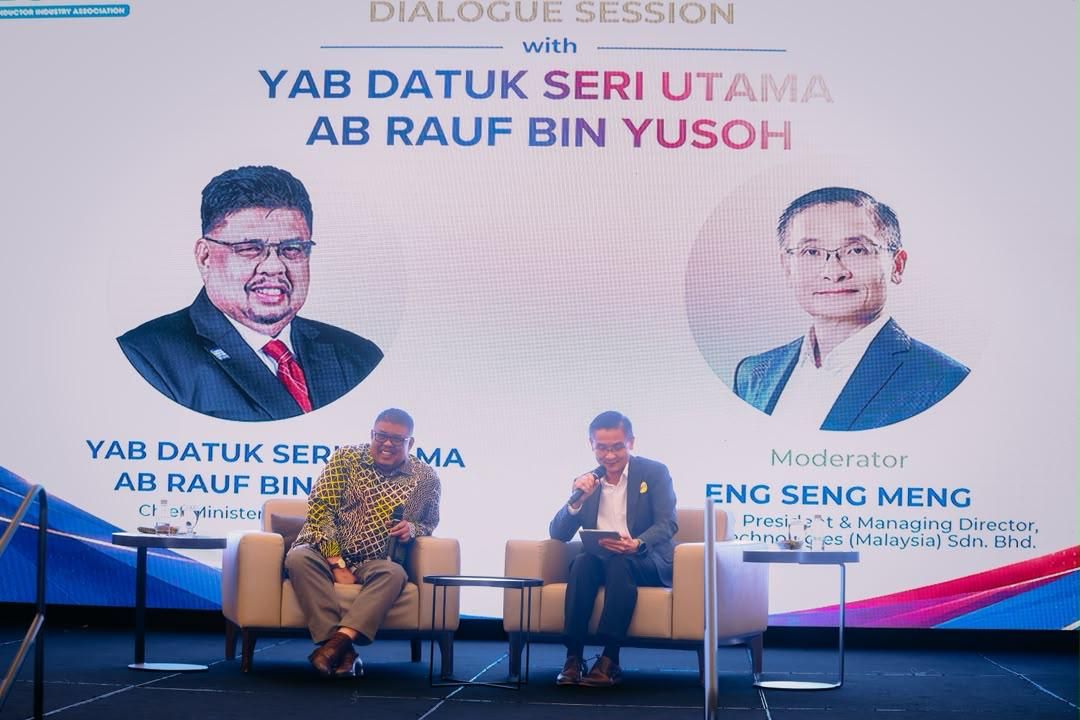
Melaka has transformed its semiconductor sector into a RM17.6 billion industrial engine, a remarkable achievement built over five decades by successive generations of workers and entrepreneurs. Datuk Seri Ab Rauf Yusoh, the state's Chief Minister, revealed this milestone during a dialogue with industry leaders, contextualising the development within Melaka's broader story of economic diversification and manufacturing prowess.
The foundation for this success was laid in the early 1970s when an international company made a pivotal investment decision to establish operations in Melaka. Rather than locating in a purpose-built industrial park, the venture initially operated from modest premises at the Umno building in Jalan Hang Tuah before expanding to Batu Berendam following the creation of Melaka's first Free Industrial Zone in 1976. This unconventional beginning belies the sector's eventual sophistication and scale, illustrating how strategic location and supportive governance can catalyse industrial clustering.
Manufacturing now represents 36.1 percent of Melaka's gross state product, with more than 400 companies operating across 18 industrial sectors. The semiconductor and electrical and electronics sub-sector, however, holds particular significance as the state's flagship industry, having accumulated over half a century of accumulated expertise, supply chain relationships and institutional knowledge. This concentration has created a self-reinforcing ecosystem where established players attract component suppliers, logistics providers and professional services that further entrench the region's competitive advantage.
The industry's expansion has generated employment across multiple skill levels, extending opportunities beyond highly trained engineers to encompassing assembly workers, technicians and support staff. Thousands of families have built livelihoods around the semiconductor manufacturing ecosystem, creating a vested interest in sustaining the sector's health and competitiveness. This employment multiplier effect extends into local communities through consumer spending, property transactions and demand for local services.
Melaka's appeal rests fundamentally on three structural advantages that distinguish it from competing regions. Its geographical position nestled between Kuala Lumpur, Johor and Singapore provides convenient access to major markets, shipping routes and talent pools while maintaining operational costs significantly lower than comparable locations in developed economies. The state possesses over 2,600 hectares of available industrial land, permitting companies to expand their footprint without relocating operations to rival jurisdictions. These logistical and cost factors explain why multinational corporations from the United States, Germany, China and Japan have sustained operations in Melaka for extended periods, often expanding their investments across multiple decades.
Talent development increasingly determines competitive positioning in advanced manufacturing. Melaka has positioned itself as a technical and vocational education hub through 61 institutions delivering programmes aligned with semiconductor industry requirements. The alignment between curriculum and employer demands addresses a persistent challenge in emerging economies where skilled workforces often lack sector-specific competencies demanded by sophisticated manufacturers. By developing a pipeline of industry-ready graduates, Melaka reduces hiring friction and allows companies to scale operations without confronting talent constraints.
The state's investment attractiveness recently reached historical peaks. In 2025, Melaka recorded RM14.68 billion in investments across 312 projects, representing the highest investment value achieved in 22 years. This recent surge suggests renewed confidence from global capital in the state's direction, though Ab Rauf cautioned that sustaining momentum requires continued vigilance and rapid decision-making. The semiconductor sector operates within compressed decision-making cycles where investment commitments shape global supply chains for 10 to 20 year horizons.
The Chief Minister articulated an urgent competitive imperative facing Melaka and Malaysia more broadly. Global semiconductor manufacturers currently evaluate locations for facility expansion, technology transfer and long-term investment commitments. These decisions, made over the next several years, will determine whether Melaka captures disproportionate shares of global semiconductor value chains or whether competing locations in Vietnam, Indonesia, Thailand and other regional centres secure preferential positioning. Companies seek destinations offering rapid administrative approval, strong technological capabilities, supply chain depth and policy certainty—characteristics that require consistent demonstrated commitment rather than temporary incentives.
The risk calculus extends beyond direct semiconductor manufacturing investment. If Melaka fails to secure major new facilities, supporting industries including precision tooling, chemical supply, logistics and engineering services face reduced demand. Hundreds of smaller enterprises depending on semiconductor manufacturer purchasing power could face contraction or closure. The interconnectedness of industrial ecosystems means that losing anchor investments triggers cascading effects across the value chain, potentially displacing thousands of workers and eroding institutional knowledge accumulated across decades.
Addressing these competitive pressures, Melaka has articulated an explicit strategic framework through the Melaka Semiconductor Strategy 2035. This long-term roadmap commits to securing high-value investments, strengthening local manufacturing capabilities and maintaining Melaka's status as a preferred destination for global semiconductor investment. The strategy extends beyond infrastructure development to encompassing institutional reforms designed to accelerate administrative processes, troubleshoot operational constraints and provide sustained support from project conception through successful implementation.
Governmental commitment represents a critical differentiator in regional competition for semiconductor investment. Ab Rauf signalled that Melaka's administration would prioritise investor facilitation, expediting approvals and resolving disputes through direct engagement rather than bureaucratic procedures that impose time costs on global corporations. This commitment to responsiveness and problem-solving appeals to investors evaluating multiple potential locations, as operational frictions in one location can be offset through expansion in jurisdictions offering superior administrative environments.
Melaka's proposition to semiconductor investors integrates multiple complementary strengths into a cohesive value proposition. Strategic connectivity via major transportation hubs enables efficient logistics. Competitive operating costs preserve profit margins. World-class talent developed through technical education systems delivers skilled workforces. The proven industrial ecosystem demonstrates that large-scale sophisticated manufacturing remains viable and profitable. Governmental commitment signals that policy will support rather than impede long-term investment. Combined, these elements create compelling reasons for companies to maintain and expand operations in Melaka rather than establishing parallel facilities in competing regions.
The semiconductor sector's evolution from a single international company's modest Melaka operation to a RM17.6 billion industry demonstrates how foundational investment decisions, accumulated expertise and supportive institutions can compound over decades. However, this historical achievement provides no guarantee of future success. Melaka faces a critical juncture where strategic decisions made today will determine whether the state captures disproportionate benefits from global semiconductor supply chain rebalancing or gradually loses competitiveness to more aggressively positioned regional rivals. The Chief Minister's recent dialogue with industry leaders signals awareness of these stakes and commitment to the sustained, disciplined effort required to maintain Melaka's semiconductor leadership.

