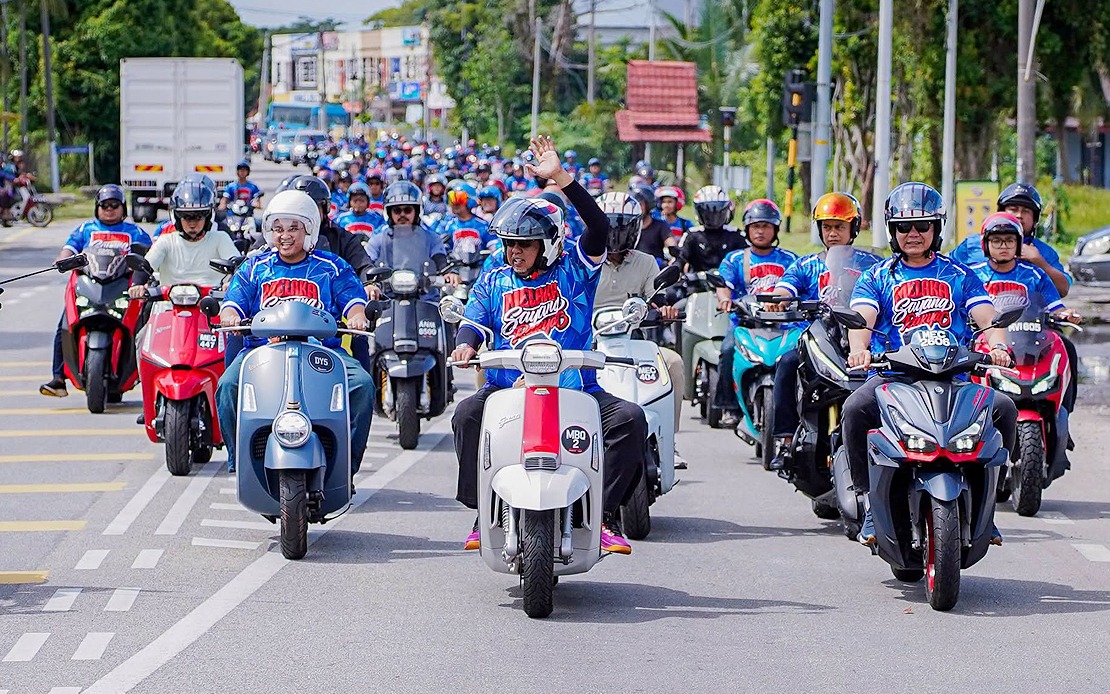
Melaka Chief Minister Datuk Seri Ab Rauf Yusoh has announced an expansion of the Tangga Batu parliamentary constituency's WRUR grassroots engagement programme, signalling the state government's sustained commitment to addressing resident concerns through direct community interaction. The initiative, formally launched under the banner Kampung Kita, encompasses two phases targeting the Pantai Kundor and Paya Rumput state constituencies, with ambitious plans to roll out more than 200 separate programmes spanning welfare distribution, community development initiatives, educational support, youth engagement, small business assistance, and targeted resolution of locality-specific problems.
What distinguishes WRUR from conventional government outreach is its framing as a permanent engagement mechanism rather than a temporary political exercise or seasonal activation. Ab Rauf emphasised during the launch that the programme represents a continuation of sustained ground-level engagement practised over the preceding two years, reflecting an institutional approach to constituency management. This positioning carries significance for Malaysian governance conversations, where the distinction between election-cycle activity and year-round representation often determines the credibility and effectiveness of constituent services. The state's approach suggests recognition that durable political legitimacy requires consistent rather than episodic engagement with voter concerns.
The scale of WRUR's operational reach becomes apparent when examining its performance metrics. Across 23 previous implementation series, the programme received over 4,000 individual complaints from residents, with the state government achieving resolution rates approaching 70 percent. Within the Tangga Batu parliamentary constituency specifically, the programme had previously operated across the Sungai Udang and Kelebang state constituencies, where it processed 359 complaints with 328 successfully resolved and 31 remaining under active follow-up. These figures indicate systematic complaint management infrastructure rather than ad hoc problem-solving, suggesting the programme functions as an institutionalised channel for resident grievances.
During the sixth implementation series, the state distributed assistance packages totalling RM150,000 across diverse beneficiary categories, reflecting the breadth of constituencies WRUR targets. Fishermen received priority support with RM22,000 distributed among 220 recipients, acknowledging their vulnerability to economic fluctuations and environmental hazards. The programme additionally provided RM1,500 to five boat owners affected by capsizing incidents, demonstrating responsiveness to specific occupational disasters. Small and medium enterprise entrepreneurs benefited from RM14,000 in business equipment funding across ten enterprises, addressing the self-employment and rural entrepreneurship dimensions of economic development. Beyond these primary allocations, the state provided further support to religious education institutions, houses of worship, student populations, and homeowners facing financial hardship.
The infrastructure investment accompanying WRUR reveals integration between social welfare programmes and developmental expenditure. The Department of Irrigation and Drainage undertook RM50,000 in cleaning and maintenance work at Sungai Seberang Gajah, responding to recent flash flooding that damaged 73 households in Pantai Kundor. This reactive infrastructure investment directly addressed immediate environmental hazards while building resilience against future inundation. Simultaneously, the department initiated procurement processes for RM100,000 in improvement works at Sungai Lereh, indicating anticipatory rather than purely responsive infrastructure planning.
Larger-scale infrastructure development also features prominently in the state's engagement strategy. The Public Works Department secured federal approval for a RM16 million project to upgrade the crossing culvert structure on Jalan Tangga Batu-Tanjung Minyak, representing significant capital investment in transportation infrastructure within the constituency. This project scale suggests coordination between state and federal resources, indicating how local engagement programmes can leverage higher-tier government involvement for infrastructure development that individual constituency representatives alone could not finance.
For Malaysian readers and regional observers, the Tangga Batu WRUR programme illustrates contemporary approaches to state-level governance in Malaysia's federal structure. The initiative demonstrates how state administrations navigate the tension between devolved responsibility for constituent services and limited resource bases compared to federal government entities. By systematising complaint reception and resolution, providing targeted assistance to occupational groups, and linking social welfare to infrastructure investment, Melaka positions grassroots engagement as interconnected rather than compartmentalised.
The programme's emphasis on resolving local issues within defined timeframes also reflects evolving expectations around accountability in Malaysian governance. Residents increasingly expect visible progress on reported problems, quantified assistance flows, and documented completion of promised projects. WRUR's tracking of complaint resolution rates, distribution of assistance with specific allocations, and public announcement of infrastructure timelines responds to these heightened expectations for transparency and measurable outcomes.
The geographic focus on Pantai Kundor and Paya Rumput constituencies indicates strategic targeting within the broader parliamentary constituency. Rather than dispersing resources evenly, the state government concentrates programming in specific areas, enabling deeper engagement and potentially greater impact per ringgit expended. This targeted approach suggests sophisticated constituency mapping and prioritisation of areas with either particularly acute problems or significant political significance.
Moving forward, the success of WRUR's expanded phases will depend substantially on execution consistency and genuine responsiveness to emerging problems. The programme's credibility rests not merely on distributing funds or announcing projects but on demonstrably resolving the complaints residents bring forward. As the additional 31 outstanding cases from previous Sungai Udang and Kelebang implementation demonstrate, complaint resolution extends beyond initial distribution, requiring sustained follow-up and administrative persistence.
The Tangga Batu initiative also provides a model that other Malaysian state governments may evaluate for adaptation. As voter sophistication regarding constituent services increases, and as social media enables rapid dissemination of government performance records, state administrations face pressure to institutionalise effective engagement mechanisms. WRUR's systematic approach—combining complaint channels, targeted assistance, infrastructure investment, and documented outcomes—represents a comprehensive response to these pressures, one that Melaka's government clearly intends to expand rather than contract.

