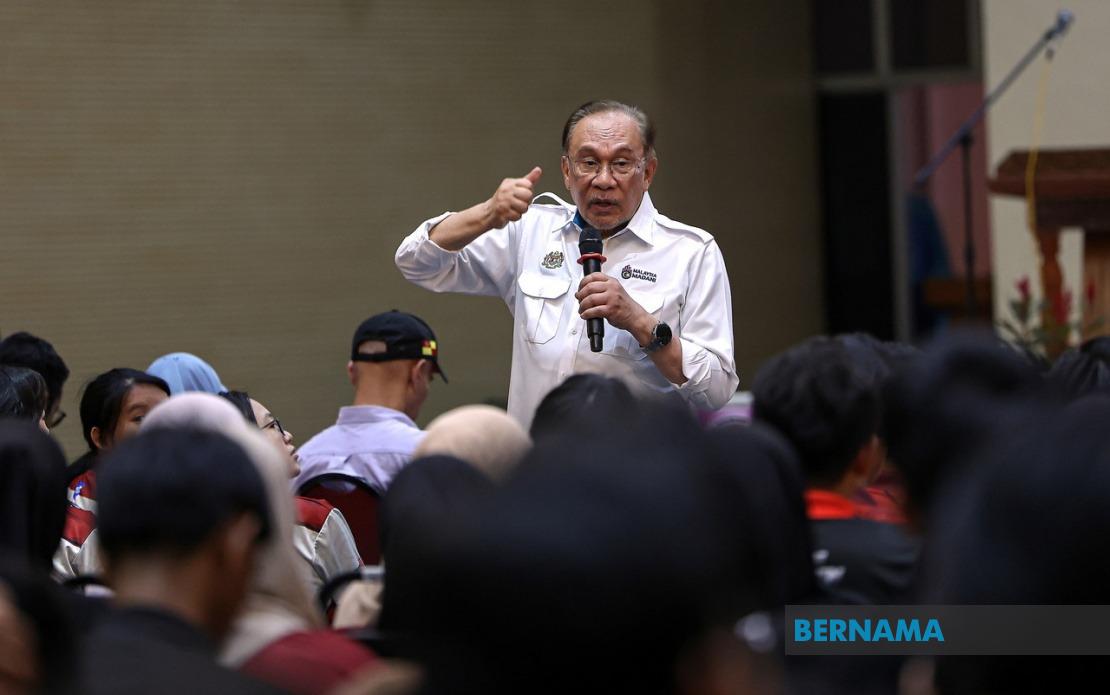
Prime Minister Datuk Seri Anwar Ibrahim has articulated a dual-track framework for the matriculation programme's student intake that aims to reconcile two competing educational imperatives: recognising exceptional academic achievement while safeguarding access for economically disadvantaged and historically underrepresented communities. Speaking at the Jelajah Rakan Muda programme in Seremban on July 22, Anwar outlined how the government intends to navigate the contentious terrain of tertiary education access, a perennial flashpoint in Malaysian higher education policy.
At the apex of the proposed system sit students who demonstrate outstanding academic performance, specifically those securing 10As in the Sijil Pelajaran Malaysia examination. These high achievers will receive automatic admission to the matriculation programme without regard to ethnic background or socioeconomic status. By extending this guarantee regardless of whether students are Chinese, Indian, Malay, or from other communities, the government signals a clear commitment to meritocratic advancement where academic excellence becomes the primary qualification criterion. This departure from historically segmented intake pathways acknowledges the growing consensus that Malaysia's educational competitiveness depends on nurturing its most capable students, irrespective of their demographic profile.
The initiative reflects a sophisticated understanding of how merit-based systems can coexist with affirmative action frameworks. Rather than viewing these approaches as mutually exclusive, the Prime Minister's formulation suggests they operate at different thresholds of the admission spectrum. Top-tier academic achievers bypass quota considerations entirely, while the matriculation system's broader intake architecture continues to incorporate mechanisms designed to support specific constituencies. This layered approach attempts to address criticism that rigid quota systems may inadvertently prevent highly qualified candidates from accessing educational pathways commensurate with their abilities.
Crucially, the government has reaffirmed its commitment to maintaining the Bumiputera quota system within the matriculation framework. This preservation indicates that despite the introduction of automatic entry for top performers, the state remains committed to addressing structural inequalities rooted in Malaysia's demographic and geographic realities. The quota's continued operation acknowledges that merit, while important, cannot be divorced from context; students from rural and interior regions, whether in peninsular Malaysia, Sabah, or Sarawak, often face resource constraints and educational infrastructure deficits that may not be fully reflected in examination scores alone.
The geographic dimensions of this policy warrant particular attention for Malaysian and Southeast Asian observers. By explicitly referencing students from rural and interior areas, and by naming Sabah and Sarawak, the government highlights how educational access remains fundamentally shaped by geography. Students in these regions confront different challenges than their urban counterparts: limited access to quality tuition, smaller school cohorts, infrastructure gaps, and socioeconomic pressures that intersect with academic performance in complex ways. The Bumiputera quota, in this context, functions not merely as ethnic affirmative action but as a tool for addressing regional educational disparities that persist despite Malaysia's development progress.
This balancing act occurs against a backdrop of ongoing debate about higher education inclusivity in Malaysia and the broader Asia-Pacific region. Regional neighbours including Singapore, Thailand, and Indonesia have grappled with similar tensions between meritocratic selection and affirmative action frameworks. Malaysia's approach, by attempting to satisfy both constituencies, positions itself within an emerging consensus that sustainable educational systems require mechanisms recognising excellence while remaining attuned to structural disadvantages. The matriculation programme, as a key pathway to university education, thus carries outsized significance in shaping national educational equity outcomes.
The remarks came during Anwar's participation in the Jelajah Rakan Muda programme at the Youth and Sports Complex in Paroi, an event also attended by Youth and Sports Minister Dr Mohammed Taufiq Johari. The venue choice—a youth-focused initiative in Negeri Sembilan—underscores the government's intention to engage young Malaysians directly on educational policy rather than confining such discussions to ministerial channels. This communication strategy recognises that tertiary education access directly affects youth constituencies who will be primary stakeholders in whatever system emerges from current policy deliberations.
For Malaysian students and families, the articulated approach offers both clarity and complexity. High-achieving students can have confidence that their academic performance will be recognised regardless of background, providing a transparency that previous systems sometimes lacked. Simultaneously, families and students navigating the broader intake spectrum must contend with multiple criteria operating simultaneously: academic results, ethnic background where applicable, geographic origin, and socioeconomic circumstances. Navigating this multi-dimensional system requires sophisticated understanding of how different admission pathways operate and which criteria apply at which decision points.
The policy formulation also carries implications for how Malaysia positions itself within regional educational competition. As nations across Southeast Asia intensify efforts to develop knowledge economies and attract high-performing students, having clarity about how merit and inclusion operate within tertiary education systems becomes strategically important. Malaysia's explicit commitment to recognising the top 10A achievers regardless of ethnicity sends a signal about educational meritocracy that may resonate with ambitious students across the region while the maintenance of Bumiputera provisions demonstrates commitment to addressing domestic equity concerns.
Implementation challenges loom, however. Operationalising a system that automatically admits 10A scorers while maintaining quota protections requires careful administrative coordination. Questions remain about how automatic admission interacts with quota allocations, whether certain quotas have their own merit thresholds, and how the system adapts if the number of 10A achievers exceeds available matriculation places. These technical questions lack explicit answers in the Prime Minister's remarks, suggesting that policy implementation may reveal tensions between the stated principles and practical constraints.
The matriculation system itself sits within a broader tertiary education landscape increasingly characterised by competition and differentiation. Beyond matriculation, students access universities through other pathways including the Unified Examination Format, direct entry, and private institutions. How the principles Anwar articulated—merging merit recognition with equity consideration—translate across these diverse pathways remains unclear. A coherent higher education strategy might extend such balanced approaches across the entire tertiary sector rather than limiting them to matriculation.
Stakeholder reactions will likely vary substantially. Educational meritocrats may welcome the automatic admission for 10A achievers as recognition that excellence transcends ethnic categories. Conversely, constituencies concerned with preserving affirmative action gains may scrutinise whether the merit track becomes sufficiently exclusive that quota protections lose significance. Rural and interior communities may appreciate explicit acknowledgment of geographic disadvantage, yet may question whether quota-based access adequately compensates for earlier educational inequalities rooted in primary and secondary schooling disparities.
As Malaysia navigates competing imperatives around educational access and excellence, the matriculation policy framework articulated by Prime Minister Anwar represents a significant attempt to mediate between meritocratic and equity-based principles. Whether the proposed system achieves its stated objectives—ensuring both that exceptional students receive opportunities commensurate with their abilities and that structural disadvantages do not automatically preclude access—will depend heavily on implementation rigour and ongoing policy adjustment based on outcomes data. The coming months will reveal how effectively this dual-track approach translates from principle into practice.

