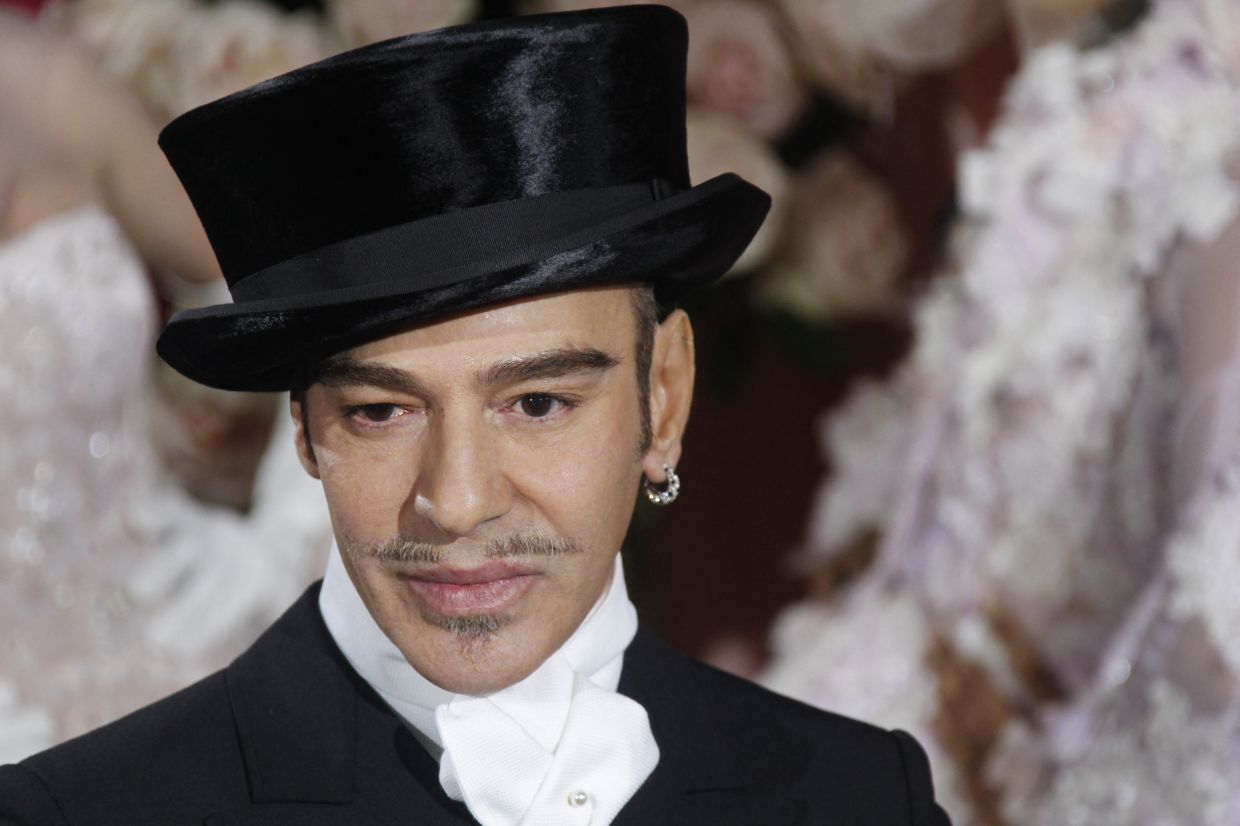
The Metropolitan Museum of Art's Costume Institute has announced that the 2025 Met Gala will celebrate—and interrogate—the career of British fashion designer John Galliano, positioning the exhibition as a complex reckoning with both artistic brilliance and serious personal failings. Galliano becomes only the third living designer to receive a solo show at the prestigious institution, an honour typically reserved for the industry's most transformative figures, though this particular retrospective promises to be markedly different from celebratory tributes of previous decades.
Galliano's trajectory in fashion represents one of the industry's most dramatic arcs of ascent and descent. For nearly fifteen years, he served as creative director of Christian Dior, arguably the most coveted position in haute couture, where he earned widespread acclaim for designs that ranged from meticulously tailored elegance to theatrical excess. His work at the French luxury house redefined the brand's aesthetic while cementing his reputation as a visionary capable of commanding one of fashion's greatest legacies. Yet this extraordinary professional standing proved fragile when, in 2010 and 2011, Galliano made a series of deeply offensive public statements containing antisemitic and racist remarks. Videos of these comments, including one in which he declared his admiration for Adolf Hitler, circulated widely online and sparked immediate professional consequences.
The fallout was swift and comprehensive. Dior terminated his position, effectively severing him from the fashion world's upper echelons overnight. The French courts subsequently convicted him for public insults based on race, religion, ethnicity and origin—a legal judgment that underscored the gravity of his conduct beyond mere social media controversy. For several years afterward, Galliano largely withdrew from public view, engaging in what the museum describes as efforts toward rehabilitation involving both professional counselling and private reflection on his actions and their impact.
His professional reemergence began in 2014 when Belgian fashion house Maison Margiela appointed him as creative director, a position he held for a decade. This comeback, while significant within fashion circles, lacked the glittering restoration that might have characterised a similar trajectory in earlier eras. Instead, Galliano's return was cautious, conditional, and perpetually shadowed by the knowledge of what had preceded it. His work at Margiela earned respect and recognition but operated within a different context than his pre-2011 prominence.
The Metropolitan Museum's decision to mount a solo exhibition dedicated to Galliano demonstrates how major cultural institutions are now grappling with the intersection of artistic merit and ethical accountability in ways that would have seemed impossible merely a decade ago. Rather than presenting a conventional retrospective celebrating creative achievement, the Costume Institute is explicitly committing to what curator Andrew Bolton describes as examining "how Galliano has remapped the world through fashion and how his conduct, its consequences, and changing cultural values have reshaped our understanding of his work." This framing acknowledges that artistic legacy cannot be disentangled from the moral dimensions of a creator's public behaviour.
The museum consulted extensively with Jewish community leaders in New York before finalizing exhibition plans, a process that reflects institutional sensitivity to the particular gravity of antisemitic statements and their ongoing impact. These consultations involved Bolton, Galliano himself, and Anna Wintour, editor-in-chief of Vogue, signalling the seriousness with which the fashion establishment is approaching this retrospective. Such engagement with affected communities represents a marked shift from how institutions historically handled controversial figures, where artistic reputation often superseded ethical concerns.
The exhibition will be organized into three thematic sections that structure Galliano's career chronologically and conceptually. The first, titled "Bearings," directly confronts the rupture in his career by examining the antisemitic, racist, and anti-Asian remarks of 2010 and 2011, their legal consequences, and his subsequent treatment for substance addiction. Rather than treating these elements as separate from his artistic identity, the exhibition positions them as central to understanding his complete trajectory. The second section, "Horizons," pivots to examine his sources of creative inspiration—historical periods, geographical locations, artistic movements, storytelling traditions, and performance—elements that have consistently animated his design philosophy. The final section, "Atlas Of Transformation," focuses on his technical mastery, craftsmanship, experimental methods, and innovations in garment construction.
For Malaysian and Southeast Asian audiences, this exhibition carries particular resonance given the region's increasing engagement with questions of accountability in global culture and fashion industries. The fashion world has traditionally operated with relatively limited scrutiny regarding designers' personal conduct, and the Met's willingness to simultaneously celebrate and interrogate Galliano's work signals broader institutional evolution. Moreover, as Southeast Asian markets become increasingly important to luxury fashion consumption, regional consumers and critics are developing more sophisticated frameworks for evaluating both product and producer values.
The 2025 Met Gala itself, which traditionally features celebrity attendees in elaborate interpretations of the exhibition's theme, will inevitably become a commentary on whether rehabilitation and artistic redemption remain possible in contemporary culture. The red carpet appearance of celebrities in Galliano-inspired designs will serve as a cultural barometer regarding societal attitudes toward artistic legacy, personal accountability, and the possibility of meaningful change. This tension—between honouring creative genius and refusing to absolve serious misconduct—reflects contemporary struggles across industries, making the exhibition particularly timely and culturally significant.

