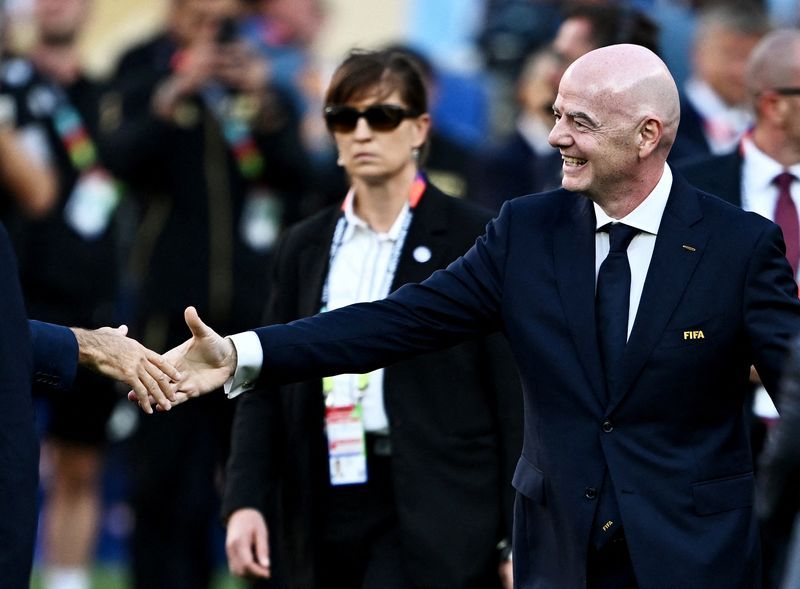
Mexico and Argentina have delivered decisive backing for FIFA President Gianni Infantino at a critical moment, as the embattled soccer chief navigates unprecedented institutional turmoil stemming from his now-shelved proposal to monetise portions of the World Cup's commercial future. The endorsements from two of world football's heavyweight nations represent a significant political victory for Infantino, yet they also expose a fractured global consensus on his leadership that threatens to undermine the stability of international soccer governance heading into 2025.
The Mexican Football Federation's public support marks a dramatic departure from its regional body CONCACAF, which had previously demanded a comprehensive reassessment of Infantino's presidency. By breaking ranks with the North American confederation, Mexico's football authorities have signalled that they view Infantino's tenure as strategically important despite the governance misstep. Argentina's football association went further, releasing a formal letter endorsing FIFA's institutional direction over the past decade and characterising Infantino's leadership as foundational to soccer's global development. These backing letters are particularly significant because they represent major World Cup stakeholders—Mexico co-hosted the recently concluded tournament, while Argentina claimed the 2022 championship—lending credibility to Infantino's claim that key football nations still trust his stewardship.
Yet the portrait of support emerging from this week's diplomatic salvage efforts reveals profound fissures within soccer's international structures. The Confederation of African Football provided unanimous backing for Infantino on Thursday, seemingly offering continental-scale endorsement. However, this apparent monolithic African support contrasts starkly with the uncompromising stance of Europe's football governing body UEFA, which has committed to boycotting FIFA tournaments if Infantino remains in office. Asia's confederation similarly aligned with UEFA and CONCACAF in expressing solidarity with their call for reform, creating a geographical bloc of dissent spanning two continents and hundreds of millions of soccer fans.
South America's CONMEBOL, through which both Argentina operates, attempted to thread a diplomatic needle by declaring that any bid to remove Infantino must proceed through a formal vote involving all 211 FIFA member associations. This position ostensibly protects Infantino by raising the procedural bar for his removal, yet CONMEBOL's simultaneous criticism of his "repeated unilateral actions taken without resorting to dialogue" suggests underlying frustration with his management style. Argentina's separate letter, while supportive, acknowledged that Infantino's commercial proposal had "generated far more uncertainties than certainties and that errors had been made," indicating conditional rather than unconditional loyalty.
The commercial rights proposal at the centre of this crisis represented an audacious attempt to unlock new revenue streams by partially selling World Cup broadcasting and sponsorship rights to investors. FIFA has since apologised for the initiative and promised to review the processes that precipitated it, admitting that mistakes occurred in communication and procedural execution. However, the fallout has already inflicted reputational damage on Infantino's administration and injected genuine uncertainty into his bid for a fourth consecutive term at the FIFA Congress scheduled for March in Morocco. Two months ago, his reelection appeared assured; today, it represents a genuine battleground.
The absence of a credible alternative candidate complicates the anti-Infantino movement's prospects significantly. While Croatian, English, and Albanian football federations have withdrawn their endorsements, and players' union FIFPRO has characterized his actions as a "profound abuse of presidential power," the opposition remains fragmented around competing grievances rather than coalescing around a replacement leader. This structural weakness means that even sizable blocs of dissent may prove insufficient to prevent Infantino's reelection, provided he maintains the support of Mexico, Argentina, Africa, and sufficient numbers of other associations.
For Southeast Asian readers and football observers across the region, this international crisis carries practical implications. FIFA's institutional instability affects how tournaments are organised, how commercial revenues are distributed among member nations, and how development funding flows to smaller associations. The World Cup expansion to 48 teams scheduled for 2026—which Mexico will co-host alongside the United States and Canada—hinges on FIFA's administrative capacity to manage an unprecedented tournament format. Should Infantino's leadership remain contested through March's Congress and beyond, the organisational strain could compromise preparations for this enlarged competition.
Moreover, the geographical split in support reveals uncomfortable truths about football's power hierarchies. Africa's unanimous backing contrasts with Europe's resolute opposition, suggesting that Infantino's tenure benefits certain regions while generating resistance in others. Asia's alignment with European and North American confederations indicates that the region's football stakeholders prioritise governance reform over institutional continuity, a signal that FIFA's leadership should regard seriously. The stakes extend beyond individual personalities to fundamental questions about how international soccer should be administered in an era demanding both commercial sophistication and democratic legitimacy.
Argentina's conditional support proves particularly consequential because it preserves Infantino's coalition while simultaneously documenting institutional dysfunction. The AFA's acknowledgment of Infantino's "errors" and the uncertainties spawned by the commercial proposal supplies ammunition to critics while the formal backing keeps Argentina within his political orbit. This calculated ambiguity reflects sophisticated diplomatic positioning by South America's largest football power, which seeks to maintain influence within FIFA without fully endorsing leadership many regard as reckless.
The timeline towards March's Congress now becomes critical. With no unified opposition candidate emerging and competing continental confederations maintaining incompatible positions on Infantino's future, the March vote appears likely to ratify his continued presidency. However, such a victory would arrive damaged and contingent rather than commanding, leaving Infantino facing a second term marked by diminished authority and active resistance from Europe's most prominent associations. For international soccer's governance structures, the looming Congress represents not closure but an uncomfortable transition to an era of chronic institutional tension.

