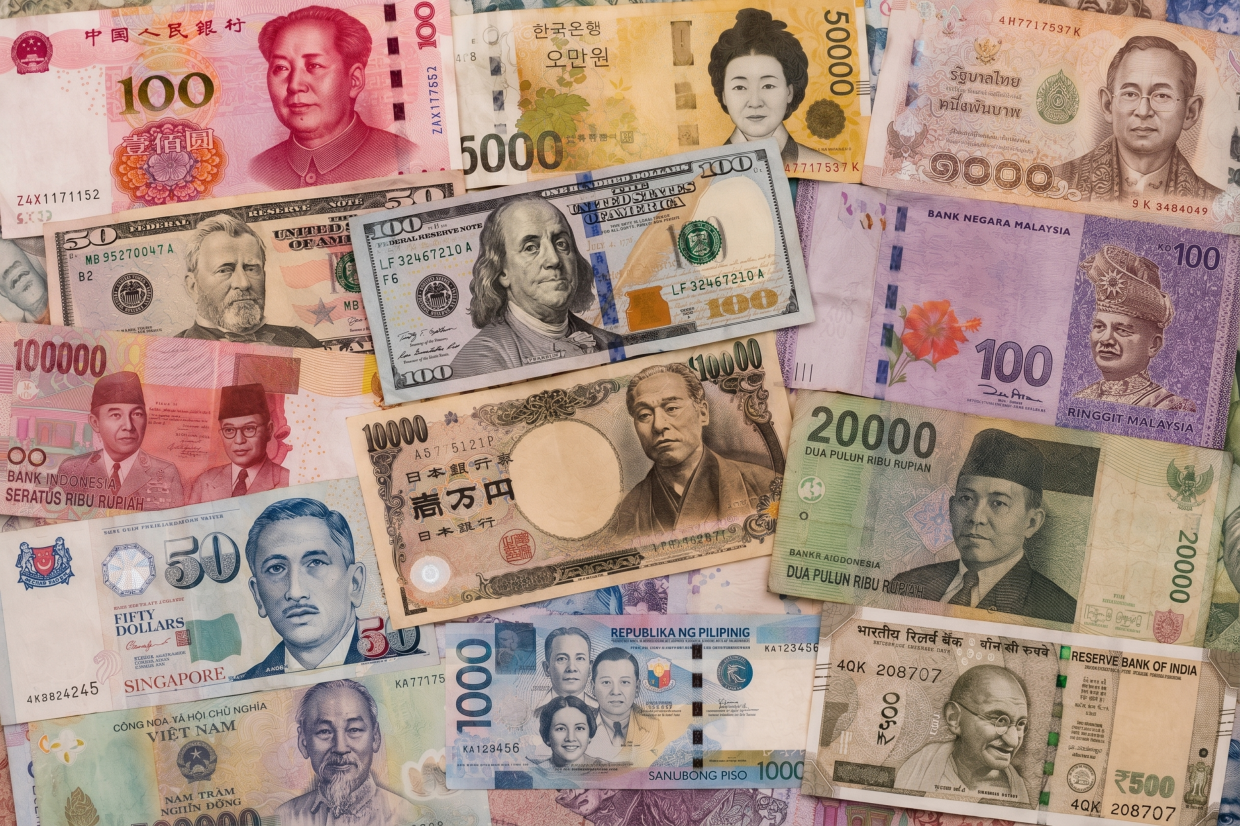
Financial markets across Asia faced mounting headwinds on Monday as geopolitical tensions in the Middle East reignited concerns about commodity price inflation and the prospect of higher interest rates globally. The renewed conflict sent crude oil prices climbing nearly 4% and gave the U.S. dollar fresh impetus, as investors rushed toward the safety of the world's reserve currency. Against a basket of major currencies, the greenback edged higher, reflecting the traditional flight-to-safety pattern that emerges whenever geopolitical risk spikes.
The weakness in the dollar's adversaries was particularly pronounced across emerging Asia's currency markets. Indonesia's rupiah touched 18,140 to the greenback, marking its poorest performance in more than a month, while South Korea's won depreciated to 1,507.9 per dollar. In Malaysia, the ringgit slipped to 4.0780, despite simultaneous strength in the country's equity markets. The divergence between currency weakness and stock market resilience in Malaysia underscores how different market segments are responding to a complex interplay of global and domestic forces.
South Korea bore the brunt of the day's volatility, with the KOSPI benchmark index tumbling 7.96% to a ten-week trough, severe enough to activate automatic trading circuit breakers. The decline was spearheaded by a precipitous 13% collapse in SK Hynix, the world's dominant supplier of artificial intelligence memory chips. The stock's dramatic retreat came on the heels of an impressive performance following the company's U.S. listing on Friday, suggesting that profit-taking by investors keen to realize gains from the recent rally proved too powerful to resist.
The broader chipmaking sector has faced mounting headwinds in recent weeks as market participants grapple with questions about the sustainability of the extraordinary earnings growth that has fuelled the AI boom. While demand for high-bandwidth memory chips remains robust, there are emerging signs that hyperscale artificial intelligence companies are becoming more disciplined in their capital expenditure patterns, potentially tempering the sector's previously explosive trajectory. Additionally, the rising popularity of highly leveraged single-stock exchange-traded funds has amplified price swings, introducing an additional layer of market instability.
Yet despite the sharp pullback on Monday, South Korea's equity market retains a formidable track record. The KOSPI remains one of the world's best-performing indices year-to-date, with a commanding 63% advance since January. Even after the 25% correction from its record close on June 22, the index reflects underlying economic dynamism and robust investor appetite for Korean equities, particularly those in the technology and semiconductors space.
Malaysia's equity market moved in a different direction, edging toward three-week highs even as the ringgit faced depreciation pressure. This apparent disconnect merits examination, particularly given the political turbulence weighing on investor sentiment. Prime Minister Anwar Ibrahim's ruling coalition suffered a crushing defeat in a critical Johor state election on Saturday, raising uncomfortable questions about the durability of federal-level political cohesion and the prospects for an early general election.
The political reversal has introduced fresh uncertainty into Malaysia's investment landscape. Goldman Sachs analysts have flagged that deteriorating coalition unity could undermine the policy-stability premium that has previously supported Malaysian financial assets. Should government continuity become questionable or the consistent implementation of the economic agenda falter, that confidence boost could evaporate rapidly. Nevertheless, Goldman noted that Bank Negara Malaysia's June measures to encourage foreign exchange inflows should provide some insulation against uncontrolled ringgit depreciation, even as the political risk premium persists.
Across the broader emerging Asian region, equity performance was decidedly mixed. Philippine stocks registered modest gains, while Indonesian indices eked out a 0.5% advance. Taiwanese equities slipped fractionally lower. Singapore's benchmark index declined as much as 0.7%, interrupting a seven-session winning streak that had driven the city-state's market to consecutive record closes. The divergent performance across the region reflects how different countries' exposure to the various forces at play—whether geopolitical risk, semiconductor demand, political stability, or macroeconomic fundamentals—generates distinct outcomes.
Looking ahead to the remainder of the week, market participants will scrutinize several significant data releases and policy decisions. Singapore's second-quarter economic growth figures arrive in advance form, providing an early snapshot of the region's most developed economy. The U.S. inflation print will capture attention globally, as it will inform expectations about future Federal Reserve policy. The Bank of Korea's interest rate decision carries particular significance for Korean asset prices and regional capital flows. Malaysia's inflation and preliminary economic output data will offer insight into how far geopolitical spillovers are transmitting into Southeast Asia's second-largest economy.
The interplay between external shocks and internal policy responses will prove crucial in determining whether Asia's markets can stabilize or face further pressure. The oil price surge and inflation concerns pose headwinds to central banks across the region, potentially complicating efforts to ease monetary policy at a measured pace. Currency depreciation, while sometimes beneficial for exporters, can feed into inflation and create balance-sheet challenges for corporations and individuals carrying foreign-currency debt. Meanwhile, the chipmaking sector's importance to several regional economies, particularly South Korea, Taiwan, and Singapore, means that semiconductor sector dynamics will continue to shape market trajectories throughout the year.

