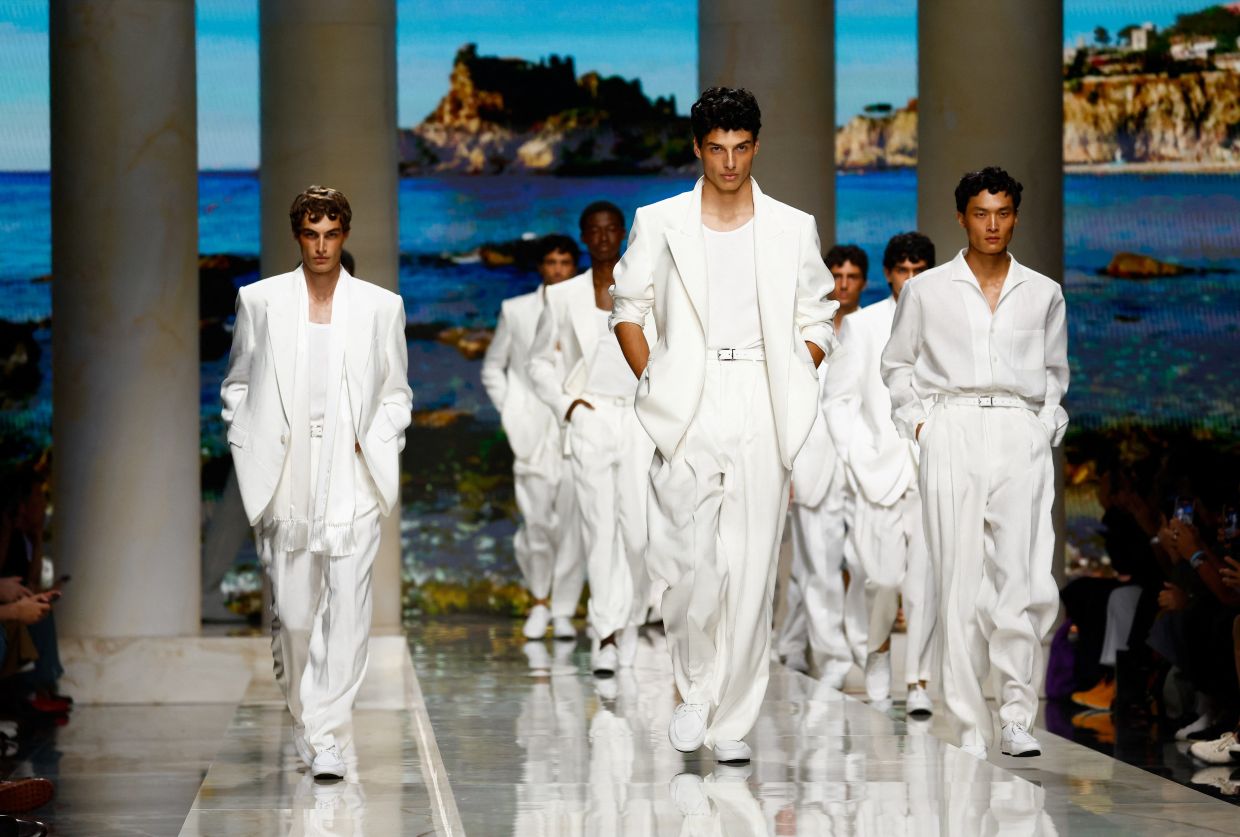
As Milan Fashion Week concluded on June 22, the Italian capital's menswear presentations revealed a fashion industry grappling with external pressures through a notably restrained creative lens. Faced with economic uncertainty, geopolitical tensions, and the punishing heat of a sweltering fashion calendar, designers across the spectrum opted for minimalism over maximalism—though not uniformly, and with significant practical considerations at the forefront of their thinking. The collections that graced the Milanese runways for the coming summer season suggest that even at the highest echelons of fashion, pragmatism and commercial viability increasingly inform artistic choice.
The intellectual and aesthetic direction of the season was set by Prada, where co-creative directors Miuccia Prada and Raf Simons articulated a deliberate philosophy centred on reduction and reimagination. Rather than introducing wholesale novelty, their approach involved deconstructing familiar garment archetypes and reassessing them through proportion and material innovation. This sensibility rippled through the presentation schedule, establishing simplicity as a kind of seasonal keynote. The decision to work within recognizable parameters rather than pursuing radical transformation reflects broader market sentiment: in times of external instability, consumers and creators alike gravitate toward the legible and the wearable, even within luxury's rarefied realm.
Yet simplification did not translate to literal lightness in fabric selection. Paradoxically, Milan's runways showcased an abundance of leather and knitwear despite next summer's anticipated temperatures—a contradiction that underscores the perpetual tension between fashion's aesthetic ambitions and the realities of climate and human physiology. The prevalence of heavier materials suggests that designers prioritize conceptual coherence and tactile luxury over suitability for warm weather, implicitly assuming that affluent clientele will exercise solutions such as robust air-conditioning systems, retreats to cooler elevations, or relocation to higher latitudes to wear these pieces comfortably.
The persistence of leather emerged as perhaps the season's most arresting surprise, defying conventional wisdom about summer dressing. Prada's leather programme drew conceptual inspiration from the democratic ubiquity of denim, manifesting in slim five-pocket trousers paired with abbreviated flat-pocketed jackets that functioned simultaneously as outerwear and undershirt. Other houses pursued technological intervention to reconcile material and climate, employing woven and perforated techniques that increased breathability without sacrificing the prestige associations of heavyweight leather. This innovation-driven approach demonstrates how technical advancement enables designers to maintain their creative vocabularies whilst responding to practical constraints.
After years during which oversized, deconstructed silhouettes dominated menswear discourse, Milan signalled a decisive pivot toward body-conscious tailoring. This represents a cyclical return to recognizable menswear foundations, reasserting that sartorial legitimacy remains tethered to the suit and its variants. Across the presentation schedule, there was near-consensus that a properly dressed man continues to wear structured tailoring. The challenge manufacturers and designers confronted was how to render this traditional framework viable in elevated temperatures without abandoning the formal register.
The solution centred on ventilation and strategic exposure. Design teams experimented with unbuttoned dress shirts—some rendered in transparent fabrics, others omitted entirely—allowing air circulation whilst maintaining formal intent. Long trousers persisted as the baseline silhouette, yet designers shifted toward closer contact with the body rather than the billowing volumes of the preceding decade. Dolce & Gabbana advanced this trajectory most aggressively through microshorts that celebrated defined musculature, whilst several brands opted for partial torso exposure. These choices suggest a recalibration of menswear's relationship to the body itself, moving away from obscuration toward a more forthright acknowledgement of physiology.
Tailoring remained foundational to the Milan collections, but in markedly softened iterations. Designers deliberately loosened construction methodologies, widened necklines, and selected fabrics and techniques permitting enhanced airflow. The resulting garments represent tailoring adapted for climatic reality without surrendering formality—a balance that requires considerable technical sophistication to achieve convincingly. Thom Browne, the American designer now operating under Zegna's ownership, marked his return to the Milan calendar for the first time since 2008 with layered suiting that drew extensively on seersucker and men's pleated skirts, both sartorial innovations traditionally associated with summer dressing and long embedded in the Browne brand's design vocabulary.
Not every designer subscribed to the prevailing aesthetic of restraint. Philipp Plein presented crystal-encrusted denim constructions requiring days of handwork per garment, whilst Dolce & Gabbana embraced embellishment featuring beaded accents reminiscent of coral formations. These collections functioned as deliberate counterpoint to Prada's reductive philosophy, offering unapologetic maximalism and theatrical glamour to audiences fatigued by minimalism. The coexistence of these opposing approaches within a single calendar demonstrates fashion's capacity to accommodate diverse sensibilities simultaneously, reflecting different designer temperaments and, crucially, different market segments with divergent spending appetites.
A moderately compressed Milan schedule created apertures for emerging and lesser-known designers to achieve visibility alongside the established hierarchy. Martin Quad made his Milan debut with innovative tailoring techniques that had garnered attention in his native Copenhagen, whilst Domenico Orefice built a co-ed collection around leather and richly textured woven textiles. Japanese designer Shinya Kozuka presented his label's Milan debut, producing one of the season's most poetically summery collections—exemplified by a shirtless model wearing a billowing sheer coat in teal over loosely fitting white trousers, a composition balancing exposure and coverage in ways that felt simultaneously unconventional and effortlessly wearable.
The overall trajectory emerging from Milan suggests that menswear is negotiating a new equilibrium between luxury tradition and contemporary functionality. The suit endures as menswear's foundational garment, but its contemporary expression must accommodate changing climates, shifting cultural attitudes toward the body, and designer responsiveness to external pressures shaping consumer psychology. For Southeast Asian readers attuned to both fashion innovation and practical dressing requirements in tropical and subtropical climates, Milan's emphasis on ventilation, breathable luxury materials, and body-conscious tailoring carries particular relevance. Regional fashion consumers increasingly expect that high-end menswear will perform adequately in warm weather without sacrificing prestige or aesthetic sophistication—a demand that designers across all price points will need to address with greater urgency and ingenuity.

