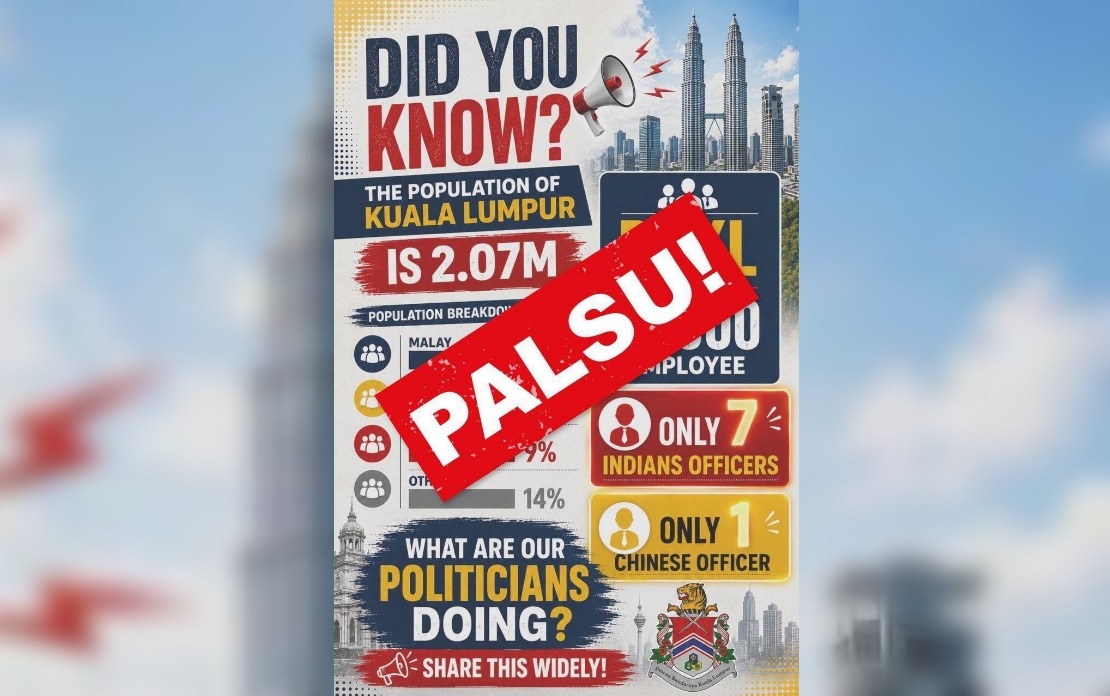
Minister in the Prime Minister's Department (Federal Territories) Hannah Yeoh has moved to counter what she describes as deliberate misinformation regarding the ethnic composition of Kuala Lumpur City Hall's (DBKL) workforce, amid a backdrop of election-related political messaging that appears designed to inflame communal sensitivities. The clarification comes as misleading material spread through WhatsApp purported to show dramatically underrepresented minority groups within the municipal authority, prompting the minister to release actual personnel data on social media platforms to set the record straight.
The false narrative that sparked Yeoh's intervention claimed that DBKL employed only seven Indian staff members and a single Chinese employee, a characterisation that bears no resemblance to the authority's genuine staffing profile. According to official figures as of July 1, 2026, the municipal body maintains a substantially larger workforce reflective of Malaysia's demographic diversity, with 9,131 employees spread across various roles and departments. Within this total, the Indian workforce comprises 490 personnel, whilst Chinese staff number 22 individuals, figures that are substantially higher than the claims circulating in messaging applications.
When examining the composition of more senior roles, a picture of underrepresentation does emerge, though still vastly different from viral allegations. The Management and Professional Group, which encompasses supervisory, specialist, and policy-making positions, includes 10 Indian officers and two Chinese officers among its ranks. These numbers suggest that whilst ethnic minorities occupy professional positions within DBKL, their representation at these levels remains proportionally lower than their overall presence in the workforce, indicating a potential structural disparity in career progression opportunities that merits attention.
Yeoh's acknowledgement that representation within DBKL can be improved signals a willingness to engage with what may be a genuine underlying issue obscured by the circulation of false claims. Rather than dismissing concerns about diversity entirely, the minister has pivoted toward constructive action, instructing DBKL management to undertake a comprehensive review of its hiring mechanisms. This audit will examine recruitment data historically accumulated, current recruitment practices, pathways for promotion within the organisation, and the channels through which job vacancies are advertised to the public.
The scope of this institutional review reflects an understanding that systemic barriers to minority representation can operate subtly, through seemingly neutral processes that inadvertently disadvantage particular groups. Advertisement placement in media outlets with skewed audience demographics, informal networking during recruitment, or promotion criteria that implicitly favour certain educational backgrounds can all contribute to underrepresentation without requiring conscious discriminatory intent. By examining these mechanisms transparently, DBKL may uncover procedural improvements that broaden opportunity without compromising merit-based selection principles.
The minister has explicitly cautioned against what she characterises as an attempt to weaponise workforce composition data for political advantage, urging all parties to resist the temptation to exploit such issues for purposes of stoking racial discord. This language reflects concern that during election periods, narratives around minority representation can be selectively amplified to mobilise particular voter blocs or generate grievance, potentially inflaming community relations in the process. Yeoh's intervention frames the challenge as one of distinguishing between legitimate diversity concerns worthy of institutional reform and cynical political exploitation.
The appeal for all stakeholders to prioritise correcting misinformation and addressing genuine shortcomings represents an attempt to reframe the conversation around recruitment and representation. Rather than engaging in point-scoring disputes over contested statistics, Yeoh suggests the priority should be establishing factual accuracy and channelling any concerns into constructive institutional change. This framing attempts to insulate the diversity agenda from partisan contestation by emphasising shared commitments to fairness, transparency, and merit.
For Malaysian readers, this episode illustrates how government personnel policies have become subject to the intense scrutiny and rapid dissemination characteristic of digital-era politics. False claims about public sector composition can circulate widely before fact-checkers intervene, potentially hardening perceptions about institutional bias regardless of actual personnel data. The speed with which misinformation propagates through messaging platforms outpaces the conventional timeline for institutional response, forcing government figures to engage through social media to reach audiences already exposed to false narratives.
The underlying issue of minority representation in public sector institutions touches on longstanding questions about whether Malaysia's civil service adequately reflects national diversity. DBKL's profile, with minorities making up roughly six percent of overall staff and an even smaller proportion of management positions, invites legitimate examination of whether organisational structures and practices inadvertently disadvantage particular groups. Such questions acquire particular salience in an international context where civil service diversity has become regarded as relevant to institutional legitimacy and community trust.
The commitment to implementing improvements that remain transparent, fair, and merit-based seeks to square a particular circle: enhancing representation without introducing mechanisms that might be perceived as departing from objective selection criteria. Malaysian employers, both public and private, often navigate tension between diversity objectives and meritocratic principles, sometimes defaulting to the latter when perceived as conflicting with the former. Yeoh's framing suggests that transparent examination of existing processes may reveal that current practices inadvertently disadvantage minorities without requiring quotas or explicit preferential treatment.
The episode also underscores the vulnerability of public institutions to reputational damage through coordinated online campaigns, regardless of factual accuracy. Once false narratives gain traction in digital spaces, correcting them requires sustained institutional engagement that may never fully erase the initial misleading impression. DBKL's experience suggests that proactive transparency around personnel practices may prove increasingly important for maintaining public confidence in institutional fairness, particularly as election periods intensify scrutiny of government operations and composition.

