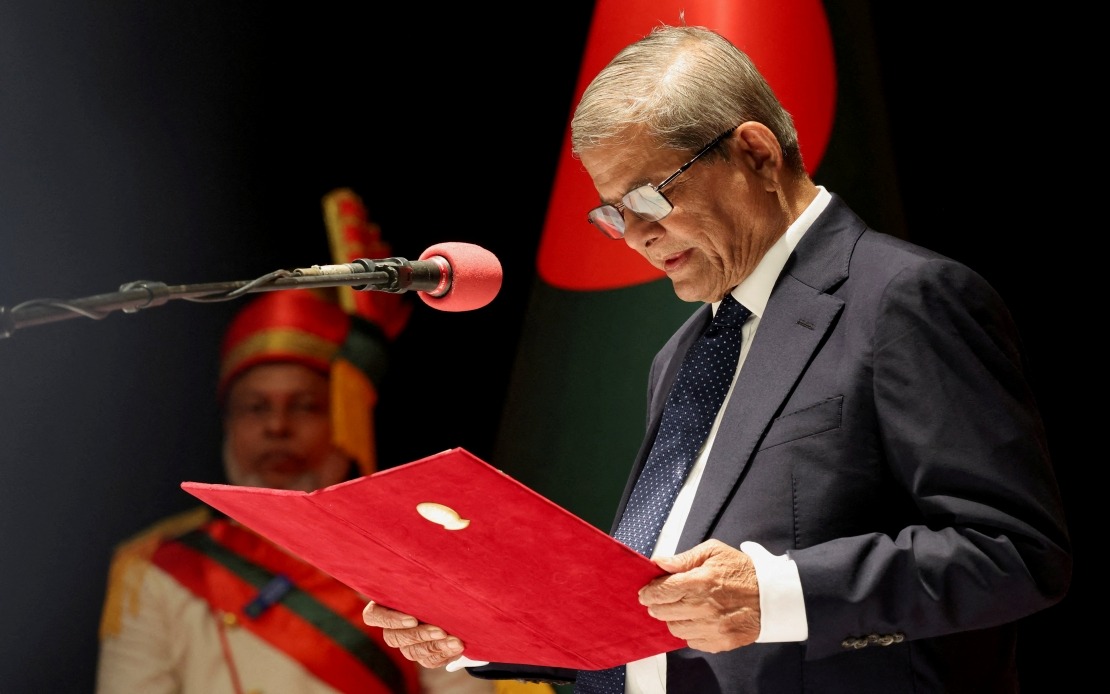
Mirza Fakhrul Islam Alamgir formally assumed office as Bangladesh's 23rd President on Friday evening in a ceremony held at the historic Darbar Hall of Bangabhaban, the nation's official presidential residence. The oath-taking, administered by Acting Speaker Barrister Kayser Kamal at 7:30 pm local time, marked a significant moment in Bangladesh's ongoing political transition and institutional reorganisation.
Fakhrul's elevation to the presidency represents a notable recognition of his decades-long prominence in Bangladesh's political landscape. As one of the country's most established political figures and a former secretary-general of the Bangladesh Nationalist Party (BNP), his appointment reflects the current administration's approach to institutional continuity and senior leadership placement. His legislative election to the post proceeded in accordance with Bangladesh's constitutional framework, following established parliamentary procedures.
The ceremony attracted a comprehensive gathering of the nation's political and administrative elite, including Prime Minister Tarique Rahman, the chief justice, members of the Cabinet, and representatives from both houses of parliament. The presence of foreign diplomatic corps underscored the international dimensions of Bangladesh's political processes and the importance placed on maintaining formal diplomatic protocols during institutional transitions. Senior civil and military officials were also in attendance, demonstrating the whole-of-government nature of presidential inaugurations in the South Asian nation.
The formal protocols observed during the ceremony carried symbolic weight within Bangladesh's constitutional system. Upon arrival at Bangabhaban, Fakhrul received a traditional welcome from senior officials before being formally received by Acting President Hafiz Uddin Ahmad Bir Bikram. This sequence of welcoming rituals represents the institutional respect accorded to the transfer of executive authority in the nation's public administration.
Following the completion of his oath, Fakhrul and the outgoing acting president engaged in a ceremonial exchange of seats—a symbolic gesture deeply embedded in Bangladesh's presidential traditions. This physical relocation between the two office-holders visually represented the formal transfer of presidential powers and authority. The new president subsequently signed both the oath of office and the oath of secrecy, binding him to the constitutional obligations and confidentiality requirements attached to his position.
The transition comes during a period of significant constitutional and political change in Bangladesh, where institutional reforms have been undertaken to reshape the nation's governance structures. Fakhrul's appointment as president reflects efforts to place experienced political leaders in constitutional positions that, while ceremonial in many respects, carry substantial symbolic importance within the Bangladeshi system of government. His background as a long-serving BNP official brings considerable political experience to the largely ceremonial role.
For Malaysia and other Southeast Asian nations monitoring Bangladesh's political trajectory, Fakhrul's presidency signals the continuation of institutional stability within the country's framework. The smooth ceremonial transfer, attended by senior government figures and conducted according to constitutional procedure, demonstrates that despite the country's recent political turbulence, formal mechanisms for power transition remain functional. This institutional resilience has implications for regional stability and bilateral relationships across South Asia and Southeast Asia.
The BNP's continued prominence in key institutional positions, as evidenced by Fakhrul's elevation to the presidency, suggests that major political parties retain significant influence over Bangladesh's governance structure. The party's historical role in Bangladesh politics, combined with its representation in both the Prime Minister's office and now the presidency, indicates that traditional political actors continue to shape the nation's institutional landscape despite recent democratic upheavals.
The conclusion of the ceremony with the national anthem represented not merely a procedural ending but a constitutional affirmation of Fakhrul's legitimacy as the nation's chief ceremonial officer. As head of state, the new president assumes responsibilities for embodying national continuity and presiding over constitutional functions, even as executive authority rests with the Prime Minister under Bangladesh's parliamentary system. The ceremonial dignity accorded to the occasion reflected the constitutional significance of the presidential office within Bangladesh's democratic framework.
Looking forward, Fakhrul's tenure will likely be examined in terms of how effectively he performs the symbolic and ceremonial functions of the presidency while navigating the broader political currents affecting Bangladesh's governance. His extensive political experience and established relationships across the political spectrum may prove valuable in performing the consensus-building and representational dimensions of the role. The international diplomatic dimensions of the presidency also gain importance given Bangladesh's significant regional role and economic engagement across Asia and beyond.

