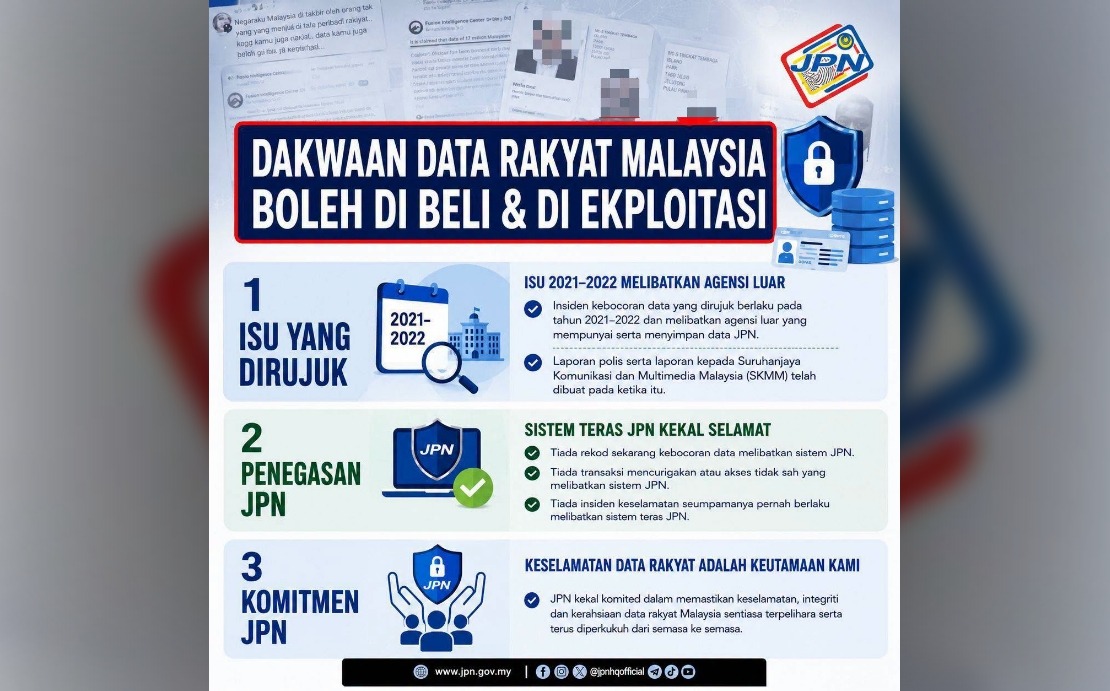
The National Security Council (MKN) has moved to quell public concerns surrounding a data leak that has been circulating widely across social media platforms, issuing a statement through the National Cyber Security Agency (NACSA) to clarify that the compromised information stems from cybersecurity breaches that occurred well before 2022. The council emphasised that the leaked data has no bearing on any systems currently in operation, a distinction that carries significant implications for the security of Malaysian digital infrastructure and the confidence users should maintain in present-day platforms.
According to NACSA, the personal information now being redistributed online without authorisation was originally obtained through unlawful cyber intrusions that targeted multiple systems prior to 2022. The agency has characterised the current circulation of this data as a redistribution of previously compromised material, effectively amplifying the damage from incidents that occurred several years ago. This pattern of rediscovering and reexploiting old breaches highlights a persistent challenge in Malaysia's cybersecurity landscape: the extended lifespan of stolen data on the dark web and its continued monetisation by criminal actors.
The legal framework underpinning NACSA's response extends beyond merely identifying the original breach perpetrators. The council has stressed that under Malaysian law, the act of providing, disseminating, or granting access to unlawfully obtained information constitutes a criminal offence regardless of whether the service distributing it is hosted within or outside Malaysia's borders. This extraterritorial perspective reflects growing international recognition that cybercriminals often operate across jurisdictions, necessitating a legal framework robust enough to address crimes that transcend geographical boundaries.
To address the immediate threat, NACSA has coordinated with MyNIC and the Personal Data Protection Department to engage foreign service providers in removing and blocking access to the affected websites. Simultaneously, the council is collaborating with the Royal Malaysia Police to conduct digital forensic investigations aimed at identifying and prosecuting those responsible for the redistribution campaign. This multi-agency approach demonstrates the institutional maturity required to combat sophisticated cybercrime operations that often involve international networks of perpetrators.
Beyond immediate law enforcement action, the council has leveraged this incident to reinforce public messaging about the legal and practical dangers of consuming stolen data. Malaysians are being advised that accessing or utilising services that offer unlawfully acquired information not only violates the law but also perpetuates the market incentives for cybercriminals to steal and trade in personal data. By framing such consumption as a form of participation in cybercrime, the government is attempting to reshape the social calculation around data breach victims and observers.
The incident has also provided political momentum for legislative efforts to strengthen Malaysia's cybercrime defences. The proposed Cyber Crime Bill, awaiting parliamentary tabling, is positioned as a comprehensive overhaul of Malaysia's legal arsenal against digital threats. The bill introduces provisions criminalising unauthorised access to or damage of computer systems and programmes, establishes identity theft as a specific offence involving the unauthorised use of another person's identity for criminal purposes, and expands the definition of cybercrime to encompass emerging threat vectors. These legislative enhancements represent recognition that Malaysia's existing legal framework, while functional, required modernisation to address the sophistication and scale of contemporary cyber threats.
Complementing the legislative agenda is the Cyber Security Act 2024, which took effect in August 2024 and imposes mandatory security requirements on entities operating critical information infrastructure. The act mandates that National Critical Information Infrastructure (NCII) operators implement comprehensive protection measures including adherence to codes of practice, conducting regular risk assessments, and subjecting their systems to periodic security audits. For Malaysia, where telecommunications, banking, energy, and government systems constitute the backbone of economic activity, this regulatory framework represents a structural shift towards embedding security requirements throughout critical sectors rather than treating cybersecurity as an optional addition.
An important component of the government's digital security narrative concerns MyDigital ID, which has achieved more than 16 million registrations since its introduction. The council has taken pains to clarify that MyDigital ID functions as an identity verification platform rather than a personal data repository, authenticating users directly against the National Registration Department's systems. This distinction is crucial for user confidence: the platform does not store personal data in a centralised repository vulnerable to breach, but instead enables secure digital transactions by verifying identity in real time. The widespread integration of MyDigital ID across government and private services including telecommunications and banking represents a strategic bet that distributed identity verification will prove more secure than traditional data centralisation approaches.
The proliferation of MyDigital ID adoption across both government and commercial sectors is presented by the council as a pathway to enhanced transaction security and identity theft prevention. As more government services, financial institutions, and telecommunications providers integrate MyDigital ID into their authentication systems, the infrastructure supporting secure digital interaction accumulates network effects that increase its value to all users. However, this expansion also elevates the stakes: any vulnerability in the MyDigital ID system would affect a broader portion of Malaysia's digital economy, creating concentrated security risk alongside distributed security benefits.
Malaysia's approach to this data leak incident reveals a multifaceted strategy for addressing cybersecurity challenges in a developing digital economy. By clearly separating the impact of pre-2022 breaches from current systems, the government seeks to prevent panic that might undermine confidence in digital services and government initiatives like MyDigital ID. Simultaneously, the activation of law enforcement, regulatory strengthening through the Cyber Crime Bill, and operational safeguards through the Cyber Security Act 2024 reflect an attempt to build institutional capacity commensurate with the threat landscape.
For Malaysian citizens and businesses, the implications are mixed. The clarification that current platforms remain unaffected by the leaked data should provide reassurance, yet the continued availability of years-old stolen information underscores the reality that data breaches represent permanent losses from a practical standpoint. The government's emphasis on public responsibility—discouraging consumption of stolen data and promoting awareness of cybercrime dynamics—signals recognition that cybersecurity depends not merely on technical and legal defences but also on collective social choices about participation in the data economy.
Looking forward, the convergence of these elements—legislative modernisation, operational security standards, identity verification infrastructure, and public awareness campaigns—reflects Malaysia's attempt to build comprehensive cybersecurity governance. The success of this approach will depend substantially on execution: whether the Cyber Crime Bill receives timely passage, whether NCII entities implement the Cyber Security Act 2024 requirements effectively, and whether MyDigital ID achieves its intended role as a security-enhancing rather than security-centralising infrastructure. For regional observers in Southeast Asia confronting similar digital security challenges, Malaysia's response provides a template combining legislative, infrastructural, and enforcement elements.

