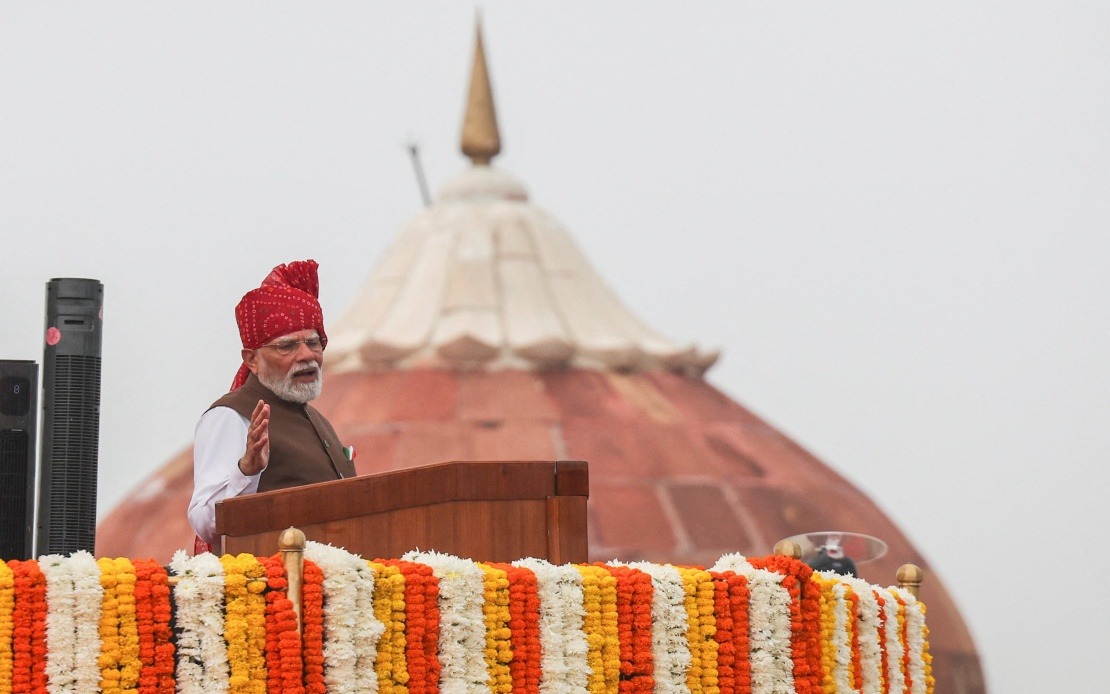
Indian Prime Minister Narendra Modi has unveiled a comprehensive strategy to transform India into a developed nation by 2047 through aggressive domestic capability-building in strategic sectors. Speaking during India's Independence Day celebrations at the Red Fort in Delhi on Saturday, Modi articulated a vision that prioritises self-reliance over imports across defence, semiconductors, and energy—sectors that have traditionally relied on external sources. The ambitious timeline reflects India's determination to reduce economic vulnerabilities and establish technological sovereignty in areas critical to national security and growth.
The semiconductor sector represents a cornerstone of Modi's self-reliance initiative. Three semiconductor manufacturing facilities have already commenced operations, with Modi projecting that five to eight additional plants will become fully operational within the next seven to eight years. This expansion addresses a critical supply chain vulnerability that has constrained India's technology sector and prompted heavy dependence on foreign suppliers. For Malaysia and the broader Southeast Asian region, India's semiconductor push carries significant implications, potentially reshaping regional trade patterns and creating both competition and partnership opportunities in chip manufacturing and supply chains that currently dominate the global market.
Nuclear energy stands as another pillar of India's energy security strategy. Modi announced that India aims to achieve 100 gigawatts of nuclear capacity by 2047, a substantial increase from current levels. The government plans to commission five new nuclear reactors within the current decade, demonstrating commitment to accelerating this transition. Notably, Modi highlighted India's recent mastery of fast-breeder nuclear technology and progress towards fuel self-sufficiency—achievements that underscore India's technological advancement and reduce its dependence on foreign nuclear fuel suppliers. This development carries regional significance as Southeast Asian nations grapple with their own energy transition challenges and nuclear infrastructure decisions.
Renewable energy capacity has experienced remarkable growth under Modi's tenure. Solar energy generation has surged from just two gigawatts twelve years ago to 160 gigawatts today, representing one of the world's fastest expansions in renewable capacity. This dramatic scaling demonstrates India's capability to mobilise resources and deploy technology at scale, offering lessons for other developing economies pursuing clean energy transitions. The trajectory suggests India will increasingly compete globally in renewable energy technology and manufacturing, potentially influencing regional energy markets and technology standards across Asia.
Beyond conventional energy, Modi revealed that India is aggressively pursuing underdeveloped offshore oil and gas reserves. The government has allocated 850 billion rupees, equivalent to approximately 8.9 billion US dollars, for exploration and development of previously untapped maritime resources. Modi characterised these zones as having been historically treated as off-limits, with exploration potential in areas designated as 99 per cent no-go. This initiative addresses India's persistent energy import dependency and could reshape geopolitical dynamics in the Indian Ocean region, potentially affecting shipping routes, maritime security considerations, and regional energy cooperation frameworks that matter to neighbouring Southeast Asian economies.
Defence manufacturing capabilities have become increasingly central to India's self-reliance agenda. Modi called for substantial investment in indigenous development of drones, counter-drone systems, and hypersonic defence technologies—areas where India currently depends on foreign suppliers. Strengthening domestic defence production serves multiple purposes: reducing import expenditure, building technological expertise, and establishing defence sector industrial capacity that contributes to manufacturing employment and economic development. For regional security dynamics, India's growing defence manufacturing capability will influence military procurement patterns and could foster opportunities for Southeast Asian defence partnerships, though it may also intensify competition in regional arms markets.
Understanding the link between consumer choices and industrial development, Modi emphasised the importance of domestic consumption patterns in supporting the self-reliance mission. He urged Indians to prioritise locally manufactured products despite the availability of cheaper and faster foreign alternatives. This appeal recognises that consumer preference shapes industrial investment decisions and market demand, making individual purchasing behaviour integral to national capability development. The statement reveals Modi's sophisticated understanding of how to mobilise public support for economic nationalism while building the domestic industrial base necessary for sustained development.
The philosophical underpinning of Modi's strategy reflects a conviction that true development cannot be outsourced or imported wholesale. By choosing to develop domestic capabilities in strategic sectors—despite potential short-term costs and inefficiencies—India aims to build institutional knowledge, develop skilled workforces, and create competitive industries that can eventually export globally. This approach distinguishes itself from purely trade-focused liberalisation strategies, instead emphasising capability development as foundational to long-term development and strategic autonomy.
For Malaysia and other Southeast Asian nations, India's self-reliance drive presents both challenges and opportunities. Increased Indian competition in semiconductors, renewable energy, and defence technology will reshape regional markets and supply chains. Simultaneously, India's development creates demand for complementary goods and services, fostering potential partnership opportunities in areas where Southeast Asian economies maintain comparative advantages. The 2047 vision also signals India's intent to assume greater regional leadership, requiring Southeast Asian nations to recalibrate trade relationships and technological cooperation arrangements with New Delhi.
The timing and scope of Modi's announcement reflect confidence in India's capacity to execute ambitious development projects, even as implementation challenges remain substantial. Semiconductor manufacturing requires sustained capital investment and technology transfer, nuclear expansion faces regulatory and safety considerations, and defence manufacturing demands specialised expertise and sustained R&D spending. Nevertheless, India's demonstrated ability to scale renewable energy rapidly suggests institutional capacity to execute at scale.
India's self-reliance strategy also intersects with global technology trends and geopolitical competition. As tensions between major powers intensify over semiconductor supply chains and advanced technology access, India's initiative to develop indigenous capabilities aligns with broader Asian trends toward regional technological sovereignty. Countries throughout Southeast Asia face similar pressures to reduce dependency on distant suppliers, making India's approach a potential template for regional development strategies.
Looking ahead, the success of Modi's 2047 vision will depend on sustaining political will across multiple election cycles, securing necessary capital investment, developing requisite technical expertise, and managing the transition costs associated with building new industries. The initiative also requires integration with global standards and markets, as complete autarky remains neither feasible nor desirable in an interconnected global economy. Nevertheless, Modi's articulation of a comprehensive self-reliance strategy signals India's determination to shape its own development trajectory and reduce strategic vulnerabilities inherent in import dependency.

