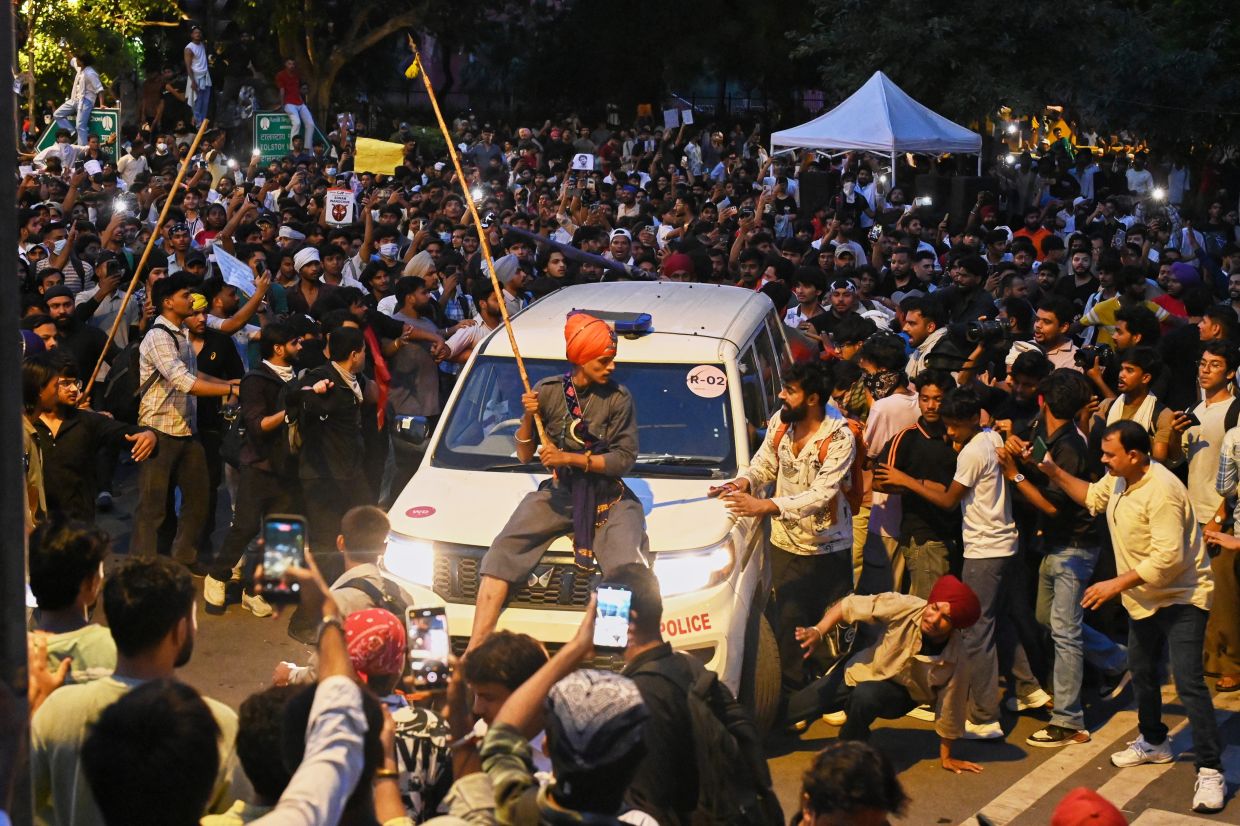
Indian Prime Minister Narendra Modi has promised tough action against those involved in exam fraud, marking his first direct response to a wave of student-driven protests that have emerged as a serious political challenge to his government. Speaking through social media on Thursday, July 23, Modi declared that "nothing is more important than the welfare and future of our youth," while pledging to establish fast-track courts to prosecute those responsible for question paper leaks that have triggered nationwide anger.
The statement came in the aftermath of dramatic clashes that unfolded on Wednesday night in New Delhi, where thousands of demonstrators, many organised through the Cockroach Janta Party (CJP)—a social media-driven movement—gathered outside the Jantar Mantar site and spilled onto surrounding streets. Police responded with what protesters described as heavy-handed tactics, leading to confrontations that extended into the late hours. According to Delhi Police, demonstrators hurled stones and plastic bottles at security personnel, causing serious injuries, while organisers countered that police "brutally" attacked protesters after shutting down internet access in the area.
The current crisis has its roots in a cascading series of educational system failures that have eroded public confidence. A particularly damaging incident involved the leak of a medical entrance examination question paper, forcing more than two million candidates to sit the test again—a logistical and emotional ordeal that sparked initial outrage. Compounding this, disputes over the online marking of examinations taken by nearly two million high school students have kept public anger simmering. These systemic failures have convinced young people that the examination infrastructure they depend upon for their futures is fundamentally compromised.
The protests escalated dramatically on Monday when police deployed tear gas and conducted baton charges against tens of thousands of demonstrators attempting to march towards parliament on the opening day of the monsoon legislative session. The resulting violence, which left at least 178 people injured including security personnel, represented the most significant street mobilisation in the capital in approximately five years. The scale of the Monday confrontation shocked observers and signalled that discontent extended far beyond a single policy complaint.
Central to the current movement is the Cockroach Janta Party, which originated in May as a satirical riposte to Chief Justice Surya Kant, who reportedly likened young people to "cockroaches" and "parasites" during a court proceeding. What began as sharp social media commentary has morphed into a genuine political movement with millions of online followers. The CJP's agenda has broadened substantially beyond mockery of the judiciary, now encompassing wider concerns about youth unemployment, limited economic opportunities, and what activists characterise as Modi's increasingly authoritarian governance style. This expansion of focus reflects deeper anxieties among India's young population about their prospects and freedoms.
The movement's rapid spread beyond New Delhi demonstrates the depth of underlying frustration. Smaller demonstrations materialised on Wednesday in major metropolitan centres including Mumbai, Bengaluru, and Patna, suggesting that the protest has genuine resonance across India's major urban areas rather than remaining confined to the capital. The geographic dispersal also indicates that underlying grievances—particularly around educational credibility and youth opportunity—transcend regional boundaries.
Political opposition parties have seized upon the unrest to amplify pressure on Modi's government. Congress leader Rahul Gandhi used social media to accuse Modi of harming young people's futures by enabling the "total capture and destruction" of India's education system and protecting those responsible. Opposition lawmakers have disrupted parliamentary proceedings, demanding an apology from Modi for the police response on Monday. These parliamentary tactics reflect an opposition strategy to transform street protests into a sustained political liability for the government.
The timing of these protests is particularly significant given Modi's political trajectory. Having secured a third consecutive term in office following 2024 elections, the Prime Minister is facing his most serious domestic challenge since returning to power. The scale, organisation, and youthful composition of the CJP-led movement suggests that previous assumptions about Modi's political invulnerability among younger voters may require recalibration. The fact that internet shutdowns and police action have failed to suppress demonstrations indicates genuine mobilisation rather than ephemeral social media activism.
The international dimension adds another layer of significance. Student movements in neighbouring Bangladesh conducted a "torch rally" on Thursday evening in solidarity with Delhi protesters, drawing explicit connections between youth-led activism in the two countries. The memory of Bangladesh's 2024 student-led protests, which toppled Sheikh Hasina's government, resonates powerfully in Indian political circles. While Indian circumstances differ substantially, the precedent of youth movements generating seismic political consequences cannot be dismissed lightly.
Modi's promise of fast-track courts represents a technocratic response to a fundamentally political problem. Prosecuting examination officials may address the immediate trigger for protests, but the movement's expansion suggests that exam fraud has become a focal point for broader frustrations about governance, opportunity, and accountability. Whether administrative reform can satisfy young demonstrators whose grievances extend to systemic economic and political concerns remains an open question. The government faces a delicate balancing act between demonstrating responsiveness through institutional action while managing the underlying pressures that fuel youth discontent.

