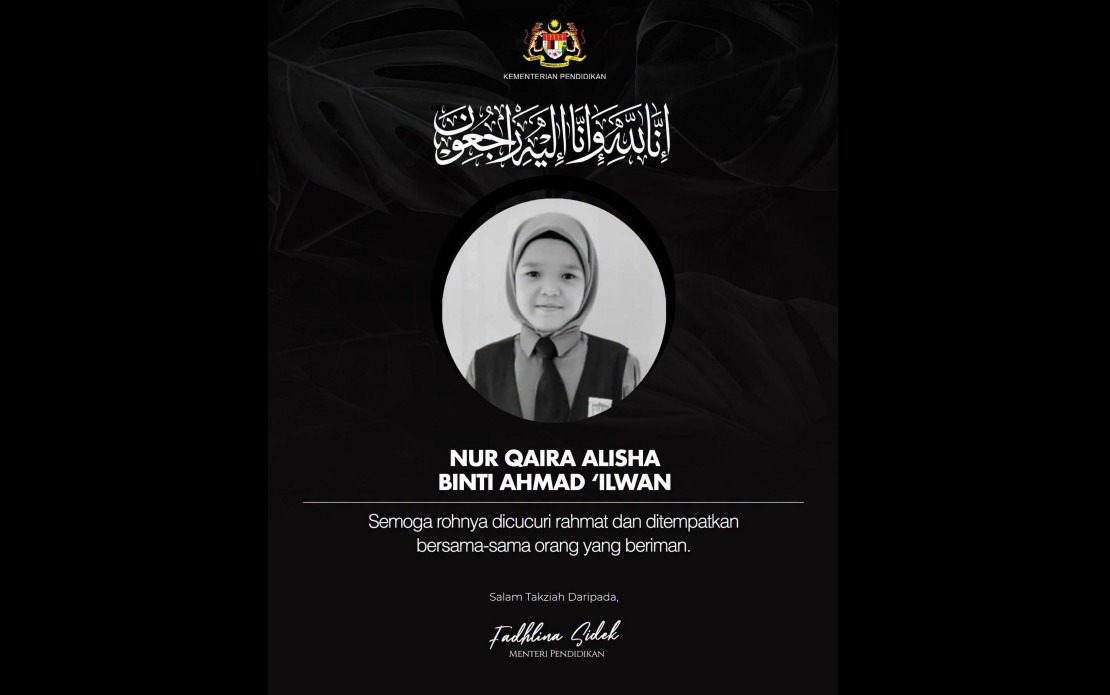
Education Minister Datuk Seri Fadhlina Sidek has instructed the Ministry of Education's Integrity Unit to pursue investigations into a formal complaint submitted by the family of Nur Qaira Alisha Ahmad Ilwan, a Year Four student whose sudden death has raised serious questions about duty of care in Malaysian schools. The minister indicated that any investigative measures would be conducted in accordance with established protocols and guided by equitable treatment of all parties involved in the matter.
The circumstances surrounding Nur Qaira's passing have drawn particular attention because of allegations that school staff disregarded documented medical guidance when determining her participation in physical activities. According to her family's account, despite the school being in possession of a medical letter confirming her health vulnerabilities, a teacher directed her to compete in a running event as part of the school's sports house selection process on April 15. This apparent disconnect between medical documentation and institutional decision-making has become the focal point of the family's complaint and subsequent investigation.
Nur Qaira had lived with a significant cardiac condition since infancy, having been diagnosed with heart complications when she was merely three months old. Her medical history necessitated an official exemption from school sports participation, a standard protective measure that exists to prevent children with known vulnerabilities from being exposed to physical exertion that could trigger medical crises. The exemption was not a casual advisory but a formal medical accommodation that required deliberate institutional acknowledgment and adherence.
The sequence of medical events that followed the April 15 sports day proved catastrophic. Within nine days, Nur Qaira developed severe symptoms including acute vomiting and significant facial swelling, prompting her admission to Sultanah Bahiyah Hospital on April 24. Medical investigations at the hospital revealed that she had suffered heart failure stemming from decompensated dilated cardiomyopathy, a progressive weakening of the heart muscle's pumping capacity. Her condition deteriorated rapidly, and she subsequently passed away at the facility.
Minister Fadhlina has publicly reaffirmed that the Ministry of Education approaches questions involving student safety and wellness with the utmost gravity. Her statement emphasises that no aspect of school operations—whether curricular, co-curricular, or administrative—can proceed without careful consideration of individual student health profiles. The ministry's commitment to scrutinising this case reflects broader institutional recognition that preventable harm to children represents a fundamental failure of the pastoral duty schools owe their charges.
The investigation already conducted by the Kedah State Education Department provides a foundation upon which the MOE's Integrity Unit will build its own examination. This layered approach to investigation, beginning at state level and escalating to national ministry oversight, suggests the seriousness with which authorities are treating the allegations. The sequential involvement of multiple institutional levels also indicates recognition that questions about compliance with medical protocols and staff accountability require sustained scrutiny beyond routine procedures.
The timing and nature of this case carry implications for how Malaysian schools manage medical accommodations and implement safeguarding procedures. Many schools across the country maintain similar exemption systems for students with chronic conditions, asthma, orthopedic limitations, and other health concerns. The question of whether Nur Qaira's case represents an isolated incident of staff oversight or a symptom of systemic laxity in enforcing medical accommodations will likely influence how the ministry refines its guidance to educational institutions nationwide.
For parents and guardians, particularly those with children managing chronic health conditions in school settings, the case underscores the necessity of maintaining clear documentation and establishing direct communication channels with school leadership about medical needs. While schools in Malaysia are generally equipped to handle health accommodations, experiences like Nur Qaira's demonstrate that written medical letters alone may not guarantee consistent adherence without proactive parental advocacy and institutional culture change emphasizing medical compliance as non-negotiable.
The ministry's commitment to ensuring the bereaved family receives appropriate support and space during their grieving period reflects an understanding that beyond institutional accountability, this case involves profound personal loss. The death of a child under circumstances potentially preventable through adherence to established medical protocols creates a compounded trauma for families, combining ordinary bereavement with questions of institutional responsibility that may never be fully resolved to their satisfaction.
As the MOE's Integrity Unit proceeds with its investigation, the broader Malaysian education sector will be watching how thoroughly the inquiry addresses not only what happened on April 15 but why documented medical guidance apparently failed to prevent a child from participating in activities explicitly contraindicated for her condition. The findings will likely shape ministerial guidance regarding medical accommodations, staff training requirements, and accountability mechanisms for schools failing to honour health-related exemptions. For Nur Qaira's family, the investigation represents a pathway toward understanding whether systemic failures contributed to their daughter's death and what measures might prevent similar tragedies in other Malaysian schools.

