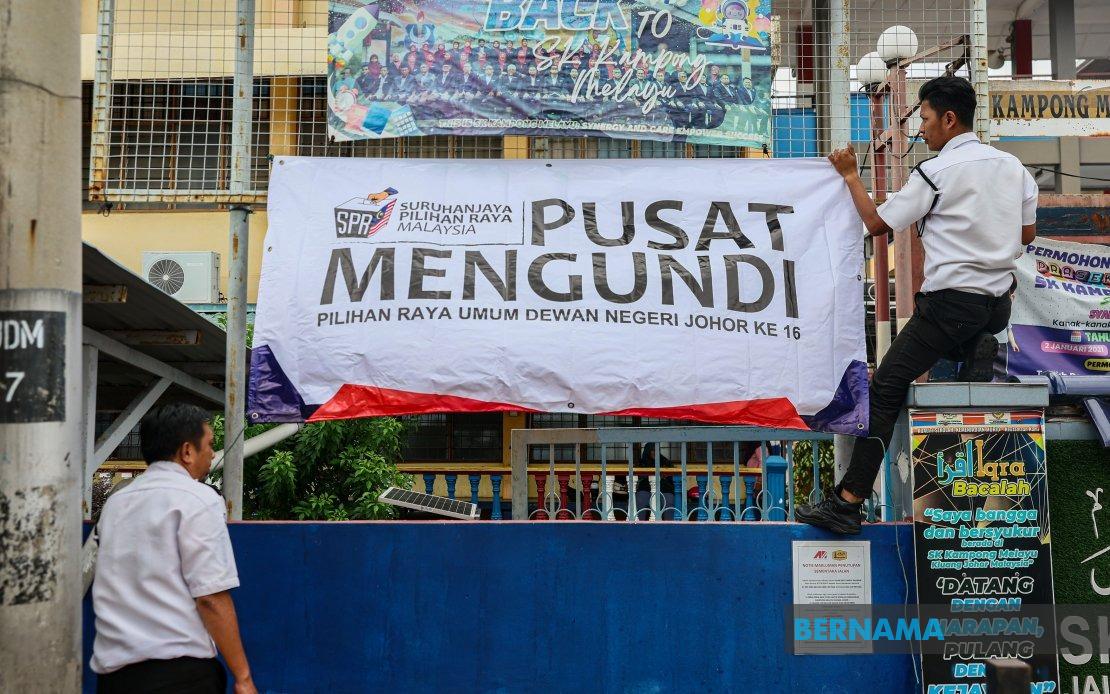
The southern Malaysian state of Johor embarked on its electoral journey today with more than 2.7 million eligible voters participating in the 16th state election, tasked with determining who will represent them in the State Legislative Assembly across all 56 available seats. The voting exercise represents a significant democratic engagement for the state's population and carries implications not only for Johor's governance but also for the broader political landscape of Malaysia's most developed southern state.
Voting commenced at 8 am across 1,076 polling stations staffed with a total of 43,036 election workers mobilised by the Election Commission to facilitate the process. The infrastructure supporting the electoral machinery was substantial, with 4,889 voting streams activated throughout the state to accommodate the voter base and ensure that the democratic exercise proceeded smoothly across its various constituencies. Voting stations were scheduled to close progressively from 11 am onwards, depending on their geographical location, with the final closure at 6 pm, allowing for variations that accounted for the state's diverse topography and accessibility challenges.
Island polling stations received special attention in the election schedule, with voting on Pulau Besar set to conclude by 11 am, followed by Pulau Aur and Pulau Pemanggil at noon, reflecting logistical considerations for voters in more remote locations. The Election Commission had also arranged for 24,677 postal ballots to be returned by the 6 pm deadline, accommodating those unable to vote in person. These administrative details underscore the complexity of conducting elections across a geographically diverse state.
The election culminated a campaign period that had lasted exactly 14 days, concluding at midnight the previous evening. This timeframe is standard for Malaysian state elections and provides candidates and political parties with structured opportunity to present their manifestos and engage with constituents. The mood during the campaign had reflected the competitive nature of Johor politics, where the state's strategic importance to national politics often elevates local electoral contests to matters of broader national significance.
Weather considerations were factored into election day planning, with the Malaysian Meteorological Department forecasting morning rainfall in several key districts including Johor Bahru, Batu Pahat, Kulai, Muar, Pontian and Tangkak, with conditions expected to improve toward afternoon and evening hours. Afternoon thunderstorms were anticipated in Kluang, Kota Tinggi and Segamat, and evening storms in Mersing. Such weather forecasts are important context for understanding voter behaviour and turnout patterns, particularly in areas prone to heavier rainfall.
The Election Commission set an ambitious target of approximately 70 percent voter participation, a notable benchmark considering that the previous state election in 2022 achieved a turnout of 54.92 percent. Achieving this increase would represent stronger democratic engagement and could reflect heightened voter interest in the current political contest. Full results were anticipated by 10 pm, allowing the state and the nation to assess the electoral outcome relatively quickly and move forward with government formation.
Early voting had already taken place on the preceding Tuesday, with 20,607 ballots cast by members of the police force, armed forces personnel and their spouses—a cohort for whom special voting arrangements are customarily made. This early exercise provides a useful indicator of institutional participation and sets the stage for broader voting patterns observed on election day proper.
The candidate field comprised 172 individuals representing diverse political forces, reflecting Johor's multi-party political ecosystem. Pakatan Harapan and Barisan Nasional each fielded 56 candidates contesting all available seats, indicating their intention to compete comprehensively. Perikatan Nasional offered 33 candidates, while smaller political entities including Parti Bersama Malaysia with 15 candidates, the Democratic Action Party-affiliated MUDA with four, Parti Orang Asli Malaysia with one, Parti Sosialis Malaysia with one, and six independent candidates rounded out the ballot. This diversity of choice reflects Malaysia's relatively open electoral system, though it also fragments the opposition vote in a manner potentially advantageous to larger, more unified political coalitions.
Before dissolution of the assembly on June 1, the political composition had favoured Barisan Nasional with 40 seats, a commanding majority that provided stability for the outgoing state government. Pakatan Harapan held 12 seats, Perikatan Nasional possessed three, and MUDA controlled a single seat. The election today would determine whether these proportions would shift significantly, alter marginally, or remain largely intact. Given Johor's historical significance as a Barisan Nasional stronghold and its economic importance to Malaysia, the outcome possessed consequences extending well beyond the state itself.
Employers throughout the state had been officially reminded to grant employees reasonable time away from work to fulfil their voting obligations, a standard administrative notice that underscores the civic importance attached to the electoral process. This notification ensures that work responsibilities do not create barriers to voter participation, supporting the Election Commission's turnout objectives.
The election day machinery reflected decades of electoral experience accumulated within Malaysia's institutional framework, combining administrative efficiency with safeguards designed to ensure electoral integrity. With polls opening simultaneously across all 1,076 centres and closing according to a predetermined schedule that accounted for geographic variations, the process demonstrated the sophistication with which modern Malaysian elections are typically administered.
For the Malaysian political system more broadly, Johor's election results would contribute to ongoing calculations about coalition strength and the relative standing of the nation's principal political groupings. As one of Malaysia's largest states by population and economic output, developments in Johor tend to reverberate throughout national political discourse and influence perceptions of political momentum heading into any future federal elections.

