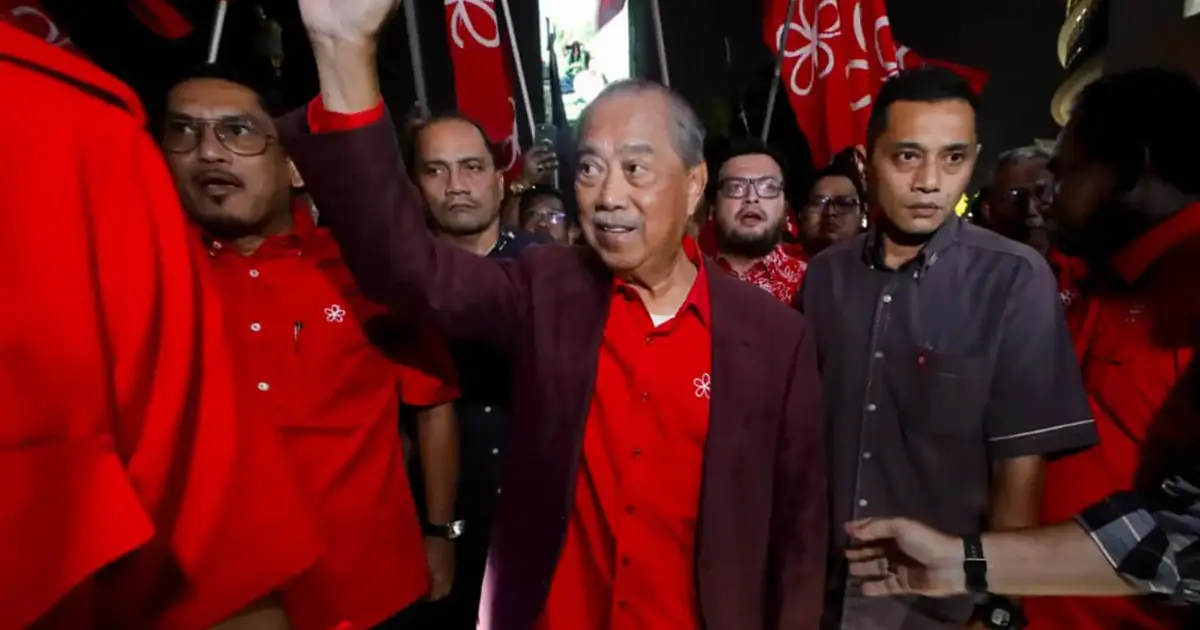
A show of support exceeding 200 gathered behind Tan Sri Muhyiddin Yassin on the eve of Bersatu's significant party assembly, underscoring the momentum surrounding the veteran politician as the Malay-Muslim party navigates a series of critical decisions affecting its political trajectory. The turnout signals internal consolidation within the party as Muhyiddin maintains his grip on the leadership amid broader coalition dynamics that continue to reshape Malaysia's political landscape.
The assembly is expected to tackle several pressing matters that will determine Bersatu's strategic direction in the months ahead. Central to the agenda are preparations for the upcoming state elections in Johor and Negeri Sembilan, two contests where the party will test its electoral appeal and assess its capacity to deliver results in constituencies where it has established a meaningful presence. These elections carry symbolic weight beyond their immediate political outcomes, as they will provide an early indication of how voters respond to Bersatu's governance record and policy agenda.
Equally important to the party's internal deliberations is the ongoing question of Bersatu's relationship with PAS, the Islamic party that has emerged as a significant partner in recent political arrangements. The nature and terms of this alliance have been subject to considerable speculation within political circles, with questions lingering about whether the partnership represents a temporary tactical arrangement or a more durable strategic alignment. How Bersatu defines and formalises its ties with PAS will have ripple effects across Malaysia's broader political coalition architecture.
Muhyiddin's continued prominence within Bersatu reflects his enduring appeal among party members, even as the broader political environment remains fluid and contested. His leadership of Bersatu has been defined by attempts to position the party as a credible alternative within Malaysia's Malay-Muslim political space, offering what the party frames as a middle path distinct from both the established UMNO machinery and PAS's more strictly religious-oriented platform. The backing demonstrated at this gathering suggests that this positioning continues to resonate with at least a substantial faction of the party's membership.
The timing of this assembly comes at a moment when Malaysian politics is in a state of considerable flux. The federal government's composition, the states' political alignments, and the strategic calculations of various political actors are all undergoing continuous reassessment. For Bersatu, which has occupied various positions within the political constellation—from cabinet participant to opposition force—the ability to maintain internal cohesion while projecting electoral credibility has become paramount. The party cannot afford significant internal rifts that might suggest instability to voters or coalition partners.
Johor and Negeri Sembilan represent contrasting political opportunities for Bersatu. Johor, Malaysia's second-largest state by population and economy, has historically been an UMNO stronghold, making any gains there a significant achievement. Negeri Sembilan, while smaller, offers possibilities for Bersatu to consolidate or expand influence. Success in either or both contests would strengthen Muhyiddin's hand both within Bersatu and across Malaysia's broader political negotiations. Conversely, disappointing results could invite questions about the party's electoral viability and potentially embolden internal challengers.
The relationship with PAS presents a different order of complexity. PAS operates from a distinct ideological and social base, with established strengths in particular states and among specific demographic groups. Bersatu's collaboration with PAS must balance the desire to leverage the Islamic party's organisational network and voter support against concerns about identity dilution or subordination of Bersatu's own policy agenda. These considerations will likely feature prominently in the assembly's discussions about positioning ahead of the state elections.
For Malaysian political observers, the gathering behind Muhyiddin offers insights into the internal dynamics of one of the country's newer major political players. Bersatu, formed relatively recently in Malaysian political terms, has nonetheless become a force capable of influencing national politics and state-level governance. How it navigates the decisions at this assembly will shed light on whether it can consolidate itself as a permanent fixture in Malaysia's political firmament or remains a transitional entity buffeted by larger forces.
The broader implications extend to coalition stability at both federal and state levels. Any significant shift in Bersatu's positioning or priorities could necessitate recalculations by other political actors who are currently aligned with it or competing against it. The party's choices regarding resource allocation, candidate selection, and coalition prioritisation across different states will create downstream effects for UMNO, PAS, DAP, PKR, and other players seeking to maximize their electoral and governing prospects.
As the assembly commences, Muhyiddin's demonstrated capacity to retain the backing of more than 200 party members provides him with a platform to advance his vision for Bersatu's future. Whether that vision can translate into electoral success in Johor and Negeri Sembilan, and whether the defined relationship with PAS can prove stable and mutually beneficial, remain open questions that will only be answered through the concrete processes of campaigns, elections, and governance.