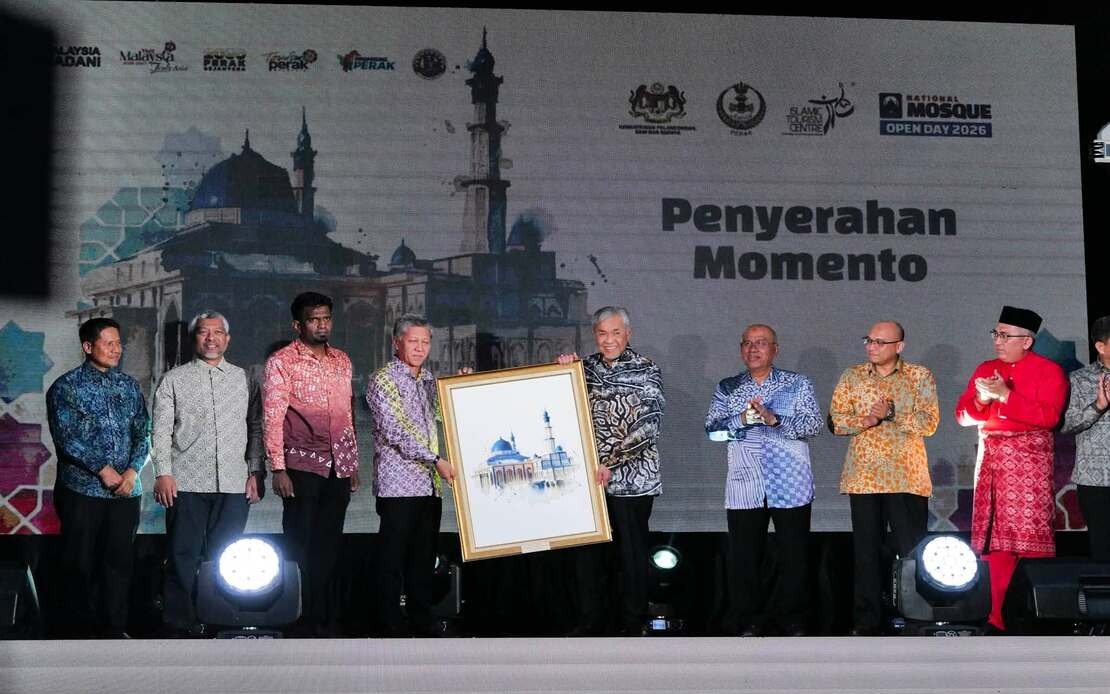
Deputy Prime Minister Datuk Seri Dr Ahmad Zahid Hamidi has articulated a vision in which mosques serve simultaneously as destinations within Malaysia's tourism landscape and as sanctuaries for worship and spiritual development. Speaking at the National Mosque Open Day 2026 in Bagan Datuk, Ahmad Zahid framed the integration of mosque institutions into tourism infrastructure not as a commercialisation of sacred spaces but as an opportunity for visitors to encounter Malaysia's Islamic heritage and values firsthand.
The strategic positioning of mosques within the broader tourism ecosystem reflects a deliberate effort to reshape visitor perceptions and experiences of Islam in Malaysia. Rather than confining mosque engagement to religious adherents, the approach recognises that tourists increasingly seek authentic cultural and spiritual encounters. When visitors depart Malaysian shores after experiencing mosque hospitality and witnessing Islamic values in practice, Ahmad Zahid suggested, they carry intangible impressions alongside photographs—memories of warmth, welcoming attitudes, and the demonstrated compassion central to Islamic teaching. This soft-power dimension carries particular significance for a nation competing in the global tourism market where experiential travel has gained prominence.
The National Mosque Open Day initiative exemplifies this strategic pivot. By systematically opening mosque doors during designated periods, institutions provide structured opportunities for people of diverse religious backgrounds, age groups, and nationalities to interact meaningfully with Islamic spaces and communities. Ahmad Zahid emphasised that such programmes facilitate the breaking down of misconceptions and foster mutual respect. The practical outcome involves not merely dispelling stereotypes but building genuine appreciation for mosques as integral components of Malaysia's national identity and heritage architecture. This approach acknowledges that understanding often emerges from direct exposure rather than abstract knowledge.
Central to this vision is demonstrating authentic Islamic practice through everyday interactions. Ahmad Zahid stressed that hospitality, service quality, and respectful engagement represent the mechanisms through which mosques can convey Islam's true character—rooted in compassion, wisdom, and benevolence. This framing suggests that tourism-oriented mosque engagement becomes a missionary tool of sorts, permitting Islam to present itself through actions and human relationships rather than formal theology. For Malaysian authorities concerned with countering negative international narratives about Islam, such grassroots cultural diplomacy offers genuine strategic value.
The formal recognition of Masjid Tuminah Hamidi as Malaysia's 98th Tourism Mosque underscores the systematic expansion of this concept. Established in 2023 as a waqf honouring Ahmad Zahid's parents, the mosque earned its designation through distinctive architectural design and an integrated gallery functioning as a centre for Islamic knowledge dissemination. This model illustrates how religious institutions can incorporate educational and aesthetic dimensions that enhance visitor experience while maintaining devotional integrity. The gallery component particularly demonstrates how mosques might evolve to accommodate tourism functions without diluting their spiritual mission.
The Islamic Tourism Centre's leadership has articulated an ambitious expansion target. With Malaysia currently hosting 6,851 mosques, the ITC director-general Mohammad Faisal Abu Suaib Khan indicated that substantial growth in Tourism Mosque designations remains feasible. The selection criteria emphasise distinctive architectural features and historical significance, suggesting a quality-over-quantity approach. Rather than indiscriminately promoting all mosques as tourism products, the framework identifies institutions with genuine heritage, cultural, or design merit—a distinction that protects against reducing sacred spaces to mere tourist attractions while still substantially expanding the tourism mosque network.
Institutional coordination mechanisms underpin this expansion strategy. The Islamic Tourism Centre collaborates with the Department of Islamic Development Malaysia and state-level Islamic religious departments to develop standardised guidelines and facilitate mosque participation. This bureaucratic architecture ensures consistency, quality control, and alignment between tourism development and Islamic authority structures. Such coordination prevents the fragmented, commercially-driven approaches that might otherwise emerge if individual mosques independently pursued tourism revenue without centralised oversight.
Complementary initiatives strengthen the ecosystem's coherence and professional standards. The Muslim-Friendly Tourism and Hospitality Assurance and Recognition programme establishes benchmarks for service quality among businesses engaging Muslim tourists, while the Muslim-Friendly Tourist Guides scheme develops professional competency among individuals facilitating mosque visits. These supporting mechanisms reflect sophisticated understanding that successful tourism integration requires training, standards, and professional infrastructure—not merely opening doors and hoping for positive outcomes.
The conceptual framework underlying these efforts—articulated as "Muslim-Friendly, not Muslim-Only"—carries significant implications for Malaysia's tourism positioning and social cohesion. This formulation suggests that mosques can remain fundamentally Muslim spaces while extending genuine welcome to non-Muslim visitors. The distinction proves crucial: it rejects both exclusionary approaches that wholly seal off Islamic institutions from external engagement and assimilationist approaches that dilute religious distinctiveness to accommodate tourism. Instead, it proposes that authentic Muslim hospitality itself constitutes the bridge-building mechanism.
For regional neighbours and international observers, Malaysia's mosque tourism model presents a template for balancing religious authenticity with cross-cultural engagement. Southeast Asian nations hosting significant Muslim populations increasingly navigate similar questions about cultural preservation, tourism development, and interfaith relations. Malaysia's systematic approach—combining formal designations, professional standards, institutional coordination, and explicit articulation of underlying principles—offers practical lessons about orchestrating such integration without generating communal tensions or spiritual compromises.
The economic dimensions deserve consideration alongside cultural benefits. Tourism mosque designation potentially drives visitation, generates modest revenue streams through donations or gift sales, and stimulates local economic activity in surrounding commercial sectors. Yet Ahmad Zahid's framing deliberately subordinates economic gain to cultural and spiritual objectives, suggesting that financial benefits represent acceptable byproducts rather than driving motivations. This positioning protects the initiative from accusations of commercialising religion while acknowledging that economic sustainability supports long-term maintenance of these institutions.
The National Mosque Open Day 2026 programming itself—combining spiritual activities, community engagement, cultural presentations, recreational elements, and family-oriented features—demonstrates practical execution of the dual-purpose concept. Rather than segregating religious and touristic functions, the event integrates them into a coherent experience where visitors participate in elements aligned with their interests while naturally encountering Islamic practice and values. This architectural approach to programming represents sophisticated cultural management, subtly weaving tourism elements into authentically religious contexts.
Looking forward, the success of this mosque tourism initiative will substantially depend on sustained institutional commitment and consistent execution at local levels. The top-level vision articulated by Ahmad Zahid and the ITC requires translation into on-the-ground practices across hundreds of institutions, each with distinct leadership, resources, and community contexts. Whether mosque officials universally embrace tourism roles, whether training standards take root consistently, and whether visitor experiences genuinely foster understanding rather than superficial curiosity will ultimately determine whether this strategy achieves its ambitious cultural and diplomatic objectives.

