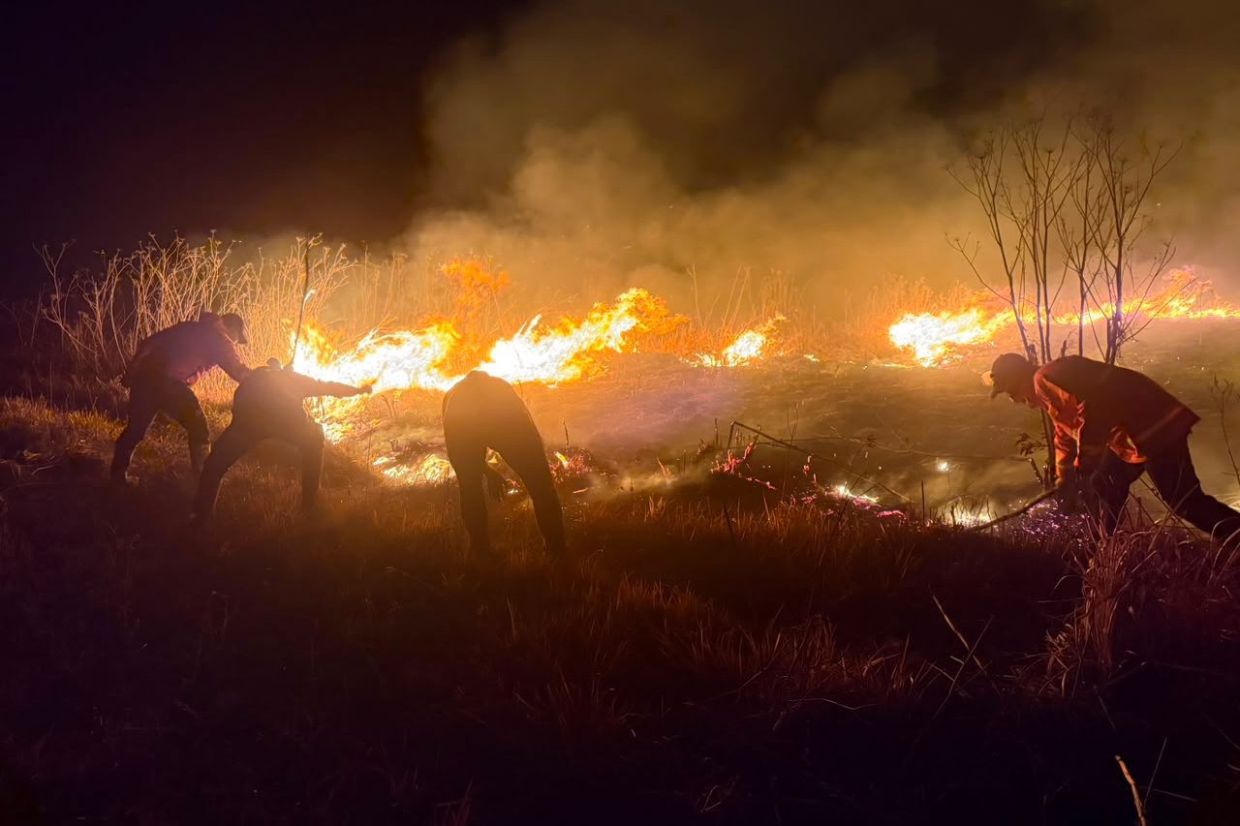
The situation at Mount Bromo National Park in East Java has deteriorated sharply over the weekend, with authorities reporting that the wildfire has now consumed approximately 520 hectares of terrain. The dramatic expansion follows a fresh flare-up that occurred Saturday night, marking a significant escalation from earlier estimates and prompting fresh concerns about the scale of the environmental damage across the region's most visited volcanic landscape.
According to Bromo Tengger Semeru National Park Authority head Rudijanta Tjahja Nugraha, the accelerating spread is directly attributable to meteorological conditions that emerged Saturday afternoon. Fairly strong winds have been channelling flames progressively downslope from the mountain's upper reaches toward lower elevations, a pattern that fire management experts recognise as particularly dangerous because it creates multiple simultaneous fire fronts and limits containment options. The fire has consumed not merely the exposed slopes but penetrated into the park's expansive savanna ecosystem, an environment where fires propagate with exceptional speed through dense dry grass and scrubland.
The vulnerability of the terrain itself has compounded the crisis. Rudijanta explained that the region's vegetation has already undergone significant desiccation, a condition that dramatically reduces the fuel moisture content across all plant materials. This hyper-dry state means even smaller ignition sources can trigger conflagrations, and existing fires face minimal natural resistance. The combination of strong wind patterns, arid vegetation, and challenging topography has created near-ideal conditions for rapid, uncontrolled fire spread—a scenario that tests even well-resourced firefighting operations.
The park administration responded decisively by imposing a complete closure across all entrance points beginning Saturday evening at 10pm. This precautionary measure remains in force indefinitely as firefighting operations intensify. The decision prioritises visitor safety while simultaneously clearing the affected area of civilian presence to allow emergency personnel unrestricted access for containment efforts. Park officials have worked to mitigate disruption for affected tourists by offering two remedial pathways: visitors may reschedule their bookings to future dates or request full refunds, acknowledging the substantial inconvenience created by the emergency closure.
Forestry Minister Raja Juli Antoni has publicly committed to pursuing accountability, announcing that anyone found responsible for deliberately setting forest or land fires will face appropriate legal consequences under Indonesian law. This messaging reflects Jakarta's recognition that wildfire prevention requires both aggressive suppression of active fires and deterrence against intentional fire-setting. However, his statement simultaneously transferred investigative responsibility to law enforcement agencies, a bureaucratic division that sometimes creates delays in determining causation.
Authorities already suspect human activity triggered this particular fire, based on preliminary evidence gathered over the initial days of the incident. This working hypothesis aligns with broader patterns in Indonesia, where agricultural clearing practices, negligent campfire management, and occasional deliberate arson account for the vast majority of uncontrolled wildfires. The distinction between accidental and intentional causation carries enormous weight in Indonesian law, as does evidence of premeditation versus recklessness. Establishing clear causation therefore becomes essential not merely for accountability but for appropriate sentencing frameworks.
The Mount Bromo situation reflects mounting challenges across Indonesia's natural resource management sector, where fire prevention infrastructure remains strained during dry season months. The expansion to 520 hectares within days underscores how rapidly conditions can deteriorate once fires establish themselves in vulnerable ecosystems. For Malaysian observers, the incident serves as reminder of the cross-border air quality implications that Indonesian wildfires periodically generate, particularly when wind patterns push smoke and particulate matter toward neighbouring countries during transboundary haze episodes.
The closure of Mount Bromo represents a significant economic disruption for the surrounding community, which depends substantially on tourism revenue. East Java's tourism sector, particularly the Bromo-Semeru region, attracts hundreds of thousands of visitors annually seeking to experience one of Indonesia's most geologically significant and photographically striking volcanic landscapes. Extended closures ripple through accommodation providers, guide services, restaurant operators, and transport businesses concentrated in nearby towns. The park administration's refund policies attempt to maintain goodwill while acknowledging that economic harm cannot be prevented when public safety demands action.
Further complicating the response is the difficulty of firefighting operations in high-altitude volcanic terrain with limited water access and challenging approaches. The elevation, loose volcanic rock surfaces, and sparse vegetation in upper areas constrain deployment of conventional firefighting resources. Aircraft-based water drops face constraints depending on cloud cover and weather patterns, while ground crews must navigate dangerous terrain while battling intense heat and unpredictable wind shifts. Indonesian authorities have not yet disclosed the scale of personnel or equipment committed to containment efforts, but the rapid expansion suggests that current resources may require supplementation.
Environmental damage from the wildfire extends beyond the immediate 520-hectare burn area. The smoke plume itself affects air quality across East Java, and depending on wind patterns, could influence conditions in neighbouring provinces. The destruction of savanna vegetation eliminates crucial habitat for endemic fauna and flora species that have adapted specifically to Mount Bromo's volcanic ecosystem. Erosion patterns may shift during upcoming rainy seasons when the protective vegetation layer has been removed, potentially triggering secondary damage through increased runoff and soil loss down the mountainside. Ecosystem recovery in such volcanic terrain typically unfolds over periods measured in years rather than months.
The incident underscores the urgency of strengthening fire prevention mechanisms across Indonesia's protected areas during dry season months. Enhanced ground patrols, public awareness campaigns discouraging fire use, and investment in early detection systems represent proven interventions that can prevent small incidents from escalating into crises of the Mount Bromo magnitude. For regional policymakers including those in Malaysia, the cross-border dimensions of wildfire impacts reinforce the value of cooperative early warning systems and coordinated suppression efforts that transcend national boundaries.

