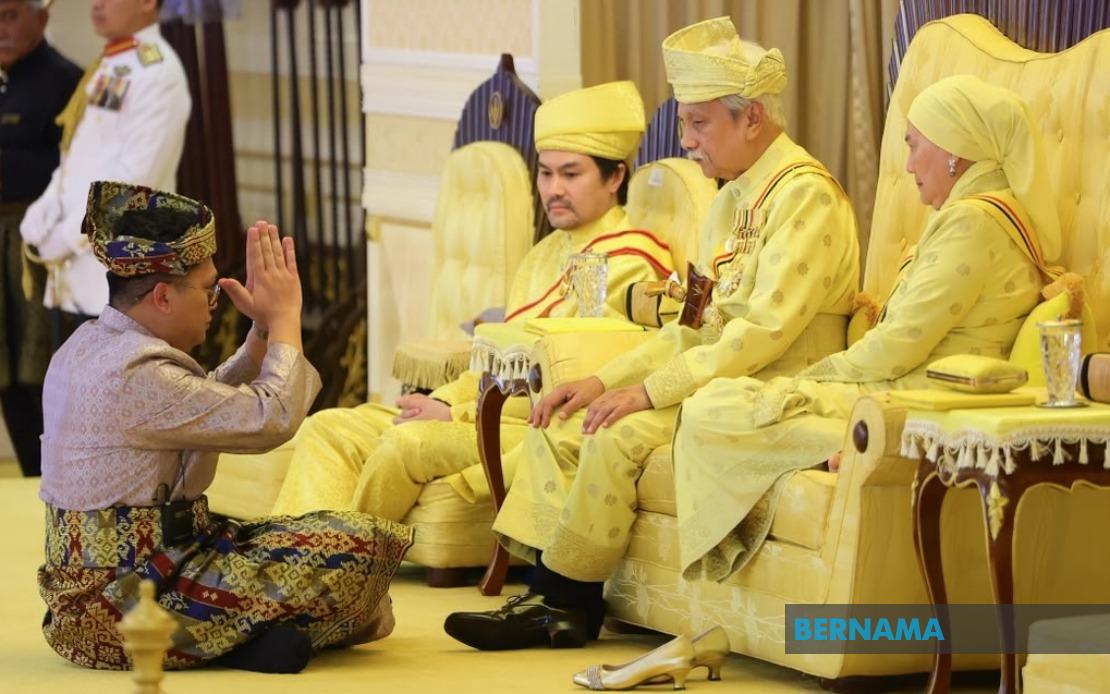
In a significant affirmation of institutional continuity within Negeri Sembilan's traditional governance structures, Tuanku Muhriz Tuanku Munawir, the Yang Dipertuan Besar of the state, formally installed Muhammad Faris Johari as the 11th Undang of Luak Sungei Ujong during a ceremonial investiture held at Istana Besar Seri Menanti on the morning of June 27. The appointment represents a meaningful moment in the state's constitutional framework, where the overlay of modern administration and customary leadership continues to shape regional identity and governance.
The installation ceremony followed traditional protocols deeply rooted in Negeri Sembilan's unique system of governance. Proceedings commenced with the Orang Empat Istana—the palace establishment's ceremonial representatives—formally seeking the ruler's permission to advance with the ritual. Following this formality, Muhammad Faris made a solemn pledge of allegiance to Tuanku Muhriz, establishing the legal and moral bonds expected of the newly elevated chief. The ruler then completed the formal investiture by publicly declaring Muhammad Faris as the 11th Undang and bestowing upon him the hereditary title Datuk Klana Petra, an honour tied to centuries of regional stewardship.
Tuanku Muhriz seized the occasion to emphasize the philosophical foundations underpinning both the monarchy and customary institutions. In his address, the Yang Dipertuan Besar stressed that the pledges exchanged during the ceremony must be upheld through genuine commitment, moral integrity, and an unwavering sense of public duty. The message carried particular resonance given contemporary discussions about institutional accountability and the role of traditional leadership in modern Malaysia. By reinforcing these values at the point of appointment, the ruler signalled that ceremonial position carries substantive responsibility.
Crucially, Tuanku Muhriz reminded the assembled Orang Kaya—the collective body of chieftains—to maintain steadfast loyalty to the institution of the Yang Dipertuan Besar and to foster respectful, collaborative relationships with the palace. This directive reflects broader concerns about preserving institutional coherence within systems that blend constitutional monarchy with customary authority. The admonition underscores a foundational principle: that Negeri Sembilan's distinctive administrative architecture depends upon mutual recognition and hierarchical respect among its various power structures. For regional observers, this emphasis illuminates how traditional Malaysia continues negotiating the balance between modern governance demands and heritage preservation.
The ruler further articulated a vision for state stability rooted in relationships built upon reciprocal respect, institutional trust, and genuine consensus-building. According to Tuanku Muhriz, these interpersonal and institutional foundations prove essential to preserving the constitutional monarchy's legitimacy, safeguarding customary traditions, and ensuring Negeri Sembilan's continued progress. This framing positions traditional leadership not as vestigial ceremony but as an active participant in the state's contemporary wellbeing—a perspective of particular relevance across Southeast Asia, where many nations grapple with integrating heritage institutions into modern governance frameworks.
The ceremony attracted notable attendees who collectively represent the apex of Negeri Sembilan's formal hierarchy. Present alongside Tuanku Muhriz were Tunku Ampuan Besar Tuanku Aishah Rohani Tengku Besar Mahmud, Tunku Besar Seri Menanti Tunku Ali Redhauddin Tuanku Muhriz, and Tunku Panglima Besar Tunku Zain Al-'Abidin. These figures embody the interlocking network of royal and hereditary authority that characterizes Negeri Sembilan's governance. Menteri Besar Datuk Seri Aminuddin Harun and senior state government officials also participated, signifying the continuity between customary and civil administrative structures. This attendance pattern demonstrates how formal recognition ceremonies serve to reinforce the institutional fabric binding various governing tiers.
Muhammad Faris himself brings professional credentials that reflect contemporary expectations for those assuming traditional leadership roles. The 28-year-old holds a bachelor's degree in accountancy from Universiti Teknologi MARA (UiTM) and obtained his professional qualification through the Association of Chartered Certified Accountants (ACCA) programme in 2022, demonstrating financial literacy and business acumen. He is married to Sharifah Amirah Syed Ismail Ash-Shahab. His profile—combining customary heritage entitlement with modern professional training—typifies an emerging pattern among Malaysia's traditional leadership, wherein younger appointees bring formal education and technical expertise to roles historically defined by genealogy and ceremonial function.
Tuanku Muhriz also called upon the broader Negeri Sembilan community to work in partnership with customary leadership whilst maintaining vigilance over Adat Perpatih—the distinctive matrilineal customary law system practised in the state. This appeal carries particular significance for Malaysian federalism, as Adat Perpatih represents a juridical and cultural alternative to the patrilineal systems dominant elsewhere. By encouraging its continued observance and transmission across generations, the Yang Dipertuan Besar positioned the state's traditional elite as custodians of a unique legal heritage. For constitutional scholars and policymakers, this reaffirmation highlights how Malaysian pluralism extends beyond religious and ethnic dimensions into customary legal frameworks requiring active institutional preservation.
The installation ceremony forms part of a broader sequence of formal appointments within Negeri Sembilan's nine-district system. According to the programme, a subsequent royal audience was scheduled for the same day to formalize the installation of the 22nd Undang of Luak Rembau, indicating that these ceremonial transitions occur systematically across the state's administrative subdivisions. This scheduling reflects the routine, if significant, nature of such appointments within Negeri Sembilan's governmental calendar. For those seeking to understand Malaysian governance in its full complexity, these ceremonies underscore how the federal system accommodates multiple overlapping institutional traditions, each with prescribed procedures and ceremonial significance.
For regional observers and Malaysian readers, Muhammad Faris's appointment exemplifies continuities and evolving expectations within Southeast Asia's traditional governance systems. As young, professionally qualified individuals increasingly assume roles historically reserved for elder statesmen, questions arise regarding how customary institutions adapt to contemporary demands for transparency, professional management, and evidence-based decision-making. Negeri Sembilan's model—integrating constitutional monarchy, hereditary chieftaincy, matrilineal customary law, and modern state administration—offers instructive lessons about institutional pluralism. The formal installation of Muhammad Faris Johari as the 11th Undang thus represents not merely a ceremonial transition but a moment illuminating how Malaysian federalism negotiates tradition, modernity, and institutional legitimacy.

