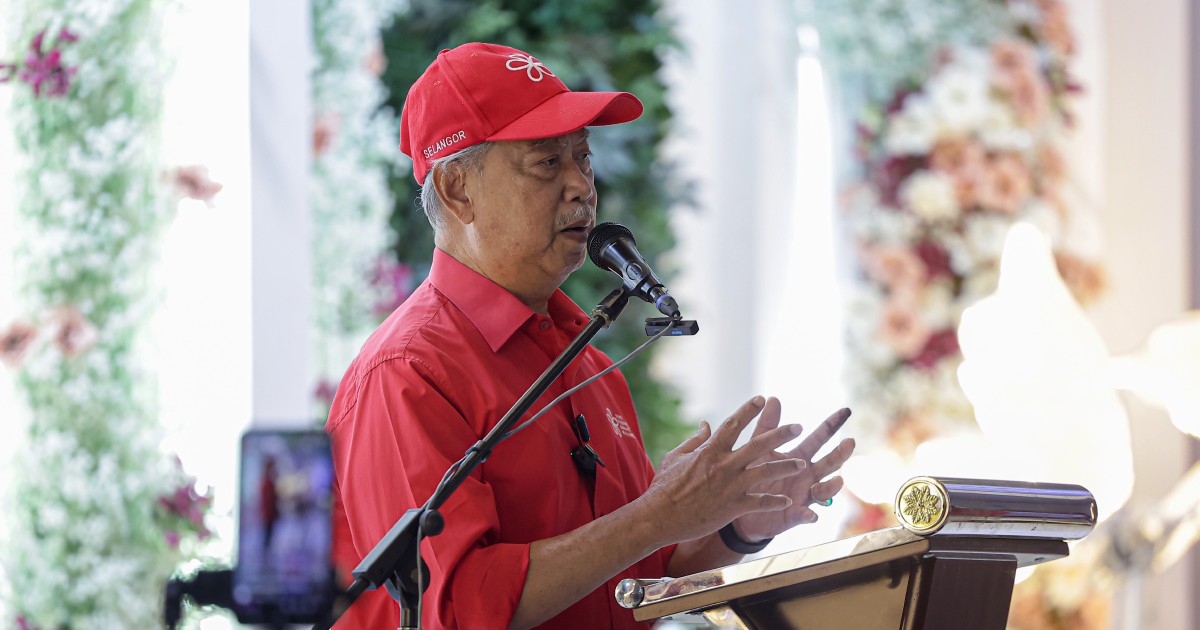
Tan Sri Muhyiddin Yassin, leading Bersatu into the Negri Sembilan state election, has pushed back firmly against suggestions from Umno circles that his party's independent participation represents a destabilising force in the contest. The Bersatu president's riposte to Datuk Seri Mohamed Khaled Nordin's "spoiler" characterisation underscores the festering tensions between the two Malay-Muslim parties as they compete for electoral space in the state.
Muhyiddin's decision to contest the election without coordinating with Umno—the traditional heavyweight in Negri Sembilan politics—marks a deliberate strategic departure. Rather than positioning Bersatu as a subordinate coalition member, the party is seeking to establish itself as a credible standalone political force capable of attracting voters directly. This approach stands in contrast to previous electoral arrangements where smaller parties have typically aligned under broader coalition umbrellas to maximise their combined electoral appeal.
The timing of Khaled's "spoiler" comment reveals the deeper anxiety within Umno circles about vote splitting in crucial Negri Sembilan constituencies. With Bersatu running parallel campaigns across multiple seats, there exists a genuine mathematical possibility that the combined opposition could fragment the ruling coalition's support base. Such fragmentation could theoretically allow Opposition candidates to prevail even without securing absolute majority backing—a scenario that explains Umno's evident discomfort with Bersatu's independent positioning.
Muhyiddin's rebuttal signals that Bersatu intends to contest aggressively rather than gracefully step aside. The party has invested considerable political capital in the state, fielded candidates across numerous constituencies, and mobilised its grassroots machinery. Backing down now would risk undermining party morale and signalling weakness to its supporters who have rallied behind the Bersatu banner specifically because of its independent political identity separate from Umno.
The friction between Bersatu and Umno reflects broader realignments within Malaysia's Malay-Muslim political ecosystem. Muhyiddin's party, which emerged from Umno's internal conflicts and represents a faction of Malay-Muslim voters disenchanted with Umno's traditional establishment, occupies an increasingly crowded political space. Both parties compete for identical demographic segments, making accommodation difficult without one party effectively conceding political ground to the other.
Negri Sembilan represents symbolically important terrain in this competition. Historically an Umno stronghold, the state has served as a bellwether for national political trends. If Bersatu demonstrates significant electoral traction here, it validates the party's claim to represent a viable alternative for Malay-Muslim voters. Conversely, if Bersatu fails to capture substantial support, it reinforces narratives that the party remains fundamentally dependent on coalition arrangements rather than commanding organic electoral appeal.
The "spoiler" accusation itself carries particular weight in Malaysian electoral politics, where first-past-the-post systems mean that even marginal vote transfers can determine outcomes. Umno's grievance rests on the assumption that Bersatu voters represent a subset that would naturally gravitate toward Umno in the absence of Bersatu candidacies. However, Muhyiddin would counter that Bersatu has cultivated its own distinct base of support drawn from voters seeking alternatives to Umno's brand of politics.
For Malaysian voters and regional observers, this contest illustrates ongoing fragmentation within the ruling coalition structure. The inability of Umno and Bersatu to coordinate—or their conscious choice not to do so—suggests that personal and factional rivalries continue to outweigh coalition solidarity. This dynamic ultimately complicates the electoral calculus and potentially creates openings for Opposition parties to capitalise on divided ruling-coalition support.
The Negri Sembilan election serves as a microcosm of Malaysian political volatility. Rather than cohesive political blocs competing along ideological lines, Malaysian elections increasingly feature intra-community competition between parties sharing similar demographic bases but divided by personality cults, factional allegiances, and competing visions of political direction. Muhyiddin's defiant response to Khaled's criticism exemplifies how these internal divisions play out in real time during election campaigns.
Looking forward, the results in Negri Sembilan will provide crucial data points about voter preferences regarding Bersatu versus Umno among Malay-Muslim constituencies. Should Bersatu perform respectably despite running against Umno, it would vindicate Muhyiddin's assertion that his party possesses independent electoral appeal rather than merely splitting votes that would otherwise automatically flow to Umno. Conversely, if Bersatu performs poorly while Umno loses ground, Khaled's "spoiler" argument would gain retrospective credibility.
The fundamental question underlying this confrontation concerns whether Malaysian electoral politics can sustain multiple competing parties within the Malay-Muslim demographic, or whether consolidation toward traditional power holders remains inevitable. Muhyiddin's defiance suggests he believes fragmentation is here to stay, and that Bersatu has established sufficient roots to thrive as a separate political entity rather than merely as a junior coalition partner.

