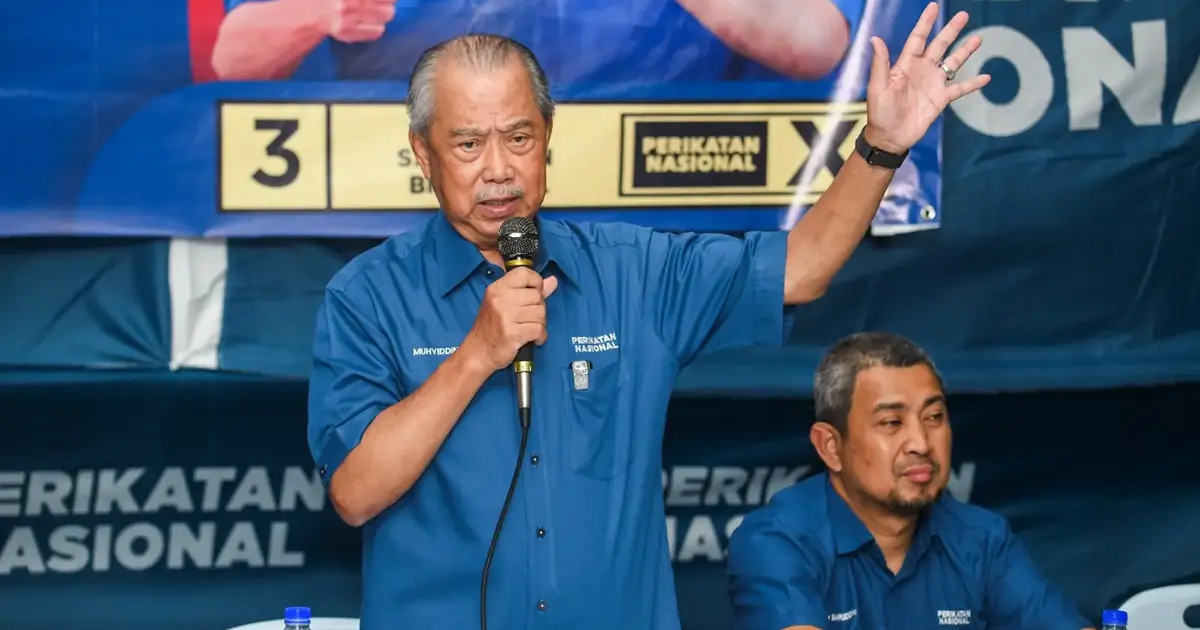
Tan Sri Muhyiddin Yassin has firmly rejected suggestions that any potential release of Najib Razak could be timed to coincide with a Johor state election, drawing a clear distinction between judicial and political processes. The Bersatu president's comments come amid widespread speculation about the former Prime Minister's status following conviction on charges related to the 1Malaysia Development Berhad scandal.
In his response to queries about the connection between Najib's case and electoral timing in Johor, Muhyiddin underscored a fundamental point: Najib Razak has been legally convicted by a court of law and remains subject to the criminal justice system. This conviction, which resulted in substantial prison time and substantial financial penalties, represents the culmination of a lengthy judicial process that captured national attention and dominated Malaysian political discourse for years.
The Bersatu leader's intervention into this debate signals the coalition government's desire to maintain distance from any perception of political interference in judicial matters. Such appearances would damage the government's credibility and undermine public confidence in the independence of Malaysia's courts at a time when institutional integrity remains crucial for national stability. By clarifying that electoral considerations bear no relevance to Najib's legal circumstances, Muhyiddin sought to establish clear boundaries between the political sphere and the judiciary.
The timing of Muhyiddin's remarks reflects broader sensitivities within the current political establishment regarding how the Najib saga is perceived domestically and internationally. Malaysia's recovery from the 1MDB scandal depends partly on demonstrating that the country possesses functional institutions capable of holding even the most powerful accountable. Any suggestion that electoral calculations could influence the treatment of convicted individuals would contradict that narrative and provide ammunition to those questioning whether Malaysia has genuinely reformed its governance standards.
The Johor state election, whenever it occurs, will be contested against a backdrop of national political realignment. The state has historically served as a crucial political battleground, and control over Johor carries significant implications for federal politics. However, Muhyiddin's intervention indicates that political calculations around this contest should not become entangled with questions about how the former Prime Minister's case is handled.
Najib Razak's legal journey represents one of the most consequential political trials in Malaysian history. The case against him encompassed serious allegations of financial impropriety and breach of fiduciary duty connected to the massive misappropriation at 1MDB. His conviction marked a rare instance of a former Prime Minister facing criminal consequences for alleged misconduct, a development that shaped perceptions of institutional accountability throughout Southeast Asia.
The distinction Muhyiddin drew between political events and judicial processes also reflects international expectations regarding Malaysia's governance. Foreign investors, diplomatic partners, and international observers have watched closely to see whether Malaysia would maintain judicial independence despite the immense political pressure surrounding such a high-profile case. Any perception that electoral considerations influence decisions affecting Najib's status could damage Malaysia's reputation for institutional governance.
Within the Johor context specifically, the state election will determine whether the coalition government retains control of this historically significant state. Johor's political orientation has often foreshadowed broader national trends, and electoral performance there carries implications for federal stability. By separating this electoral contest from the Najib narrative, Muhyiddin attempted to ensure that the election focuses on governance and development issues rather than becoming a referendum on how the government handles its predecessor's conviction.
The broader challenge for the Malaysian political establishment involves moving beyond the 1MDB era while ensuring that accountability mechanisms remain credible. Najib's conviction, whatever its ultimate judicial outcome, has already established precedent that even former heads of government can face criminal consequences. Preserving the integrity of that process requires clear demarcation between electoral strategy and judicial administration.
Muhyiddin's position also reflects internal coalition dynamics. Different political parties within the government coalition maintain varying positions on various issues, and managing these tensions while maintaining unified messaging on fundamental matters like judicial independence remains a constant challenge. His statement attempted to establish a position that all coalition partners could theoretically support without compromising their respective political interests.
For Malaysian citizens and regional observers, Muhyiddin's clarification serves an important function in reasserting the principle that courts and elections operate in separate spheres. While Malaysian politics has historically seen significant overlap between legal proceedings and political calculation, the current government's explicit rejection of any such linkage in the Najib case represents an attempt to strengthen institutional boundaries that underpin democratic governance.

