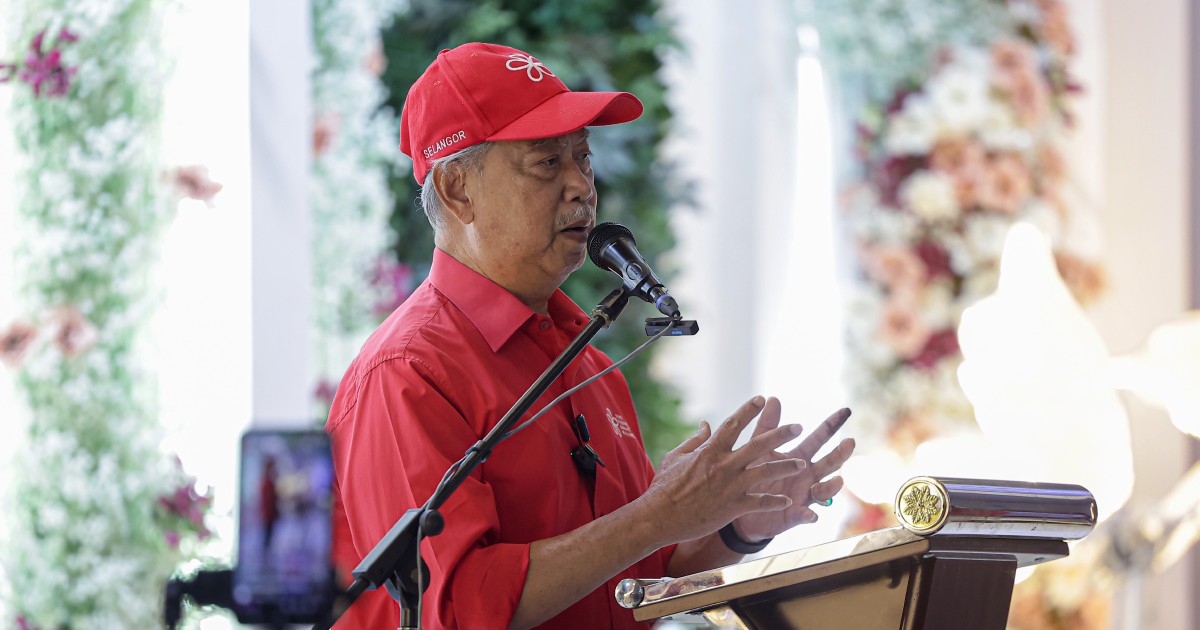
Tan Sri Muhyiddin Yassin, leading Bersatu, has responded sharply to criticism from within Malaysia's political establishment, taking issue with Umno vice-president Datuk Seri Mohamed Khaled Nordin's characterisation of his party's election strategy. Speaking in Seremban, the Bersatu president rejected the suggestion that his party's participation in the Negri Sembilan state contest represents a spoiling tactic, instead framing the move as a legitimate exercise of democratic choice.
The exchange underscores deepening tensions within Malaysia's coalition politics ahead of the Negri Sembilan state election, where multiple factions are vying for voter support. Khaled's use of the term "spoiler" reflects growing frustration among certain Umno circles about electoral competition from parties they view as ideological allies. His comments touch a nerve precisely because they suggest Bersatu's candidacy could fragment the Malay-Muslim voter bloc that both parties traditionally compete for.
Muhyiddin's rebuttal carries significance beyond rhetoric. Bersatu emerged from a faction of Umno and has maintained considerable overlap in its support base, particularly among Malay-majority constituencies. The party's decision to field candidates in Negri Sembilan signals confidence in its ability to mobilise voters independently, yet it simultaneously invites accusations that such contests merely divide opposition to Pakatan Harapan. This dynamic has become increasingly contentious as Malaysia's political landscape fragments further.
The timing of this exchange is strategically important. Negri Sembilan represents a critical test case for coalition mathematics in Malaysia. The state has traditionally been viewed as moderate political territory where multiple parties can vie for representation without necessarily producing a clear victor. If Bersatu performs strongly, it validates Muhyiddin's argument that his party commands genuine electoral support rather than merely cannibalising votes from Umno. Conversely, a weak showing would strengthen Khaled's implicit argument about the party's marginal status.
Bersatu's electoral strategy reflects the party's broader challenge since its formation in 2016. Positioned as a reformist alternative within Malay-Muslim politics, the party seeks to establish itself as distinct from Umno while remaining competitive in constituencies where Islamic values and Malay interests dominate political discourse. This positioning creates inevitable friction with Umno, which views such competition as illegitimate given the two parties' overlapping constituencies and shared ideological terrain.
Khaled's criticism also hints at broader frustrations within Umno about coalition fragmentation. Many senior Umno figures remain concerned that splitting the conservative vote enables Pakatan Harapan to capture seats that might otherwise fall to Umno or its allies. This perspective gained traction following the 2022 general election, where Malaysia's polarised political environment saw unexpected results in several states. The fear that multiple right-leaning parties competing simultaneously might inadvertently help left-leaning coalitions gain ground motivates such complaints.
Muhyiddin's response demonstrates his determination to assert Bersatu's independence and legitimacy as a political force. By publicly rejecting characterisations of his party as a spoiler, he reinforces the narrative that Bersatu represents a genuine political movement with its own mandate and policy direction, not merely a vehicle for dissident Umno politicians. This distinction matters for Bersatu's long-term viability and its ability to attract younger voters seeking alternatives to established parties.
The broader context for this dispute involves the ongoing realignment of Malaysia's political parties. Since 2020, when Muhyiddin served as Prime Minister, the political landscape has become increasingly fragmented, with multiple parties competing for the same voter demographics. This fragmentation creates unpredictable electoral outcomes and complicates coalition-building after elections. For states like Negri Sembilan, where no single party traditionally dominates, such competition can be particularly consequential.
For regional observers and Southeast Asian political analysts, the Negri Sembilan election offers insights into how established political systems respond to fragmentation. Malaysia's Westminster-derived parliamentary framework was designed for two-party or clear coalition competition, yet the country now operates with multiple parties pursuing overlapping agendas. The tensions between Bersatu and Umno illustrate how difficult such a transition has become, with accusations of spoiling reflecting deeper anxieties about whether Malaysia's democratic institutions can accommodate sustained multi-party competition.
The stakes for Muhyiddin personally are substantial. Bersatu's electoral performance across the country has been mixed since 2020, and a strong showing in Negri Sembilan would provide validation for his political strategy. Conversely, a disappointing result would strengthen narratives that he has become a political liability to conservative coalitions. This personal element adds weight to his sharp response to Khaled's criticism.
Looking ahead, how these tensions between Bersatu and Umno evolve will significantly influence Malaysia's political trajectory. Should Bersatu establish itself as a durable force capable of winning seats independently, Malaysia's political landscape will continue fragmenting. Alternatively, if Bersatu struggles at the ballot box, consolidation around larger parties may occur. The Negri Sembilan contest thus functions as an early indicator of which trajectory the country is following.

