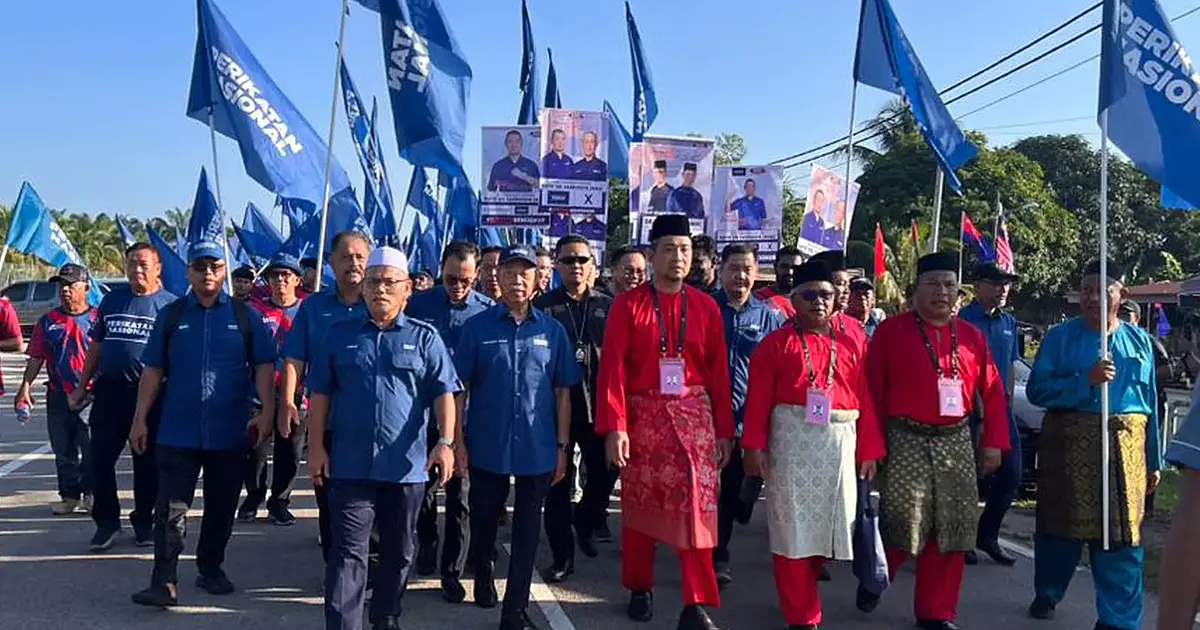
The Perikatan Nasional coalition demonstrated its organisational muscle in Bukit Kepong when party leaders, including Muhyiddin Yassin, accompanied hundreds of supporters in a show of solidarity for the coalition's candidate at the state assembly level. The mobilisation reflects the political stakes in this particular contest, where Dr Sahruddin Jamal is running under the Bersatu banner—a key component within the PN alliance.
Dr Sahruddin Jamal brings considerable legislative experience to his re-election campaign, having served two consecutive terms representing Bukit Kepong constituents. His track record suggests voter familiarity with his work in the state assembly, though his electoral prospects remain contingent on broader factors affecting PN's performance across the state. The decision by Muhyiddin to personally lead campaign efforts underscores the national leadership's confidence in both the candidate and the coalition's prospects in this seat.
The scale of supporter turnout hints at deeper organisational capacity within PN's grassroots machinery. Assembling hundreds of people for a campaign event requires substantial coordination across party divisions, membership networks, and allied organisations. For a coalition that has experienced internal tensions and electoral headwinds, such visible demonstrations of party unity carry symbolic importance in signalling cohesion to both party members and rival coalitions.
Bersatu's role as the standard-bearer in Bukit Kepong reflects the internal division of labour across PN's component parties. Within the broader coalition framework, different partners contest distinct seats, though tactical agreements often involve cross-party coordination and mutual support during campaigns. The choice to run Dr Sahruddin under Bersatu rather than another PN member-party suggests calculated seat allocation within the alliance structure.
Muhyiddin Yassin's personal involvement in state-level campaigns indicates the national leadership considers these assemblyman contests integral to the coalition's overall political standing. State seats collectively determine which coalition controls state government, making cumulative results across dozens of constituencies critically important for PN's strategic objectives in whichever state Bukit Kepong is located. Rather than treating assembly elections as secondary to parliamentary contests, PN leadership evidently prioritises building state-level strength.
The campaign event also functions as a recruitment and morale-building exercise for PN's volunteer base. Seeing senior national figures actively supporting local candidates encourages party workers to intensify ground-level activities such as door-to-door canvassing, voter registration drives, and community engagement. The visible commitment from leadership can translate into volunteer enthusiasm that ultimately affects election outcomes through repeated personal contact with voters.
Dr Sahruddin's incumbency advantage carries both benefits and vulnerabilities. As a sitting assemblyman, he possesses name recognition and an established network of community contacts developed through two terms of service. Conversely, he bears responsibility for his legislative voting record and the effectiveness of development projects delivered to constituents. Voters often apply stricter accountability standards to sitting candidates, evaluating whether promises made in previous campaigns materialised in concrete constituency benefits.
The rally also sends strategic messaging to rival coalitions contesting Bukit Kepong. By deploying substantial crowd numbers and senior leadership, PN signals its determination to defend or advance this seat. Such shows of force can influence voter psychology, as some electors tend to support parties perceived as strong and organised. Conversely, the spectacle provides opposition candidates with footage and narratives highlighting PN's campaign tactics for counter-messaging to voters concerned about party dominance or top-down politics.
For Malaysian politics more broadly, state-level elections determine the distribution of state government resources, influence over development allocations, and platforms from which state-level leaders launch drives toward national prominence. Control of multiple state governments strengthens a coalition's claims to national legitimacy and provides geographic bases for political recovery if national-level fortunes decline. Dr Sahruddin's re-election thus extends beyond local representation to affect the broader coalition power balance across the country.
The mobilisation reflects PN's apparent confidence in its voter appeal within this particular constituency, though such campaign shows do not guarantee electoral victory. Previous election cycles have shown surprise results where visible campaign strength failed to translate into anticipated margins. Voter sentiment, national political dynamics, local issues, and opposition campaign effectiveness ultimately determine outcomes that rallies alone cannot predetermine.
As polling day approaches in this electoral cycle, such campaign demonstrations will likely proliferate across both coalitions competing for assembly seats. These events serve multiple functions simultaneously—they motivate party workers, project strength to opponents, build media coverage, and physically connect voters with their candidates. For Dr Sahruddin, Muhyiddin's backing provides valuable national-level association that may influence undecided voters evaluating whether his re-election serves their interests.

