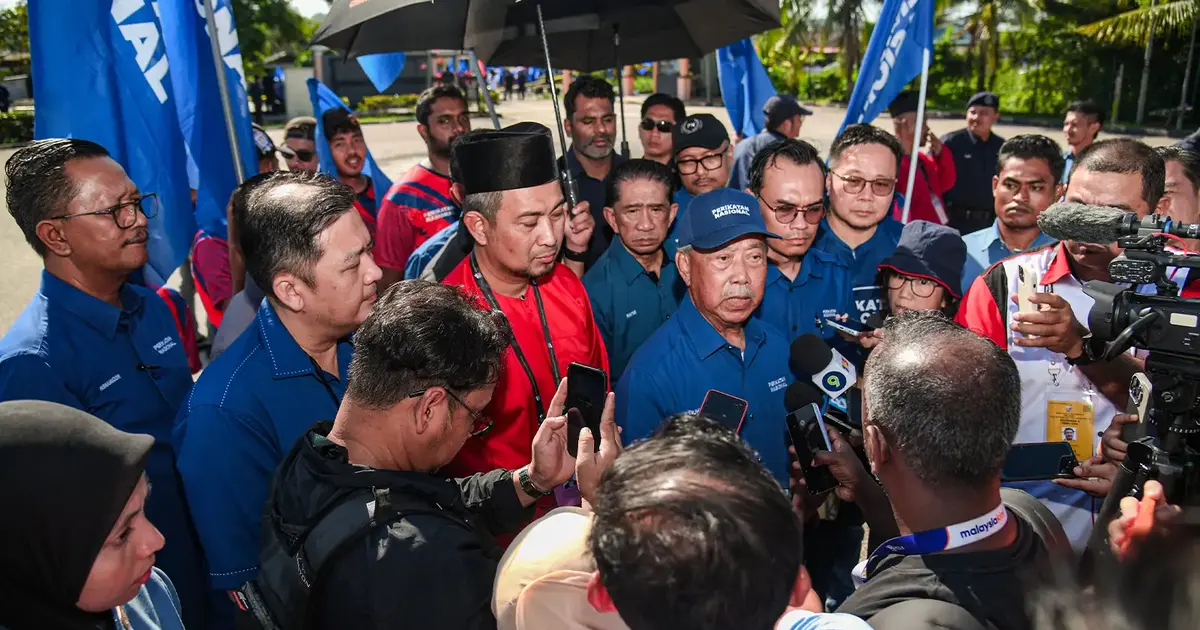
Perikatan Nasional possesses the political capacity to establish the next state government, according to Bersatu president Muhyiddin Yassin, who underscored the coalition's expanding network of parliamentary backers stretching beyond its formal membership. His remarks reflect growing confidence within the opposition alliance as it seeks to consolidate influence across Malaysia's varied political landscape, where state-level contests remain crucial battlegrounds for national relevance and resource control.
Muhyiddin's assertion gains significance given the fragmented nature of contemporary Malaysian politics, where no single coalition commands overwhelming dominance in all states. Perikatan Nasional has consolidated support among Malay-Muslim constituencies and maintains strongholds in several East Malaysian territories, yet faces persistent challenges in urban centres and mixed constituencies where other blocs retain substantial influence. The coalition's ability to translate national positioning into state-level governing majorities hinges on assembling diverse parliamentary partnerships that extend beyond traditional Bersatu, PAS, and Gerakan alignments.
The inclusion of Muda in Muhyiddin's strategic calculus represents a noteworthy development in Malaysia's coalition mathematics. The reform-oriented party, which emerged from internal Bersatu disputes and carries significant appeal among younger, urban voters, has maintained strategic flexibility in its parliamentary alliances. By signalling openness to cooperation with Muda outside formal coalition structures, Muhyiddin seeks to broaden Perikatan Nasional's appeal and address perceptions that the alliance primarily represents conservative, rural interests. This approach acknowledges demographic realities: successful governance requires bridging ideological divides and attracting support from constituencies beyond traditional opposition strongholds.
State governments in Malaysia control substantial resources through land administration, state finances, and regulatory authority over local matters, making them prized political assets. Whoever commands state assemblies directs development spending, contracts, and bureaucratic appointments—advantages that extend far beyond symbolic governance. For Perikatan Nasional, capturing additional state governments would strengthen its negotiating position in future national coalition discussions and demonstrate sustained electoral viability beyond its core base. Conversely, Muhyiddin's confidence statement serves notice to other coalitions and fence-sitting lawmakers that Perikatan Nasional remains a credible alternative government formation.
The coalition's current state government positions already provide foundation stones for expansion. In Kelantan, Terengganu, and Perak, Perikatan Nasional maintains assembly majorities and administrative experience. However, the path to additional state governments requires capturing seats in contests where competing coalitions hold sway, whether in Peninsular Malaysia's mixed constituencies or through complex negotiations in Sabah and Sarawak, where state politics operate under distinct electoral and constitutional frameworks. The flexibility that Muhyiddin emphasizes—particularly through potential alliances with external parties—acknowledges that rigid coalition constraints could prove counterproductive in diverse electoral contexts.
Muda's positioning reflects broader realignments occurring within opposition politics. Established in 2021 by former Bersatu Youth chief Syed Saddiq Syed Abdul Rahman, the party has attracted supporters dissatisfied with both Perikatan Nasional's Islamist inclinations and Pakatan Harapan's perceived centrism. While Muda holds fewer than a handful of parliamentary seats, its electoral performance in younger voter concentrations and its distinctive messaging around meritocracy and transparency give it outsized strategic value in close contests. Muhyiddin's acknowledgment of potential cooperation signals recognition that modern Malaysian coalition-building requires accommodation of ideologically diverse partners rather than monolithic structures.
The external alliance structure Muhyiddin describes carries both advantages and vulnerabilities. Loose coordination with sympathetic parties like Muda allows flexibility and avoids internal coalition tensions that could fracture unity. However, it also creates uncertainty about support reliability in close assembly votes, where independent members or loosely aligned lawmakers might shift allegiances based on inducements or changing political calculations. Malaysian state politics has witnessed numerous instances of assembly minority governments collapsing when external support evaporated or was withdrawn as leverage in larger political disputes.
Regional dynamics add another dimension to Perikatan Nasional's state government strategy. East Malaysian territories of Sabah and Sarawak operate semi-autonomous political systems where federal coalition affiliations matter less than local factional dynamics and personality-driven politics. Perikatan Nasional's presence in these regions depends heavily on provincial allies and indigenous-based parties rather than unified national operations. Muhyiddin's confidence necessarily encompasses success in these complex environments, where winning additional state governments would represent significant breakthroughs.
For Malaysian voters and observers, Muhyiddin's statement reflects the fluid nature of national politics following the 2022 general election, which produced a Perikatan Nasional surge and reconfigured parliamentary composition. The coalition's ability to translate parliamentary arithmetic into state government control tests its organizational capacity, leadership credibility, and ability to negotiate cross-cutting interests. As Malaysia approaches potential state elections in various jurisdictions, the coalition's performance will indicate whether current polling advantages and rural support translate into sustained administrative control and policy implementation capability that justifies Muhyiddin's expressed confidence.

