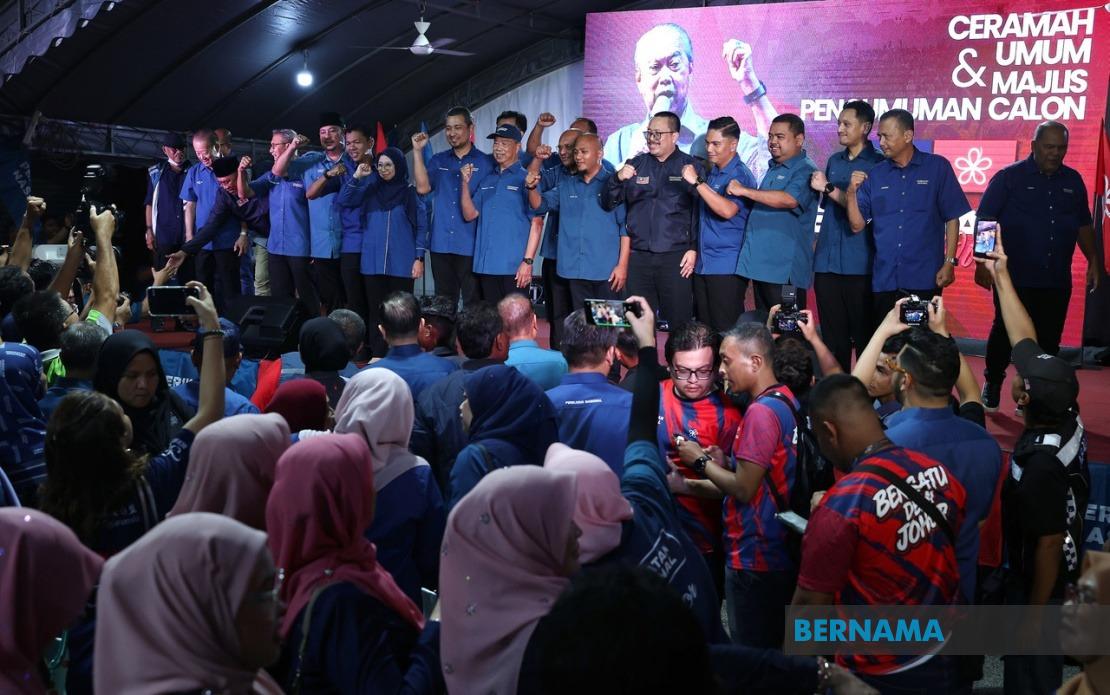
Tan Sri Muhyiddin Yassin, president of Parti Pribumi Bersatu Malaysia, formally unveiled the party's complete roster of 16 candidates for the forthcoming Johor State Election during a packed event at the Pagoh Parliamentary Service Centre in Taman Pagoh Jaya. The announcement ceremony, which doubled as a public ceramah to energise supporters and introduce the candidates to voters, signals Bersatu's determined push to retain and expand its foothold in the southern state, where it has emerged as a significant political force in recent years.
The 16th Johor State Election represents a crucial test for the Perikatan Nasional coalition and Bersatu's standing within the broader political landscape. Following the dissolution of the Johor State Assembly on June 1, the Election Commission set June 27 as the nomination day, giving candidates just over a week to file their papers before the official campaign season begins in earnest. Polling is scheduled for July 11, a compressed timeline that requires all competing parties to mobilise their machinery rapidly and execute focused ground operations across their respective constituencies.
Among the candidates announced was Mohd Idzharruddin Mohd Nasirruddin, who will contest the N8 Bukit Pasir seat. This constituency, located in the Pagoh parliamentary area, has traditionally been competitive terrain where each election cycle brings shifts in voter preferences. Bersatu's decision to field seasoned or strategically positioned candidates reflects the party's assessment of which seats offer the strongest prospects for victory within an increasingly fragmented electoral environment.
Bersatu's performance in Johor carries significance beyond the state itself. The party's trajectory in peninsular Malaysia's largest state by land area has implications for the broader stability of the Perikatan Nasional coalition government at federal level. A strong showing would reinforce Muhyiddin's standing as a national political figure and validate the coalition's governance model, while a disappointing result could invite internal questioning about party strategy and positioning.
The timing of these elections also intersects with broader currents in Malaysian politics. Johor has historically been a barometer of sentiment in the more developed, urbanised portions of Malaysia's west coast, with results often reflecting wider national trends. Voters in constituencies ranging from semi-rural Bukit Pasir to suburban areas around Johor Bahru will be assessing not only local issues but also their confidence in federal policies and the Perikatan coalition's overall direction.
Bersatu entered the Johor political arena as a relative newcomer compared to established parties like UMNO and DAP, yet has accumulated a meaningful presence through defections and electoral gains. The party's 16-seat slate represents either a consolidation of existing strength or, potentially, an ambitious expansion strategy depending on its prior representation. Either way, the announcement reflects Bersatu's commitment to contesting broadly rather than focusing narrowly on a handful of winnable seats, a posture that carries both organisational and financial implications.
The ceremonial and public relations aspects of the candidate announcement cannot be overlooked. By hosting a full-scale event with ceramah sessions, Bersatu sought to generate momentum, project unity, and demonstrate organisational capacity to supporters and the media. Such public events serve multiple purposes: they energise the party faithful, introduce candidates to constituents who may be unfamiliar with them, and generate news coverage that extends the party's message beyond paid advertising channels.
For voters in Johor, the availability of Bersatu as an alternative to UMNO, which has long dominated the state, offers a choice within the conservative-leaning political space. Bersatu's candidates will likely campaign on platforms emphasising stability, development, and effective administration, themes that resonate in a state conscious of its economic importance and infrastructure development. The party's federal coalition status also allows it to promise voters direct access to federal resources and decision-making.
The technical timeline—from June 27 nominations through the July 11 polling date—compresses the formal campaign window considerably. Malaysian state election campaigns typically last several weeks, allowing for sequential rounds of rallies, door-to-door canvassing, and media engagement. The compressed Johor schedule means candidates and party machinery must hit the ground immediately after nomination, prioritising high-traffic locations and community events to maximise voter contact within the available fortnight.
Bersatu's candidate selections will likely reflect a balance between incumbent advantage, factional considerations within the party, and strategic assessments of swing constituencies. The party's central leadership, alongside state-level branches, presumably weighed factors including incumbent performance, local community acceptance, and the likelihood of victory in each seat when finalising the list that Muhyiddin presented.
The Johor election comes amid a broader pattern of state-level electoral activity that has characterised Malaysian politics since the 2022 federal election. States with dissolved assemblies or expiring terms provide periodic opportunities for parties to test their positioning, refresh their messaging, and recalibrate their coalition arrangements. Results feed back into calculations about federal stability and future national elections, making state polls far more consequential than their local focus might suggest.
For Bersatu specifically, the Johor election offers a platform to demonstrate that the party remains a viable political force and credible coalition partner, rather than a vehicle dependent entirely on Muhyiddin's personal standing. The performance of these 16 candidates will shape perceptions about the party's durability and appeal to voters beyond its core base, factors that will influence both internal party dynamics and external coalition negotiations in the months ahead.

