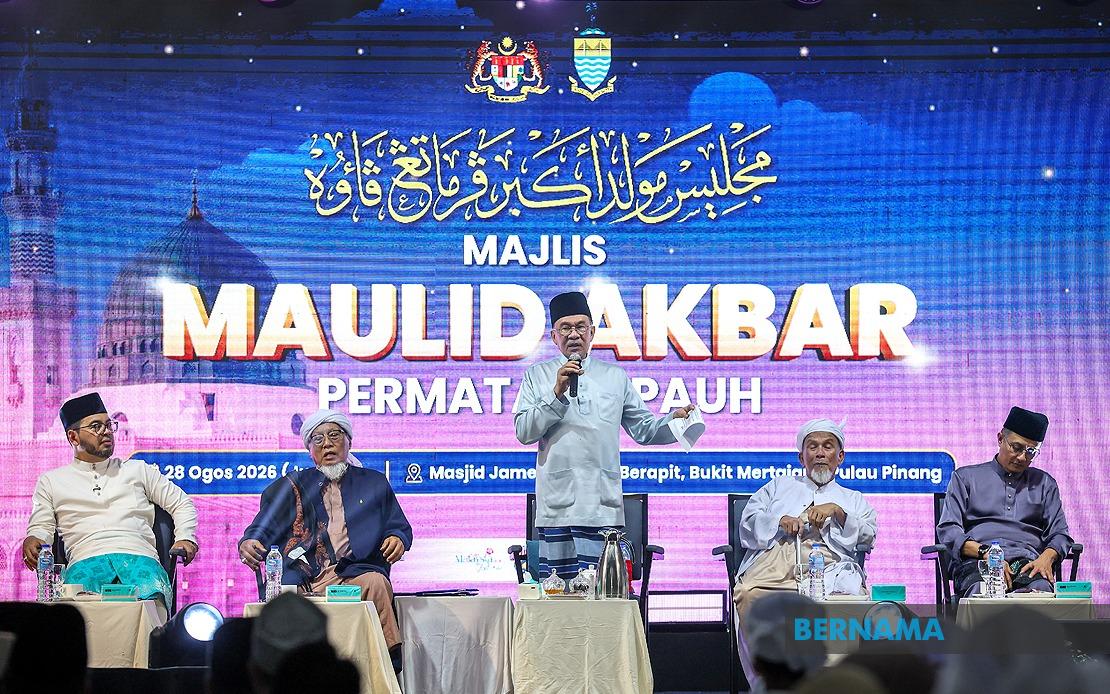
Prime Minister Datuk Seri Anwar Ibrahim has emphasised that Muslims must establish themselves as moral exemplars within society, contending that genuine respect flows from demonstrated virtue rather than religious identity alone. Addressing a gathering at Masjid Tengah in Bukit Mertajam during a Maulid Akbar ceremony coinciding with National Day celebrations, Anwar outlined a vision of Muslim leadership rooted in character and ethical conduct. The Prime Minister stressed that visible commitment to honesty, hard work and trustworthiness forms the foundation upon which community esteem is built, suggesting that external perceptions of Islam are ultimately shaped by the everyday behaviour of its adherents.
Anwar articulated a comprehensive framework encompassing multiple dimensions of personal conduct that he believes Muslims should cultivate. Beyond mere abstinence from corrupt practices, he emphasised the importance of diligence in professional and personal endeavours, reliability in honouring commitments, and responsible stewardship of positions entrusted to them. This multifaceted approach suggests recognition that moral leadership extends beyond avoiding wrongdoing to encompassing proactive demonstration of virtuous qualities. The Prime Minister's emphasis on visible behavioural change indicates an understanding that religious values gain credibility through consistent, observable application in real-world contexts rather than rhetorical assertion.
Central to Anwar's message is the assertion that Islam carries an inclusive spiritual and social mission transcending narrow communal boundaries. He articulated that Muslim communities bear responsibility for safeguarding not merely their own welfare but the broader social fabric encompassing all citizens regardless of religious or ethnic affiliation. This universalist interpretation of Islamic teaching carries significant implications for Malaysia's plural society, positioning Muslim-majority populations as custodians of collective national well-being. The articulation reflects evolving discourse within Malaysian political leadership regarding interfaith relations and the role of religious communities in pluralistic democratic governance.
The Prime Minister introduced the concept of balanced development as integral to Muslim exemplary conduct, suggesting that moral authority requires simultaneous cultivation of spiritual, intellectual, physical and material dimensions. Rather than portraying religious commitment as incompatible with modern economic pursuits or technological mastery, Anwar presented these elements as complementary components of holistic human development. This framework directly addresses historical tensions within Islamic discourse between secular modernisation and religious authenticity, proposing instead an integrative model where material progress and moral grounding reinforce rather than contradict each other.
Anwar's invocation of Malaysia MADANI as the overarching national development framework provides crucial context for understanding his ethical pronouncements. He contended that the success of this vision depends fundamentally on the spiritual and moral foundations undergirding policy implementation and economic strategy. The Prime Minister argued that technological advancement and GDP growth, while necessary, prove insufficient as standalone development indicators without corresponding enhancement of national character and ethical standards among both leaders and citizens. This positioning suggests that institutional excellence and economic competitiveness ultimately rest upon the moral quality of the human capital driving development.
The metaphor Anwar employed—remaining rooted in the earth while reaching for the sky—encapsulates his vision of development that refuses false choices between tradition and progress. He suggested that maintaining faith, morality and character constitutes the essential grounding preventing development from becoming untethered from foundational values. The imagery implicitly critiques models of modernisation that discard ethical frameworks in pursuit of technological and economic gains, arguing instead that authentic progress requires simultaneous advancement in material and moral registers.
Anwar's emphasis on consultation with Islamic scholars and the role of religious leadership in national governance reflects broader questions about institutional arrangements in Malaysia's Islamic governance structures. By stressing the importance of constructive advice from religious scholars and enhanced coordination between religious and political leaders, he acknowledged the particular authority that Islamic institutional knowledge carries within Muslim-majority contexts. This positioning suggests that effective governance in religiously diverse Malaysia requires genuine engagement with Islamic scholarly traditions rather than marginalisation or instrumentalisation of religious expertise.
The Prime Minister's remarks occur within Malaysia's ongoing process of defining the Malaysia MADANI vision, an initiative that carries significant symbolic importance for the current administration. Anwar's insistence that this development framework incorporate moral and spiritual dimensions indicates commitment to positioning Malaysia not merely as an economic competitor but as a model of values-based development. This ambition carries particular resonance across Southeast Asia, where several nations grapple with balancing rapid economic and technological transformation against concerns regarding social cohesion and cultural preservation.
For Malaysian readers and the broader Southeast Asian audience, Anwar's message carries implications extending beyond homiletic exhortation. His articulation of Muslim responsibility for demonstrating integrity and rejecting corruption directly addresses concerns that have plagued Malaysian governance institutions. By framing anti-corruption efforts as religious obligation rather than mere administrative requirement, he attempts to mobilise faith-based motivations toward institutional reform. The effectiveness of this approach will depend substantially on whether political and bureaucratic elites themselves visibly embody the standards Anwar articulated.
The presence of Dr Zulkifli Hasan, Minister in the Prime Minister's Department (Religious Affairs), signified governmental coordination around these themes. This administrative backing suggests intention to operationalise Anwar's ethical vision through institutional policy rather than leaving it as inspirational rhetoric. Whether such intentions translate into concrete mechanisms for promoting integrity within government structures and the private sector remains an open question requiring sustained observation of subsequent policy implementation.

