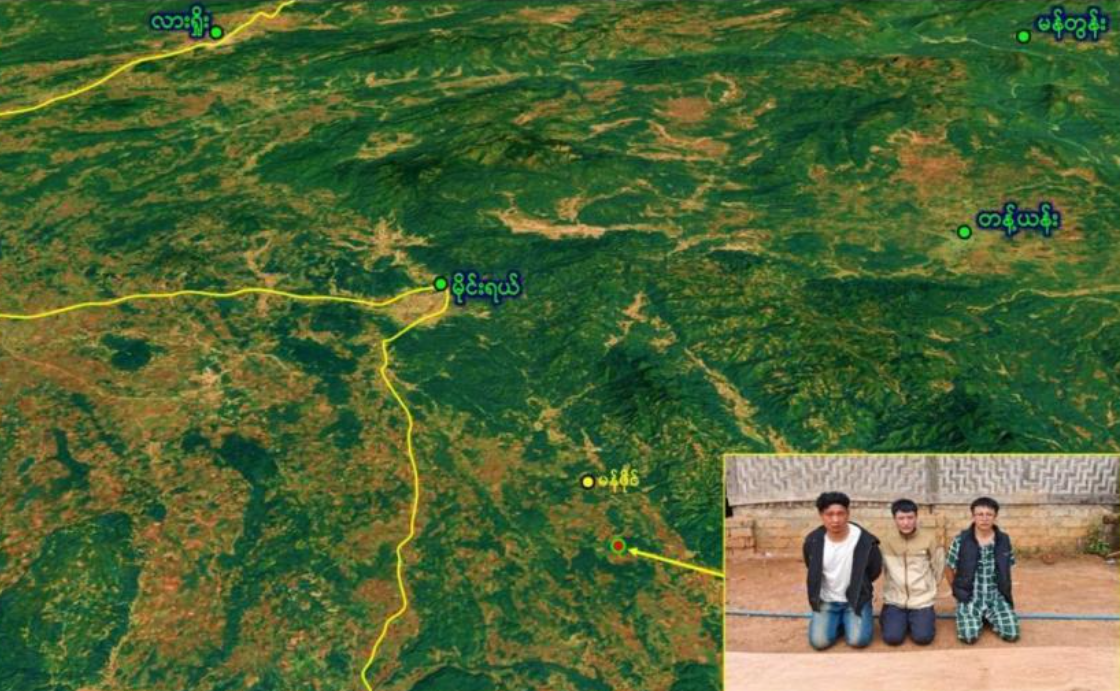
Myanmar's military has detained three Chinese nationals suspected of orchestrating an online scam gambling enterprise in Mongyai Township, located in the mountainous northern reaches of Shan State, marking another significant crackdown in the government's intensified campaign against cross-border cybercrime. The arrests, made on August 26 in a remote area approximately 26 kilometres southeast of Mongyai township and roughly 5 kilometres south of Manphai Village, represent part of a broader push by Naypyidaw to dismantle the networks of illicit online gambling operations that have proliferated across Myanmar's porous border regions.
Myanmar has elevated combating online scams and online gambling fraud to a matter of national importance, with security forces now systematically targeting these operations across the country. The strategy particularly focuses on border zones where such activities have flourished due to geographical isolation and limited law enforcement presence, though authorities have simultaneously expanded their efforts to identify and prosecute perpetrators operating within Myanmar's urban centres. This multifaceted approach reflects growing recognition among Myanmar's leadership that online scam gambling represents not merely a criminal issue but a threat to financial stability and social cohesion.
The breakthrough in Mongyai Township originated from intelligence provided by local residents who had observed suspicious individuals establishing makeshift accommodation in the area for conducting their illicit operations. These reports prompted security personnel to launch investigations that ultimately led to the military columns executing the operation that netted the three suspects. The reliance on community information underscores how remote rural areas, while geographically isolated, remain under informal surveillance by populations alert to unusual activities that disrupt their communities.
The three Chinese men had allegedly crossed into Myanmar illegally from the border, part of a pattern wherein foreign nationals exploit Myanmar's porous frontier with China to establish operation bases for conducting online fraud targeting customers throughout the region. Their choice of location in northern Shan State reflects a calculated decision to position themselves in an area where geographical remoteness and limited governmental infrastructure provide operational advantages, though such advantages have proven increasingly fragile as military awareness and interdiction efforts have grown more sophisticated.
The material seized during the raid reveals the technological sophistication required to sustain such operations at scale. Authorities recovered twenty-five mobile phones used for coordinating scams and managing customer interactions, five all-in-one computers serving as processing and analysis terminals, and two power stations providing the electrical capacity necessary to maintain continuous operations in areas lacking reliable grid infrastructure. A Starlink satellite communication device was also confiscated, indicating that the network deliberately invested in satellite-based internet to ensure operational continuity independent of terrestrial infrastructure that might be monitored or disrupted.
Beyond the electronic equipment, investigators documented the physical infrastructure the suspected fraudsters had constructed, including one primary corrugated iron-roofed structure measuring fifty by twenty feet with bamboo walls that served as a base of operations, complemented by five temporary tarpaulin shelters of varying dimensions that likely housed personnel and provided secondary operational spaces. The existence of multiple shelters suggests the operation was sufficiently established to require accommodation for several workers, indicating this was not a small-scale enterprise but rather an organised criminal venture with meaningful operational capacity.
Myanmar's authorities have committed to systematically dismantling and destroying all illegally constructed shelters associated with scam gambling enterprises, signalling a determination to eliminate the physical infrastructure that enables these operations. This approach extends beyond merely arresting individuals to target the territorial establishment of criminal networks, making it substantially more difficult for replacement operations to quickly reconstitute themselves following disruptions. The strategy acknowledges that preventing online scam gambling from gaining renewed footholds requires not just enforcement against perpetrators but destruction of the ground-based facilities that support them.
The detained suspects now face prosecution under Myanmar's existing legal framework following completion of interrogation and investigation procedures. The severity of potential charges remains unclear from available reports, though Myanmar has progressively strengthened penalties for online fraud and gambling-related offences as part of its national response strategy. The seizure of equipment will be processed according to established governmental procedures, with devices likely retained as evidence pending adjudication.
For the broader Southeast Asian region, Myanmar's operations against border-based online scam operations carry significant implications. These networks frequently target victims across multiple countries, with operators using Myanmar's geographic position and relative regulatory permissiveness to conduct fraud operations targeting populations throughout Thailand, Laos, Cambodia, and beyond. Each disruption to these operations reduces the capacity of criminal networks to generate revenue and coordinate activities, contributing incrementally to regional efforts to combat transnational cybercrime that has become increasingly sophisticated and difficult to track.
The persistence of these operations despite escalating enforcement efforts suggests that the economic incentives driving participation remain substantial, likely reflecting significant profit margins that continue attracting new entrants and enabling replacement networks to establish operations following disruptions. Myanmar's challenge therefore extends beyond tactical law enforcement success to addressing the underlying conditions that make border regions attractive bases for criminal enterprises, a task requiring sustained commitment across multiple governmental agencies and potentially cooperative efforts with neighbouring nations sharing interest in stemming cross-border criminal activity.

