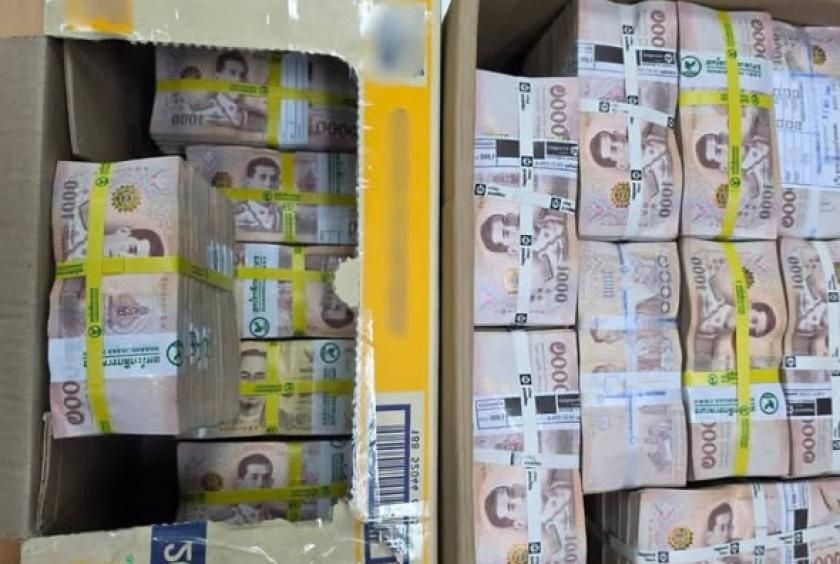
Thai authorities have arrested a Myanmar national suspected of attempting to smuggle more than 23 million baht out of Thailand through the Mae Sai border checkpoint on the Thai-Myanmar Friendship Bridge. The 31-year-old driver's vehicle, bearing Myanmar licence plates, triggered a routine inspection by customs officials that uncovered one of the region's more substantial currency seizures in recent months. The discovery highlights the persistent challenge of illegal money movements across Southeast Asia's porous borders, where significant sums continue to be transported through creative concealment methods despite heightened security measures.
The arrest occurred when customs personnel at the Mae Sai crossing, one of Thailand's busiest land borders, stopped the private vehicle for a standard inspection as it traversed the Friendship Bridge. What began as routine protocol evolved into a major interdiction when officials examined the cargo more closely. Inside cartons ostensibly containing dried fish and potatoes, inspectors found bundled Thai currency carefully packed in plastic bags and layered within the food products, a technique designed to obscure the contraband from casual observation or basic scanning procedures.
The seized amount totalled 23.023 million baht, comprising approximately 17 million baht discovered in the first carton and an additional 6.023 million baht in the second. All of the currency consisted of 1,000-baht banknotes, suggesting a deliberate selection of higher denominations to maximise the value-to-weight ratio of the shipment. This methodical approach indicates either prior planning or experience with border smuggling operations, raising questions about whether the suspect was acting as a courier for larger networks rather than operating independently.
The enforcement action represents a clear violation of Thailand's Customs Act, which prohibits the unauthorised transport of currency across international boundaries. Additionally, Thai authorities have invoked the nation's foreign exchange control regulations, which strictly govern the movement of Thai currency outside Thai territory. Thailand's regulations on foreign exchange exist partly to prevent capital flight and maintain monetary stability, particularly during periods of economic uncertainty or currency pressure. The case underscores how border enforcement agencies must balance trade facilitation with security priorities, especially at high-volume crossing points where thousands of vehicles transit daily.
The Mae Sai checkpoint, situated in Thailand's northernmost Chiang Rai province, processes substantial bilateral trade between Thailand and Myanmar. The location's geographic position and role in regional commerce make it strategically important but also attractive to smuggling operations. Customs officials at such crossing points operate under intense pressure to maintain efficient trade flows while simultaneously intercepting contraband, requiring a calibrated approach to inspection protocols that can identify suspicious shipments without creating bottlenecks that impede legitimate commerce.
For Malaysian readers and observers across Southeast Asia, this seizure reflects broader patterns of currency smuggling affecting the region's borders. The method employed—concealing cash within food products—remains surprisingly effective despite years of enforcement campaigns. Similar techniques have been documented at Malaysian border checkpoints and airports, where authorities regularly discover significant sums hidden in luggage compartments, clothing, or food items. The case serves as a reminder of the continued demand for illegal currency movement, driven by factors ranging from corruption and money laundering to tax evasion and capital flight.
The 31-year-old Myanmar driver is now in custody at Mae Sai Police Station facing formal charges under both customs and foreign exchange legislation. Thai authorities have indicated that investigations will expand beyond the arrested individual to identify associates, financiers, and any organisational structure supporting the smuggling attempt. Law enforcement officials often find that individual couriers represent merely the visible component of larger networks, with decision-makers and financial operators remaining several layers removed from border crossing points.
The investigation's expansion reflects standard procedure in Thai border enforcement, where authorities routinely pursue transnational aspects of smuggling cases. Identifying sources of the currency, intended recipients, and any connection to proceeds from illegal activities such as drug trafficking or human smuggling remains a priority. Thai-Myanmar border regions have historically grappled with multiple forms of trafficking, and currency smuggling frequently intersects with these more serious criminal enterprises.
This seizure arrives amid ongoing concerns about capital flight from Myanmar following the 2021 military coup and subsequent civil conflict. Many individuals and entities have sought to move assets out of Myanmar through various legal and illegal channels, creating demand for currency smuggling services. The presence of substantial Thai baht, rather than Myanmar kyat or international currencies, suggests either economic activity on the Thai side generating proceeds requiring repatriation, or deliberate selection of Thai currency for its relative stability and utility in regional financial networks.
Thailand's customs and law enforcement agencies have progressively upgraded detection capabilities at major border crossings, implementing scanner technology, intelligence-sharing protocols with neighbouring countries, and enhanced training for inspection personnel. Nevertheless, the volume of cross-border traffic and the ingenuity of smugglers continue to present operational challenges. The Mae Sai case demonstrates that despite improvements, significant contraband still reaches inspection points, requiring vigilant and consistent enforcement.
For regional financial stability and anti-money laundering efforts, this seizure holds relevance beyond Thailand's borders. Coordinated action among ASEAN member states to combat illicit financial flows strengthens overall regional security and economic integrity. Malaysia, as a significant financial hub, has particular interest in disrupting cross-border smuggling networks that may funnel proceeds through legitimate financial institutions or real estate markets. Information sharing among Thai, Malaysian, and Myanmar authorities regarding smuggling routes and methodologies enhances collective capacity to detect and prevent similar operations.
The case also highlights asymmetries in border enforcement capacity across the region. While Thai customs possesses resources to inspect vehicles systematically, enforcement on the Myanmar side of major crossing points remains inconsistent due to institutional challenges. This disparity can create opportunities for smugglers who exploit weaker points in bilateral enforcement architecture. Strengthening Myanmar's customs capacity through international assistance programmes represents a longer-term solution to this persistent vulnerability.

