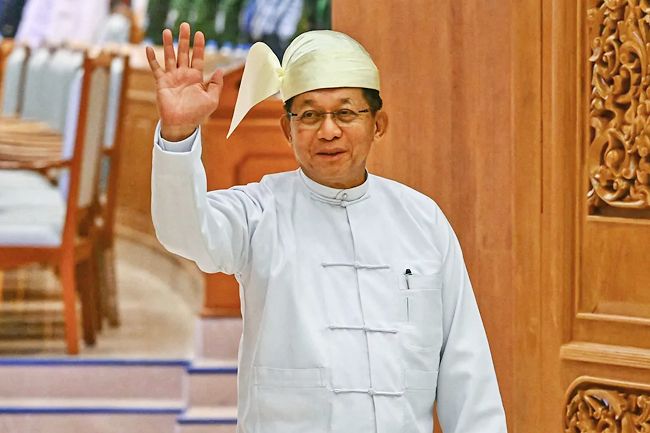
Myanmar's military leader Min Aung Hlaing is set to visit Bangkok next month for high-level discussions with Thai Prime Minister Anutin Charnvirakul on August 6 and 7, Thailand's foreign minister announced this week. The planned engagement signals a continued diplomatic push by Bangkok to maintain dialogue with its troubled neighbour, even as the junta remains ostracised from ASEAN's major forums following its 2021 coup that deposed elected leader Aung San Suu Kyi. Thailand's commitment to pursuing this bilateral channel reflects the complex balancing act Southeast Asian nations must perform when dealing with Myanmar's military administration.
Thailand's Foreign Minister Sihasak Phuangketkeow disclosed the upcoming visit after participating in what he characterised as candid and forthright discussions among ASEAN foreign ministers in Manila regarding how best to facilitate Myanmar's eventual return to full participation within the regional bloc. The conversation underscores the persistent challenge Myanmar presents to ASEAN consensus, with member states deeply divided over the pace and conditions for reengagement with a junta that many international observers view as having consolidated authoritarian control through electoral manipulation and the suppression of democratic movements.
Myanmar's formal exclusion from ASEAN's principal gatherings has created an awkward situation for the ten-nation association, which traditionally prides itself on the principle of non-interference in internal affairs while simultaneously maintaining diplomatic standards. The country technically retains its membership in ASEAN, yet its absence from substantive meetings reflects the diplomatic punishment meted out by fellow members in response to the military takeover. This arrangement has left Myanmar in a peculiar limbo—neither fully expelled nor fully engaged—that has complicated efforts to chart a coherent regional policy.
Tailand's geographic and humanitarian stakes in Myanmar's ongoing turmoil are substantial and make Bangkok's diplomatic efforts understandable despite criticism from democracy advocates. The kingdom shares an extensive border with Myanmar where civil conflict has created profound instability, and Thailand currently hosts millions of Burmese refugees fleeing violence and persecution. These factors have positioned Thailand as a natural interlocutor, yet also exposed it to criticism for appearing to normalise relations with a regime many view as illegitimate. Sihasak's willingness to pursue dialogue does not necessarily signal approval of the junta's actions but rather reflects Thailand's assessment that complete isolation serves neither humanitarian nor security interests.
Sihasak characterised the upcoming bilateral engagement as part of a "dual-track approach" that acknowledges the reality of Thailand's relationship with Myanmar while maintaining theoretical commitment to ASEAN's collective position. Under this framework, Bangkok intends to address immediate bilateral concerns including transnational criminal networks, online fraud operations, and drug trafficking—issues that directly affect Thai security and prosperity. These pragmatic considerations coexist with ASEAN's long-standing five-point peace plan, which calls for dialogue cessation, humanitarian access, and political reconciliation, though the foreign minister notably did not abandon that framework even while pursuing narrower bilateral interests.
Crucially, Sihasak introduced a more nuanced understanding of measuring progress in Myanmar, one that may signal shifting expectations among ASEAN members regarding what constitutes realistic benchmarks for the junta's behaviour. Rather than insisting on immediate, comprehensive political transformation, he posed questions about incremental improvements such as whether Min Aung Hlaing's government would grant ASEAN's special envoy access to detained leader Aung San Suu Kyi or whether violence along the Thai-Myanmar border might be reduced. This calibrated approach suggests that Thailand and potentially other ASEAN members are prepared to accept smaller gains rather than hold out for wholesale systemic change that appears unlikely in the near term.
The foreign minister's candid assertion that progress in Myanmar "is not going to happen overnight" and will instead come "incrementally" represents a significant acknowledgment of the limitations facing regional diplomacy. This measured perspective may provide political cover for continued engagement with the junta while offering modest incentives for behavioural improvements. However, it also risks creating the perception that ASEAN has gradually lowered its expectations and abandoned its professed commitment to democratic restoration, a concern that may resonate strongly across Southeast Asia where democracy advocates worry that geopolitical pragmatism is overwhelming principled stands.
Sihasak's suggestion that Thailand could facilitate dialogue between Myanmar's military government and armed ethnic groups along the border offers another dimension to Bangkok's diplomatic strategy. These ethnic armed organisations, which control significant territory and command substantial military forces, represent potential counterweights to junta authority and have expressed interest in political settlements. If Thailand can position itself as a broker between the military administration and these groups, it might generate diplomatic opportunities that serve regional stability while demonstrating that engagement with Myanmar produces tangible results that benefit the broader Southeast Asian community.
Parallel to Thailand's bilateral efforts, there are indications that ASEAN itself may restructure its approach to Myanmar policy. Philippine Foreign Minister Theresa Lazaro revealed that the bloc is considering appointing a permanent, long-term special envoy to Myanmar, acknowledging that the current system of yearly rotating representatives has proven ineffective. This potential institutional change suggests growing recognition among ASEAN members that Myanmar's complexity requires sustained, continuous diplomatic attention rather than the ad hoc engagement that has characterised recent years. A permanent envoy could develop deeper expertise and relationships while providing ASEAN with greater consistency in messaging and negotiating positions.
The timing of these diplomatic initiatives remains significant for Myanmar's broader trajectory. Min Aung Hlaing's installation as president following the junta-controlled elections suggests that the military leadership views its consolidation of power as sufficiently stable to permit controlled international engagement. The question of whether these meetings will genuinely open pathways to negotiations with democratic opposition elements or armed ethnic groups remains uncertain, and scepticism about the junta's willingness to share power with non-military actors remains widespread among analysts. For Malaysia and other ASEAN members watching from the sidelines, Thailand's diplomatic efforts serve as a test case for whether incremental engagement can eventually produce meaningful political change or whether it merely provides legitimacy to a regime firmly committed to indefinite military rule.

