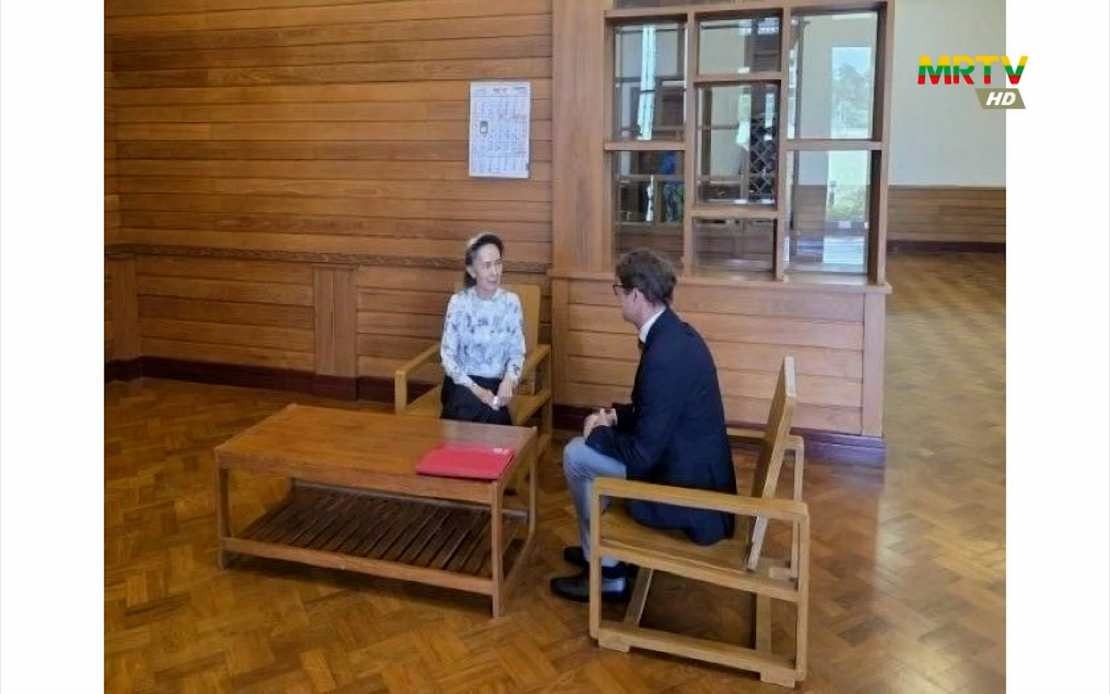
Myanmar's military-controlled government has released photographs documenting a meeting between detained former leader Aung San Suu Kyi and Arnaud de Baecque, the International Committee of the Red Cross representative to the country. The encounter, which took place in Naypyitaw on Monday, represents one of the few publicly confirmed interactions involving the 81-year-old political figure since she was removed from power during a military coup more than three years ago. Government spokeswoman Khine Khine Soe disclosed the meeting via Telegram, accompanied by four images showing Suu Kyi in traditional Burmese dress meeting with the ICRC official in a minimally appointed wooden-paneled room.
The photographs carry significant diplomatic weight given the international scrutiny surrounding Suu Kyi's imprisonment and the secretive nature of her detention. One image captures a rare view of what appears to be her residence, showing her cutting a birthday cake inscribed with her name. A fourth photograph displays the cake more closely, bearing the inscription "Happy Birthday Aunty Suu 19.6.2026". However, Reuters was unable to independently verify either the location where these photographs were taken or their precise dating, finding no earlier versions published online before the government's release on Monday. The ICRC has not yet commented publicly on the meeting or its outcomes.
Suu Kyi's detention stems directly from the military takeover in February 2021, which dissolved the elected civilian government she led and thrust Myanmar into profound instability. Over the intervening years, her exact location and physical condition have remained largely opaque to international observers, creating persistent concerns about her well-being among family members, supporters, and regional governments alike. No foreign dignitary or international envoy has been permitted to meet her publicly until this ICRC visit, making Monday's encounter a notable if limited breach in the military administration's isolation of the former leader.
The background to her imprisonment involves an extensive series of closed-door trials that concluded with convictions on multiple charges, including corruption allegations, election fraud incitement, and violations of state secrecy laws. The original sentence of 33 years was subsequently reduced to 27 years, and further shortened by one-sixth in April, leaving Suu Kyi with approximately 18 years remaining to serve according to her legal team. Her supporters and international observers have consistently characterized these charges as politically motivated, designed specifically to neutralize her influence as arguably Myanmar's most popular political figure among the nation's 51 million population.
Concerns about her health have intensified given her age and the conditions of her confinement. In December, her son Kim Aris revealed to Reuters that he possessed minimal information about his mother's well-being, obtaining only infrequent and indirect reports regarding her heart, bone, and gum complications. He disclosed that years had passed without direct communication with Suu Kyi, raising fears that she might pass away without his knowledge. These anxieties have been compounded by the military administration's consistent but unverified assertions that Suu Kyi remains in "good health", statements that grow increasingly difficult for international observers to accept without independent confirmation.
In late April, following a carefully orchestrated military-controlled election that elevated former junta chief Min Aung Hlaing to the presidency, the authorities claimed to have relocated Suu Kyi to house arrest. This announcement represented a shift in her detention status but provided no meaningful access to independent monitors. The move occurred amid mounting regional diplomatic pressure regarding her circumstances. During an ASEAN foreign ministers gathering in Bangkok last month, Thai Foreign Minister Sihasak Phuangketkeow explicitly called for international access to Suu Kyi, framing such contact as essential for verifying the military government's claims about her health status. His statement reflected growing consensus within Southeast Asian capitals that verification required direct observation rather than government assertions.
The Philippine government took this pressure further in May, formally requesting that the military authorities permit an ASEAN special envoy to visit Suu Kyi. The military-backed administration has thus far declined such proposals, maintaining its restrictive stance toward foreign access. This reluctance suggests that the Monday meeting with the ICRC representative, while symbolically important, may represent a carefully controlled concession designed to deflect international criticism without genuinely opening avenues for independent assessment of her condition or detention circumstances.
Suu Kyi's political significance within Myanmar extends beyond her recent three-year imprisonment. As the daughter of General Aung San, the independence hero who led Myanmar's struggle against British colonial rule, she carries immense symbolic weight in the nation's historical consciousness. During the previous junta period, she endured 15 years of house arrest at her family residence on Yangon's Inya Lake, where she became an iconic figure delivering passionate speeches to supporters gathered outside the property's metal gates. Her current detention, therefore, represents not merely the imprisonment of a political opponent but the subjugation of a figure deeply embedded in Myanmar's national narrative and democratic aspirations.
For Malaysian and Southeast Asian observers, Suu Kyi's situation encapsulates broader regional anxieties about democratic backsliding and military assertiveness in the post-Cold War era. Myanmar's 2021 coup shattered optimism that the country was progressing toward institutional democratic consolidation. The treatment of Suu Kyi has become emblematic of the military regime's disregard for civilian political authority and its determination to eliminate potential rivals through juridical processes widely perceived as orchestrated. The international response, including ASEAN diplomatic initiatives, reflects the bloc's struggle to balance non-interference principles with humanitarian and governance concerns that increasingly affect regional stability and credibility.
The release of photographs on Monday should be examined within this diplomatic context. Rather than representing a genuine opening toward transparency, the move likely constitutes a tactical response to mounting international pressure while maintaining fundamental control over information flows. The deliberate framing of Suu Kyi in what appears to be reasonable living conditions, combined with the birthday cake imagery suggesting a degree of normalcy, serves to counter persistent narrative of harsh treatment without permitting the independent verification that regional governments have requested. The ICRC's silence on the meeting's substance and any findings further underscores the limitations of even humanitarian organizations' access within Myanmar's current political environment.
Looking forward, the Suu Kyi case will likely remain a focal point for regional diplomatic engagement, particularly as ASEAN member states navigate the tension between respecting Myanmar's sovereignty and expressing concern for democratic principles and human rights. The fact that an ICRC visit required government orchestration and photograph release, rather than occurring with genuine independence and follow-up access, illustrates how thoroughly the military regime controls narratives around its detained critics. For Malaysia and other regional democracies, the situation underscores the fragility of democratic institutions in the face of coordinated military action and serves as a cautionary reminder about the ease with which democratic gains can be reversed without sustained international attention and pressure.

