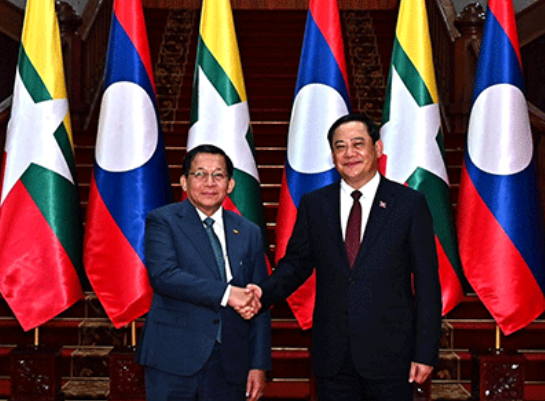
Myanmar President Min Aung Hlaing's July 3-5 state visit to Laos represented a carefully timed diplomatic gesture, arriving as the two neighbours marked seven decades of formal relations. The three-day engagement saw senior leadership from across Laos's political establishment welcome the Myanmar delegation with ceremonial honours at the Presidential Palace in Vientiane, signalling the strategic importance both capitals attach to maintaining this relationship during a period of significant regional flux.
The visit carried particular weight given Myanmar's recent internal political transformation. President Thongloun Sisoulith explicitly congratulated Myanmar on conducting general elections and forming a new government, framing Min Aung Hlaing's presidency as continuity that would drive progress. This diplomatic language masked a more complex reality: the relationship between these two impoverished, landlocked nations has historically served as a stabilising anchor amid periodic regional turbulence, with Laos demonstrating consistent support for Myanmar's sovereignty and development aspirations.
At the core of the three-day programme lay substantive discussions between Myanmar and Laos's top leadership tiers. Beyond the formal presidential talks between Thongloun and Min Aung Hlaing, Prime Minister Sonexay Siphandone and National Assembly President Xaysomphone Phomvihane each met separately with the Myanmar leader. This multi-level engagement format underscored that cooperation transcends individual personalities or single government portfolios, instead reflecting institutional commitments across executive, diplomatic and legislative branches. The breadth of these interactions suggests both nations view their partnership as resilient and comprehensive.
The tangible outputs from the visit included two cooperation memorandums that address immediate, practical concerns. A tourism cooperation agreement between Laos's Ministry of Culture and Tourism and Myanmar's Ministry of Hotels, Tourism and Culture seeks to facilitate visitor flows and perhaps encourage regional tourism circuits combining both nations. Separately, Vientiane and Naypyidaw formalised "friendship city" relations, a symbolic gesture that nonetheless provides administrative frameworks for cultural and commercial exchange at municipal level. These instruments matter because they translate high-level political goodwill into actionable channels where officials and business actors can operate.
Defence and security cooperation featured prominently in the communiqués, with both sides identifying border security, information sharing and cross-border coordination as priority areas. For landlocked Laos, a stable western frontier with Myanmar—itself bordered by Thailand—forms a crucial component of national security architecture. Myanmar similarly benefits from predictable relations with its eastern neighbour, avoiding the kind of bilateral friction that could invite external interference or complicate its own governance challenges. The emphasis on border management and information exchange acknowledges shared threats ranging from smuggling networks to organised crime.
The two nations identified the Mekong-Lancang Cooperation framework, Asean, and United Nations forums as appropriate venues for deepened collaboration. This positioning reflects a deliberate strategy to embed bilateral ties within multilateral institutions, thereby insulating the relationship from purely bilateral shocks or leadership changes. For Malaysia and other regional states, this approach suggests that Laos and Myanmar—despite their economic constraints and limited military capabilities—are consciously building diplomatic depth that leverages existing regional architecture rather than creating parallel arrangements.
Cross-border air pollution emerged as a named priority, indicating that both nations recognise environmental degradation as a transnational challenge requiring coordinated response. Seasonal haze from agricultural burning and industrial emissions affects air quality across the region, and formalising cooperation on this issue acknowledges scientific reality while creating political mechanisms to address it. This dimension of the visit reflected growing Southeast Asian acknowledgement that environmental governance cannot remain confined within national boundaries.
Trade, investment, transport and energy cooperation formed another pillar of discussions, reflecting both nations' development imperatives. Laos, dependent on hydropower exports and Chinese investment in infrastructure projects, views expanded commercial ties with Myanmar as diversification of economic partnerships. Myanmar similarly seeks to expand regional trade links beyond traditional partners. The invocation of these sectors suggests both capitals recognise that sustained bilateral relations require measurable economic benefit, not merely political rhetoric or historical sentiment.
Xaysomphone's observation that Laos constituted Min Aung Hlaing's first Asean member state visit for official foreign engagement carried diplomatic significance. This sequencing choice placed Laos as Myanmar's chosen entry point into Southeast Asian institutional diplomacy, reflecting the comfort and confidence both nations share. For other Asean members, particularly Thailand which shares borders with both countries, this visit signalled that the Myanmar-Laos axis remains functionally coherent despite regional uncertainties.
The ceremonial elements—wreath-laying at the Unknown Soldier Monument, attendance at a traditional Baci ceremony, and participation in an official state banquet—reinforced historical and cultural commonalities binding the two Buddhist-majority, Lao-speaking societies. These rituals matter in Southeast Asian diplomacy because they communicate respect for shared heritage and tacit acknowledgement of deeper civilisational bonds transcending modern state boundaries. The scheduling of temple tours and cultural visits to Luang Prabang during the delegation's onward journey to the UNESCO World Heritage city similarly emphasised people-to-people connections and cultural appreciation.
The handover of snake antivenom serum to Laos's Ministry of Health constituted a practical humanitarian gesture, addressing a genuine public health need in a region where snake encounters pose genuine risks to rural populations. This transfer exemplified the type of low-profile, technical cooperation that often sustains bilateral relationships more reliably than grand political declarations. Such medical partnerships create ongoing institutional linkages between health bureaucracies and generate positive sentiment among affected populations.
For Southeast Asian observers, the Myanmar-Laos visit demonstrated that despite global attention on Myanmar's internal challenges and regional security concerns, the nation remains actively engaged in calibrated diplomacy with immediate neighbours. The visit's emphasis on strengthening existing cooperation frameworks rather than announcing transformative initiatives suggested both nations recognise the value of stability and predictability in their relationship. The formal affirmations of mutual respect, trust and non-interference reflected a diplomatic vocabulary carefully constructed to maintain workable relations despite occasional underlying tensions or divergent interests on specific regional questions.
The three-day engagement ultimately represented a successful diplomatic exercise in consolidating existing relationships rather than reshaping fundamental regional alignments. For Malaysian observers tracking developments in the broader Asean neighbourhood, the visit confirmed that Laos and Myanmar continue prioritising bilateral stability, institutional cooperation and measured economic engagement—providing a counterbalance to more volatile geopolitical currents affecting the region.

