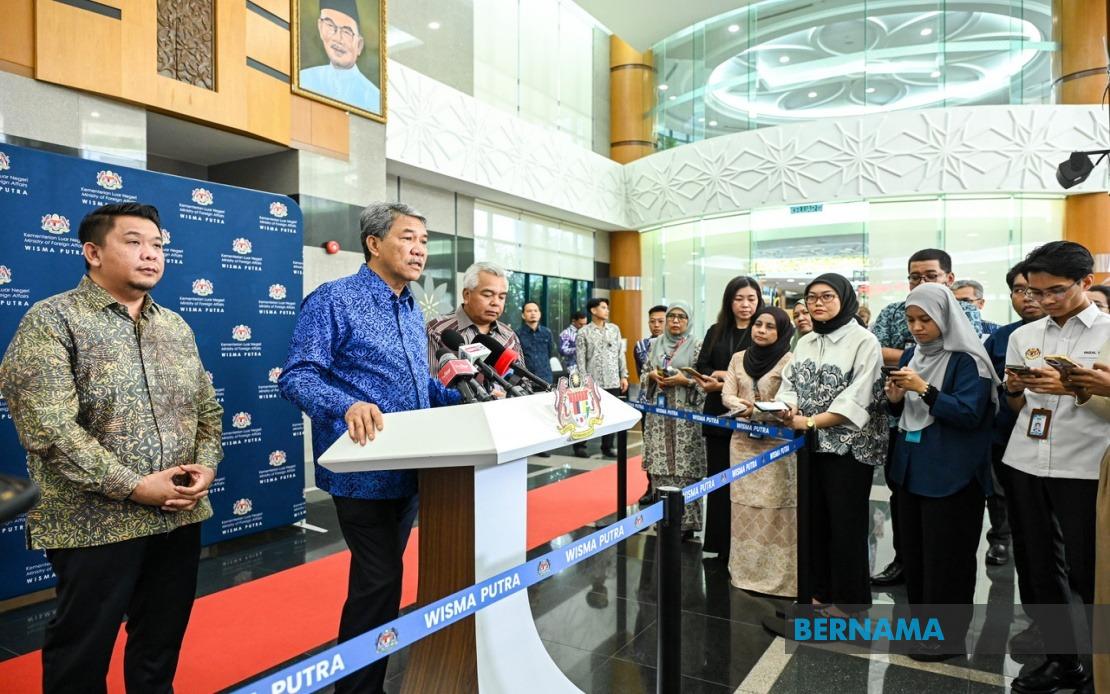
Malaysia's Foreign Minister Datuk Seri Mohamad Hasan revealed that Myanmar has signalled its willingness to repatriate 5,000 refugees through maritime routes, marking a potential shift in addressing one of Asia's most intractable displacement crises. The announcement came during remarks at the 59th ASEAN Day celebration in Putrajaya, where Hasan disclosed that Myanmar's Foreign Minister Tin Maung Swe had broached the matter during their recent bilateral discussions.
The proposed repatriation underscores growing pressure on Malaysia to reduce its burden as one of the region's largest refugee-hosting nations. With identification of the 5,000 individuals already completed by Malaysian authorities, the logistics of transporting such numbers by sea has emerged as the immediate focus. Yet Hasan's cautious framing highlighted a fundamental tension at the heart of refugee returns: the tension between political expediency and humanitarian responsibility. He emphasised repeatedly that safety guarantees must underpin any repatriation scheme, questioning whether maritime transit would pose undue risks to vulnerable populations.
This development reflects broader ASEAN-wide frustrations with Myanmar's military government, which took power in a coup in February 2021 and has since triggered massive internal displacement. The region has struggled to manage the humanitarian fallout while simultaneously maintaining diplomatic channels with Naypyidaw. Malaysia, home to approximately one million refugees and asylum seekers, has borne a disproportionate share of the burden, straining public services and community resources. The promised repatriation, if realised, would alleviate immediate pressure on Malaysian infrastructure, though scepticism about Myanmar's commitment to such pledges runs deep among regional observers.
Hasan's remarks also signalled Malaysia's deliberate expansion of the refugee discourse beyond the Rohingya narrative that has long dominated international attention. By explicitly acknowledging the Chin and Karen communities as displaced persons requiring equivalent consideration, the Foreign Minister broadened the conversation to encompass the diverse ethnic and religious groups fleeing Myanmar's instability. This framing carries strategic importance, as it positions Malaysia as a balanced actor responsive to multiple constituencies within Myanmar's fractured society rather than championing a single narrative. The recognition reflects ground realities; while Rohingya refugees have attracted significant humanitarian focus, ethnic minorities from Burma's borderlands have suffered equally devastating impacts from conflict and persecution.
Central to Malaysia's diplomatic posture remains the Five-Point Consensus, the ASEAN framework adopted in April 2021 that committed Myanmar to dialogue, humanitarian assistance, and constructive engagement. Hasan stressed with uncommon insistence that this framework must remain the bedrock of regional policy toward Myanmar, warning against unilateral amendments. He suggested that any modifications to the consensus require collective ASEAN endorsement rather than individual interpretation, implicitly cautioning against initiatives that circumvent the broader regional framework. This emphasis reflects concern that individual nations pursuing parallel tracks could fracture ASEAN unity on Myanmar, a perennial vulnerability in the bloc's decision-making architecture.
The absence of a specified timeline for the repatriation underscores persistent uncertainty around Myanmar's actual capacity and commitment to absorbing returning populations. Previous attempts at refugee returns to Myanmar have been complicated by ongoing armed conflict, political instability, and questions regarding conditions awaiting returnees. Safety assurances from a military government with questionable human rights records remain inherently suspect. Hasan's insistence that the repatriation process be expedited, despite lacking concrete deadlines, reflects the competing pressures facing Malaysia's diplomacy: demonstrating responsiveness to public concerns about refugee populations while avoiding the appearance of callousness toward humanitarian imperatives.
The maritime route itself introduces operational complexities absent from land-based returns. Shipping 5,000 individuals across the Andaman Sea or through regional waters requires coordination spanning multiple agencies, maritime authorities, and international observers. Insurance, vessel quality, medical provisions, and security protocols all demand careful planning. The experience of Rohingya maritime movements, often involving overcrowded and unseaworthy vessels resulting in tragedy, has conditioned regional scrutiny of any sea-based population transfers. Malaysia's emphasis on safety likely reflects awareness of public memory regarding maritime refugee crises in Southeast Asia.
The timing of Myanmar's overture—conveyed through official diplomatic channels rather than media pronouncements—suggests calculated positioning ahead of potential ASEAN pressure or international scrutiny. By offering a concrete repatriation proposal, Myanmar's junta may be attempting to demonstrate responsiveness to regional concerns whilst maintaining firm control over repatriation conditions and sequencing. This tactical manoeuvre provides political cover without necessarily committing to rapid or comprehensive refugee returns, a pattern familiar to observers of Myanmar's governance style.
For Malaysia, the repatriation prospect offers tangible diplomatic progress to present domestically, where public sentiment increasingly favours refugee burden-sharing. However, Hasan's measured language suggests official wariness about treating this announcement as a breakthrough. The Foreign Minister's repeated qualifications regarding safety and his emphasis on collective ASEAN oversight indicate that Malaysia views this as merely the opening of a longer negotiating process rather than a definitive resolution. Regional analysts expect the repatriation timeline to extend considerably, with bureaucratic obstacles, security concerns, and political complications likely to slow implementation significantly.

