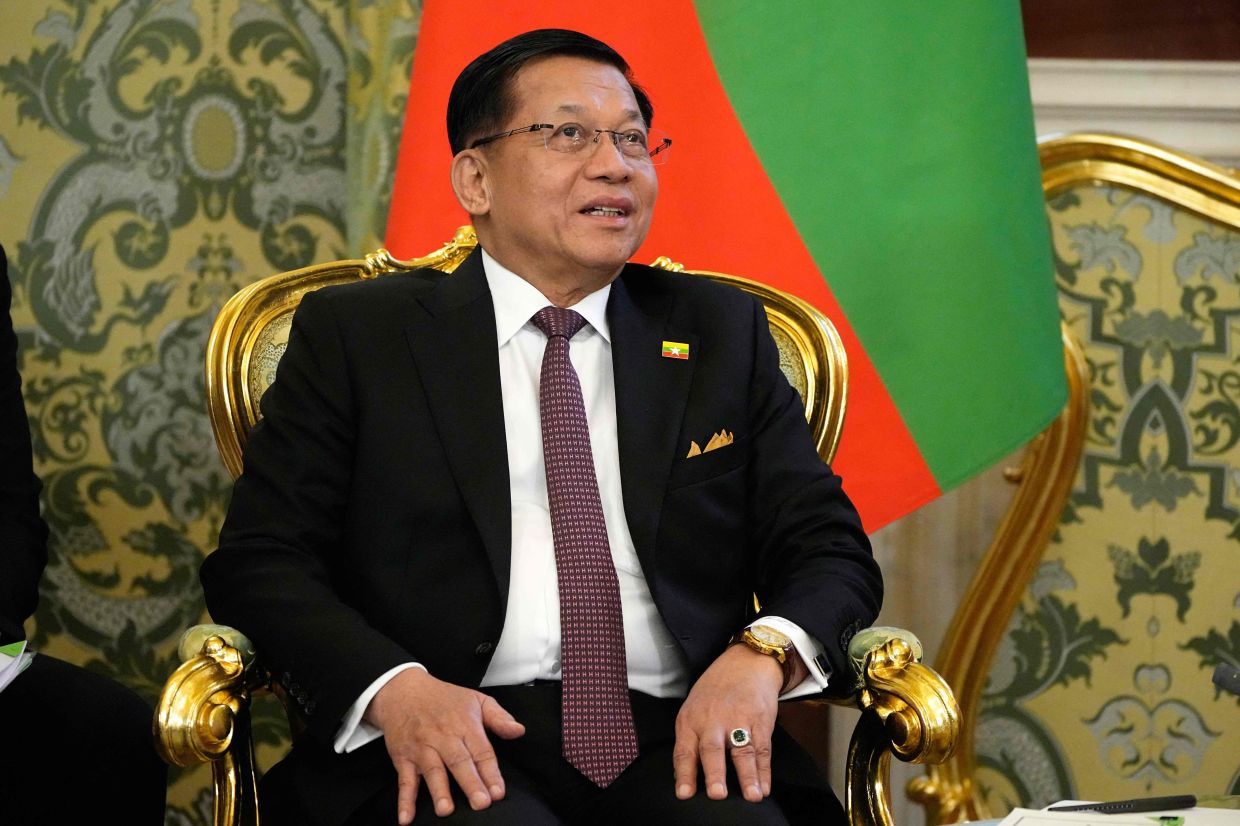
Myanmar's military leader Min Aung Hlaing is scheduled to arrive in Cambodia in early September for an official state visit intended to deepen ties between the neighbouring countries. The Cambodian Senate has confirmed the visit, with palace officials and festival organisers already inspecting venues to accommodate the Myanmar delegation. This journey forms part of a broader international tour by Min Aung Hlaing, who has already travelled to India, China, Laos, Thailand and Russia since assuming the presidency in April following a controversial election process.
Cambodia's Senate has framed the visit as a straightforward diplomatic engagement aimed at fostering bilateral cooperation. Chea Thyrith, the Senate president's spokesperson, stated that the visit would strengthen historical friendship and deepen mutual cooperation between the two nations. Officials including Kuy Sophal, Minister of the Royal Palace, have been tasked with preparing appropriate facilities and protocols for the high-profile meeting, signalling Cambodia's intent to extend a formal welcome to its neighbour.
However, the visit has attracted significant scrutiny from international observers and human rights advocates who view it through a more critical lens. The flurry of Min Aung Hlaing's overseas engagements, particularly following his election just months earlier, is widely interpreted as a calculated strategy to secure international recognition and diplomatic legitimacy. Many analysts and civil society groups argue that these carefully orchestrated state visits serve to normalise Min Aung Hlaing's rule despite the deeply controversial circumstances of his political ascendancy.
The backdrop to these concerns is substantial. Min Aung Hlaing orchestrated the military coup in February 2021 that ousted democratically elected leader Aung San Suu Kyi from power. Following the takeover, thousands of pro-democracy activists, civil society members and political opponents have been arrested and detained under military governance. Reports from human rights organisations have documented widespread abuses, including extrajudicial killings, torture and systematic suppression of dissent. These actions have severely damaged Myanmar's international standing and complicated its relationships within the Association of Southeast Asian Nations.
The April presidential election that formally elevated Min Aung Hlaing to civilian leader has been widely dismissed by democratic nations and observers as lacking legitimacy. Conducted under a military-drafted constitution and held in an environment of restricted freedoms, the election was seen as little more than a façade legitimising military rule under a civilian veneer. This sham election process has intensified international criticism and prompted calls for accountability from Western governments and human rights bodies.
Asean's response to Myanmar's political crisis has been notably constrained. The bloc has excluded Myanmar from its flagship annual summit meetings in response to the military junta's failure to implement the Five-Point Consensus, a framework agreed upon to guide Myanmar's political transition. This consensus calls for cessation of violence, dialogue among stakeholders, and acceptance of humanitarian assistance—conditions that Min Aung Hlaing's government has largely ignored. As a result, Myanmar remains isolated from the region's highest-level diplomatic forums, a significant setback for a nation seeking to project normalcy and international acceptance.
Kin Phea, president of Cambodia's International Relations Institute, offered a more nuanced perspective on the impending visit. He acknowledged that the engagement reflects Min Aung Hlaing's broader strategy to accumulate diplomatic capital and reinforce his legitimacy as a state leader through international recognition. Simultaneously, Phea suggested that Cambodia itself may benefit from enhanced bilateral cooperation with Myanmar, particularly given Cambodia's own experience in addressing post-conflict reconciliation and nation-building challenges.
Phea drew attention to Cambodia's diplomatic efforts during its 2022 Asean chairmanship, when the country attempted to facilitate dialogue and de-escalation within Myanmar's political crisis. He proposed that Cambodia might now share experiences and lessons from its own complicated history of rebuilding national unity and pursuing peace-building initiatives. However, he cautioned that meaningful progress in Myanmar cannot be engineered through external visits or international diplomatic courtesy alone—substantive change requires genuine commitment from actors within Myanmar itself.
Crucially, Phea emphasised that bilateral visits and individual country recognitions, while diplomatically valuable to Min Aung Hlaing, do not translate automatically into Asean acceptance or reinstatement to summit participation. The Five-Point Consensus remains the determining framework, and compliance with its terms is non-negotiable within the regional bloc's established protocols. Cambodia's reception of Min Aung Hlaing, therefore, represents a bilateral gesture rather than a signal that Myanmar has satisfied Asean's collective conditions for political rehabilitation.
The Cambodia visit underscores the tension within Southeast Asia over how to engage with Myanmar's military government. While some nations practise quiet diplomacy and incremental engagement, others maintain that dialogue must be contingent on demonstrable progress toward the democracy, ceasefire and humanitarian standards outlined in the Five-Point Consensus. Cambodia's position appears to favour engagement without confrontation, viewing bilateral cooperation as preferable to isolation whilst avoiding explicit endorsement of the military regime.
For Malaysia and other Asean members, this visit highlights the ongoing challenge of balancing pragmatic diplomatic engagement with principled stands on governance and human rights. The region continues to grapple with how to address Myanmar's political stalemate without fracturing Asean's unity or legitimising what many view as an illegitimate military takeover. Min Aung Hlaing's tour of sympathetic capitals serves his immediate agenda of projecting state leadership, but it does not resolve the fundamental democratic deficit and human rights concerns that have isolated Myanmar within its own regional organisation.

