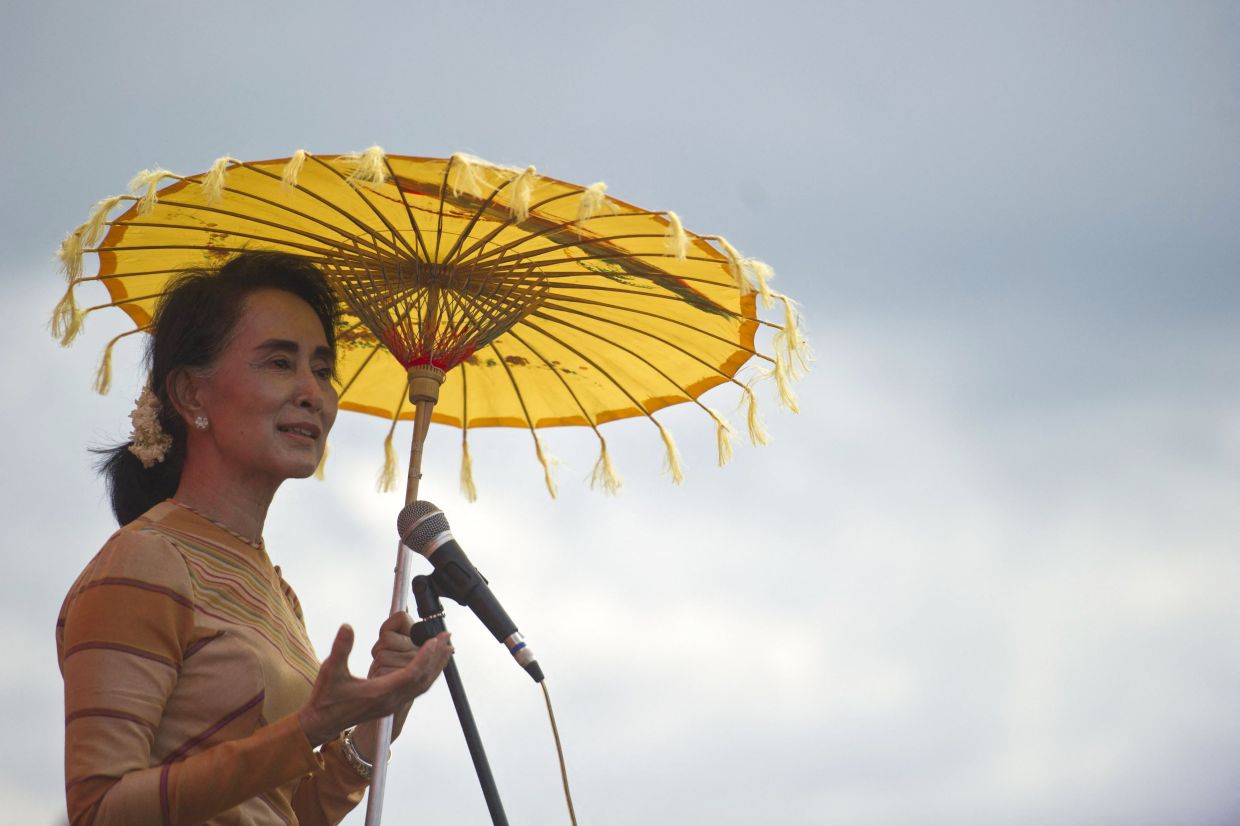
Myanmar's military government has once again refused Asean's request to meet Aung San Suu Kyi, the deposed civilian leader who recently turned 81 and remains imprisoned since the February 2021 coup. The latest denial, delivered through regime spokesperson Khaing Khaing Soe at a June 30 news conference, marked the second time that Philippines Foreign Secretary Maria Theresa Lazaro—speaking in her capacity as Asean chair—was unable to secure access to Myanmar's highest-profile political prisoner. The rebuff carries significance far beyond the personal circumstances of one individual, as it illuminates the junta's calculation that the Association of Southeast Asian Nations lacks the means or will to compel compliance with its stated objectives.
Analysts attribute the regime's intransigence to a fundamental asymmetry in how Myanmar's military leadership views its relationship with Asean. Hunter Marston, director of the South-East Asia programme at the Lowy Institute, suggests that the Myanmar regime believes it holds greater leverage over the bloc than the reverse. The regime appears confident that Asean needs Myanmar—strategically positioned between India and China, with significant geopolitical weight—more acutely than Myanmar requires Asean's approval or cooperation. This perception shapes the junta's willingness to disregard the grouping's diplomatic entreaties, treating them not as meaningful constraints but as minor inconveniences to be dismissed.
The pattern of access to Suu Kyi further illustrates the regime's selective engagement strategy. While Asean delegates have been rebuffed repeatedly, the junta has permitted visits from carefully chosen foreign officials. Former Thai Foreign Minister Don Pramudwinai managed to meet Suu Kyi during a July 2023 visit to Naypyitaw, and Chinese Foreign Minister Wang Yi reportedly secured a meeting during his April 2024 visit. These selective permissions carry unmistakable messages about which relationships Myanmar's military prioritises and which foreign actors it views as sufficiently aligned with its interests. Thailand's historical military connections and China's strategic importance stand in stark contrast to Asean's collective posture of demanding accountability and reform.
Meanwhile, Suu Kyi continues to serve what amounts to a lengthy custodial sentence, having received multiple rounds of sentence reductions that have whittled her original 33-year total down to approximately 18 years remaining. She was convicted on charges including violating Myanmar's official secrets act and corruption allegations that international observers, human rights groups, and family members have characterised as fabricated and politically motivated. By maintaining her imprisonment while presenting carefully controlled narratives about her condition to international audiences, the regime preserves what some analysts view as a crucial diplomatic asset. Her incarceration serves both a practical political function—neutralising the opposition while preventing the emergence of rival civilian leadership—and a symbolic one, demonstrating the regime's capacity to act with impunity.
The regime's refusal strategy reflects a deeper message about its relationship with Asean oversight. Myanmar scholar Phyo Win Latt notes that granting access to Suu Kyi would implicitly concede that Asean possesses legitimate supervisory authority over Myanmar's internal political arrangements. By denying such access, the junta signals its preference for Asean recognition without Asean scrutiny. The regime wants the regional bloc's acceptance of its authority and a seat at Asean councils, but it categorically rejects the notion that regional peers should have any influence over how it conducts domestic governance. This distinction between recognition and accountability has become the fulcrum on which Myanmar's relationship with Asean now pivots.
The broader context involves Asean's Five-Point Consensus, a peace framework adopted following the 2021 coup that calls for cessation of violence, humanitarian aid access, dialogue among Myanmar's stakeholders, and crucially, the ability of Asean's special envoy to meet with all relevant parties. The junta has largely ignored this roadmap, instead conducting elections widely viewed as orchestrated theatre that allowed military leader Min Aung Hlaing to transition from military chief to president in April 2024 while maintaining absolute control. Since the coup, Myanmar has descended into devastating conflict, with independent monitors documenting at least 100,000 deaths according to the Armed Conflict Location & Event Data project. Asean's repeated calls for implementing the peace framework have been treated with studied indifference by Naypyitaw.
Suu Kyi's isolation extends beyond diplomatic meetings. Her son Kim Aris, now 48 years old, has not seen or spoken to his mother for five years, though the regime claims she remains in good health without providing independent verification. Her placement under reported house arrest in April means independent observers have not verified her condition in months. The regime justifies its visitor restrictions by categorising her as a convicted prisoner subject to Myanmar's laws, an argument her family and international observers reject as pretextual. The cumulative effect of these restrictions is to render her entirely incommunicado, severing her from meaningful contact with the outside world while the regime maintains complete control over information about her circumstances.
The military's confidence in defying Asean reflects broader regional dynamics that complicate the bloc's leverage. Min Aung Hlaing and his advisors observe that Asean declines to intervene forcefully in other member disputes, citing the unresolved Thailand-Cambodia border disagreement as a parallel case. From the junta's perspective, applying pressure exclusively to Myanmar for internal political arrangements constitutes selective and potentially discriminatory treatment. This argument, whether accepted on its merits or not, provides Naypyitaw with a justification for non-compliance rooted in principles of non-interference that Asean itself has historically championed. The regime essentially weaponises Asean's own foundational doctrine against the bloc's attempts at persuasion.
For over five years, Asean has maintained a ban on Min Aung Hlaing attending leaders' summits, conditioning his return on demonstrable progress toward fulfilling the Five-Point Consensus. Yet this sanction appears to carry limited weight with a regime that views exclusion from summits as an acceptable cost relative to surrendering control over Myanmar's political trajectory. The junta's calculation suggests that attendance at regional forums matters less than sovereign independence to conduct affairs according to its preferences. This inverted hierarchy of values—domestic control over regional standing—reflects a profound divergence between how Asean conceives of its influence and how Myanmar's military actually responds to that influence.
Amara Thiha, a non-resident fellow at the Stimson Centre, characterises restrictions on Suu Kyi's visitors as a diplomatic card the regime continues to hold. By controlling who may see her and when, the junta maintains a tool of leverage that it can potentially deploy in future negotiations or leverage in exchange for concessions from either Asean or individual member states. As long as Suu Kyi remains incommunicado and her condition shrouded in regime-controlled information, uncertainty persists about her health and treatment, creating ongoing international concern that the junta can mobilise or dampen strategically. This approach transforms a political prisoner's isolation into an instrument of state policy.
The implications for Southeast Asia and Myanmar's trajectory appear increasingly grim. A regime that dismisses Asean's collective diplomatic voice shows no inclination toward democratic restoration or civilian-led governance. The continued exclusion of Suu Kyi from meaningful external contact, combined with the junta's broader rejection of the Five-Point Consensus framework, suggests Myanmar's military intends to entrench authoritarian rule for the foreseeable future. Regional efforts at persuasion have demonstrably failed, and Myanmar shows every sign of strengthening ties with extra-regional powers like China and Russia rather than accommodating Asean's preferences. The question facing the bloc is whether it possesses any mechanism to alter this trajectory, or whether Myanmar's calculated defiance represents the shape of regional relations to come.

