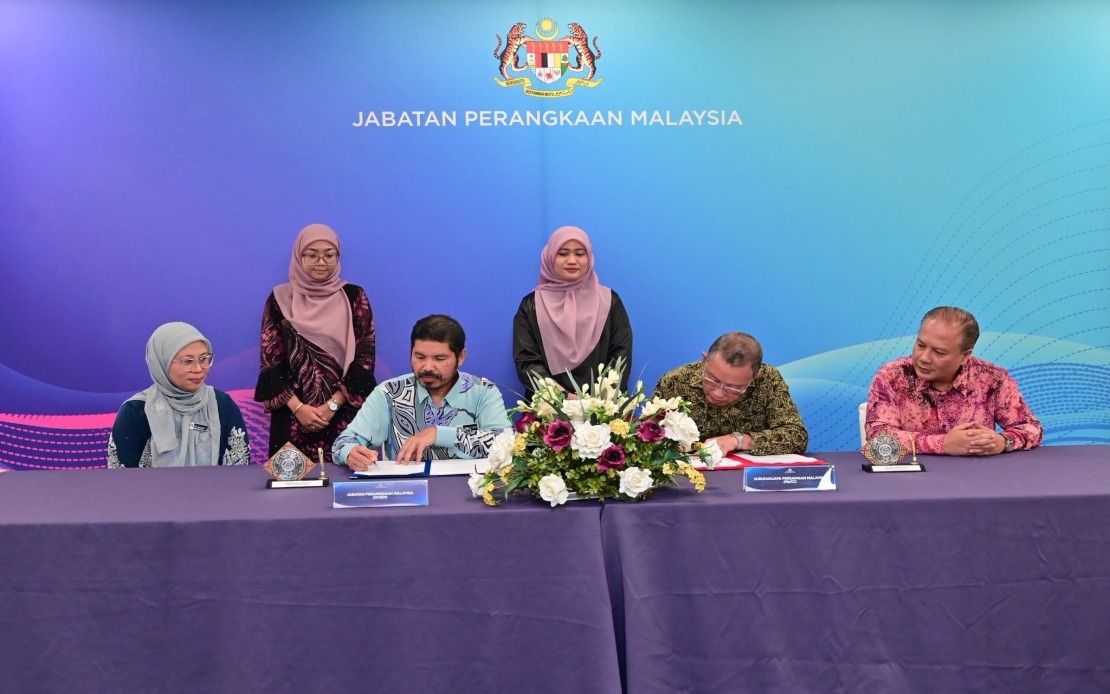
Malaysia's two key economic watchdogs have taken a significant step toward closer coordination, with the Malaysia Competition Commission (MyCC) and the Department of Statistics Malaysia (DOSM) signing a memorandum of understanding designed to harness the power of shared data and analytical expertise. The agreement, formalized at DOSM headquarters in Putrajaya on June 19, signals the government's evolving recognition that integrated data strategies are essential for effective economic governance and fair market oversight in an increasingly complex business environment.
The signing ceremony brought together MyCC chairman Tan Sri Idrus Harun and Chief Statistician of Malaysia Datuk Seri Dr Mohd Uzir Mahidin, with MyCC chief executive officer Datuk Iskandar Ismail and DOSM Deputy Chief Statistician (Economic Programmes) Siti Asiah Ahmad witnessing the formal execution. This institutional-level commitment reflects not merely administrative procedure but rather a deliberate policy shift toward consolidating Malaysia's data infrastructure for economic analysis and enforcement.
At its core, the MoU establishes a comprehensive framework for cooperation spanning three interconnected domains. The first pillar focuses on data sharing mechanisms, enabling both agencies to access administrative and economic datasets that previously may have operated in separate silos. The second component addresses capacity building, with plans for joint training programmes, staff exchanges, and knowledge transfer initiatives that will enhance the analytical capabilities of personnel across both organizations. The third element emphasizes ongoing expertise sharing, creating institutional memory and best-practice protocols that strengthen how Malaysia monitors competitive dynamics.
The collaboration arrives at a pivotal moment in Malaysia's economic evolution. Data has become the dominant commodity in global commerce, shaping everything from pricing strategies to market entry decisions. MyCC's explicit acknowledgment of this reality suggests the commission recognizes that traditional competition analysis tools may prove insufficient without access to comprehensive, real-time economic datasets. By partnering with DOSM, which maintains the country's most authoritative statistical infrastructure, MyCC gains institutional capacity to track market behavior across sectors with unprecedented granularity.
For DOSM, the partnership represents an opportunity to deepen the strategic value of the statistics it produces. Chief Statistician Mohd Uzir framed the agreement as enabling "more comprehensive evaluation and understanding of data through combining expertise in the fields of statistics and competition." This dual focus matters considerably: while DOSM excels at gathering raw economic data, MyCC brings specialized knowledge of how that data reveals anticompetitive conduct, market concentration, and consumer harm. The synergy transforms disparate statistics into actionable intelligence.
A particularly important dimension of the MoU involves joint monitoring of strategic economic sectors and assessment of government policy implementation. By combining statistical expertise with competition analysis, the two agencies can now evaluate whether economic policies intended to promote fair competition are achieving their objectives. This capability becomes especially valuable when assessing emerging sectors—such as digital markets, renewable energy, or financial services—where competitive dynamics remain poorly understood and require sophisticated analytical approaches.
The agreement also addresses supply chain transparency and price movement analysis, areas of considerable relevance for Malaysian consumers and policymakers. Recent inflation pressures across Southeast Asia have heightened public and government scrutiny of pricing behavior. Through coordinated data analysis, MyCC and DOSM can now investigate whether price movements reflect legitimate cost increases or stem from anticompetitive collusion. This investigative capability directly impacts consumer welfare and business confidence.
The human capital development component should not be underestimated. Economic analysis and competition economics have become increasingly technical fields requiring proficiency in statistical methods, econometrics, and data science. By establishing formal training and exchange programmes, the MoU enables both organizations to build talent pipelines with hybrid expertise. This institutional investment in human resources creates lasting advantages beyond any single investigation or policy review.
From a regional perspective, this cooperation model offers lessons for other Southeast Asian economies grappling with similar challenges. Countries like Thailand, Indonesia, and the Philippines operate competition agencies and statistics departments that often function independently despite complementary mandates. Malaysia's formalized partnership could become a template for regional economic coordination, particularly as ASEAN member states increasingly seek to harmonize competition enforcement and economic data standards.
The broader policy implications extend to market transparency and business conduct. When competition authorities have access to comprehensive economic data, companies face stronger incentives to compete on merit rather than engage in collusive practices. Similarly, policymakers gain evidence-based understanding of how regulation influences competitive outcomes, potentially reducing the risk of counterproductive interventions. The MoU thus creates positive externalities that extend beyond the two signing agencies.
Mohd Uzir emphasized that the collaboration supports "development of a more competitive and transparent economic ecosystem, while helping to safeguard the interests of businesses, consumers and the Malaysian economy." This tripartite framing—addressing business interests, consumer protection, and macroeconomic health—reflects sophisticated understanding that competition policy serves multiple stakeholders. Businesses benefit from level playing fields, consumers gain better pricing and choice, and the broader economy becomes more efficient and resilient.
Implementation will be critical. Many government memoranda of understanding remain largely aspirational, constrained by resource limitations, institutional silos, or divergent operational cultures. Success will require MyCC and DOSM to invest in compatible data systems, establish clear protocols for information sharing while respecting confidentiality boundaries, and create measurable benchmarks for assessing collaboration outcomes. The commitment of senior leadership provides a foundation, but sustained attention will determine whether this partnership meaningfully strengthens Malaysia's competition enforcement and economic intelligence capabilities.
Looking forward, the MoU establishes infrastructure that could evolve substantially. Future expansions might include bringing other agencies into the partnership—such as the Securities Commission for financial market analysis or the Malaysian Digital Economy Corporation for technology sector monitoring. The foundational agreement signed in Putrajaya thus represents not merely a bilateral arrangement but the beginning of an integrated approach to economic governance in which data, expertise, and enforcement mechanisms operate in coordinated fashion, ultimately benefiting Malaysia's competitive positioning in the regional and global economy.

