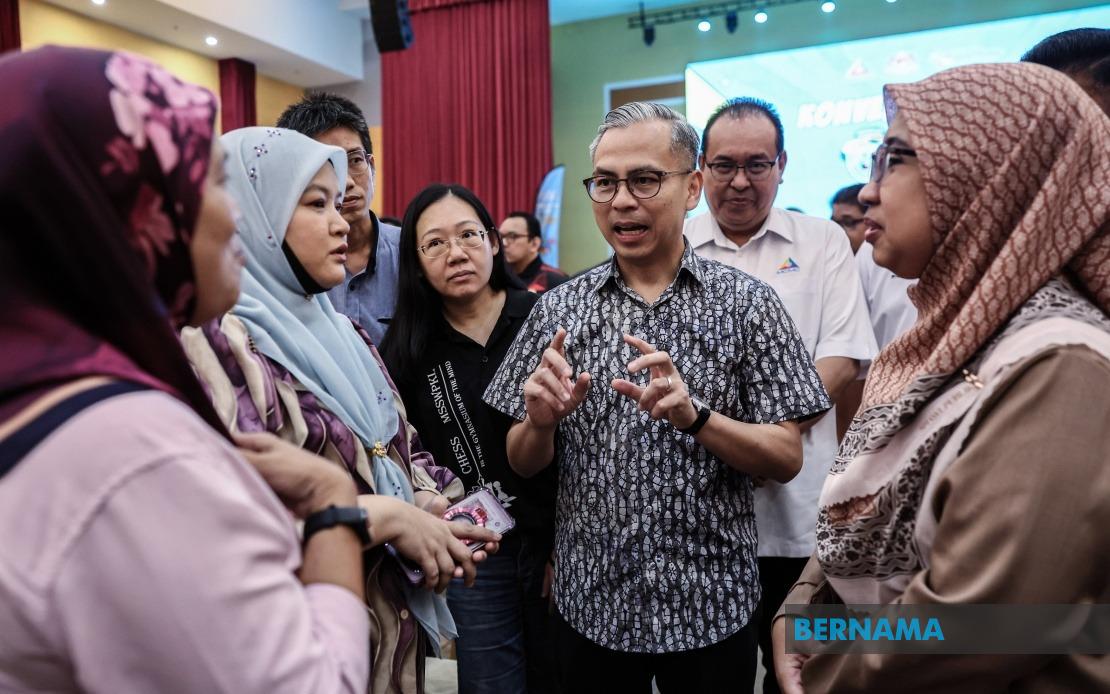
The government has moved to clarify the purpose and administration of MyKhas, emphasising that the fund represents resources intended for grassroots benefit rather than parliamentary perquisites. At a media briefing in Kuala Lumpur on August 8, Communications Minister Datuk Seri Fahmi Fadzil stressed that MyKhas operates as a special allocation under the Prime Minister's direct oversight, with disbursements made to serve the welfare needs and priorities of people living within parliamentary constituencies. This clarification appears to be part of a broader effort by the MADANI administration to distinguish between government resources earmarked for public benefit and allowances or entitlements that accrue personally to elected representatives.
Fahmi, who also serves as Information Chief for PKR and spokesman for the MADANI Government, articulated the position that MyKhas allocations are formally structured within Malaysia Plan and Budget documents as a reserved fund under the Prime Minister's purview. The mechanism allows for flexible distribution determined by the Prime Minister's office based on identified needs rather than formulaic allocation to individual MPs. This institutional arrangement reflects Prime Minister Datuk Seri Anwar Ibrahim's stated principle that government financial resources fundamentally belong to the public they serve and should not be treated as exclusive privileges of any elected official, regardless of party affiliation or parliamentary status.
The distinction drawn by Fahmi carries particular significance in the Malaysian political context, where questions about resource allocation and the relationship between government funds and political representation remain sensitive. By anchoring MyKhas authority explicitly in the Prime Minister's office rather than in individual MP discretion, the administration appears to be centralising control over how and where these resources flow. Fahmi underscored this point personally, noting that even as a senior minister and communications portfolio holder, he cannot unilaterally access MyKhas for his own purposes or projects. The fund's design ensures it serves voters and residents within constituencies, with allocation decisions remaining under Prime Ministerial authority.
When questioned about how constituencies represented by opposition parties access MyKhas funding, Fahmi indicated that applications can be submitted through the Implementation Coordination Unit operating under the Prime Minister's Department. This procedural pathway suggests that opposition-held constituencies are not automatically excluded from MyKhas support, though the centralised application process means that access depends on formal submission and Prime Ministerial approval rather than on automatic entitlements tied to parliamentary representation. The transparency of this mechanism may be intended to address concerns about potential inequitable treatment of opposition areas.
Anwar's own recent comments reinforce this administrative philosophy. The Prime Minister emphasised that allocations directed to parliamentary constituencies should be understood as resources for public infrastructure and community welfare, not as political emoluments. He outlined the breadth of potential applications, including schools, religious institutions such as mosques, and essential services like drainage maintenance and repairs. This framing positions MyKhas as a practical tool for addressing tangible community needs rather than as discretionary funding for MPs to allocate as they see fit.
The emphasis on constituency-level benefit rather than MP entitlement reflects a shift in how Malaysia's government frames its relationship with resource distribution. In many developing democracies, local representatives traditionally enjoy considerable discretion over fund allocation, using such authority to build political support within their constituencies. By contrast, the MyKhas structure as described places genuine decision-making authority in the Prime Minister's office, with field-level needs assessment and application driving the flow of resources. This approach could reduce the personalisation of government spending while potentially enhancing efficiency and equity across constituencies.
From a Southeast Asian perspective, Malaysia's approach to constituency funding offers an instructive model regarding how centralised administrations can maintain control over resource distribution while maintaining the appearance of local representation. The MyKhas system allows the government to fund constituency-based projects without surrendering financial authority to individual MPs, many of whom come from opposition parties. This structural arrangement becomes particularly important in a parliamentary democracy where coalition governments and complex party alignments create incentives for careful management of political resources.
The clarification also addresses implicit concerns that MPs might misuse or privatise government allocations. By explicitly stating that no elected representative, regardless of rank or party, can personally access MyKhas funds, the administration signals a commitment to public accountability. Fahmi's personal restatement that he cannot use MyKhas for himself provides a credible illustration of this principle, using his own position to demonstrate the fund's genuine public orientation. Such transparent governance claims matter considerably in jurisdictions where public confidence in financial probity remains contested.
For Malaysian constituents and civil society organisations, the MyKhas structure has implications for how communities can engage with their elected representatives regarding development priorities. If MyKhas resources respond to formal applications processed through the Prime Minister's office rather than to MP advocacy, constituent strategy must adapt accordingly. Communities may need to develop direct relationships with central government agencies rather than relying exclusively on their local representatives as the primary channel for securing public resources. This shift potentially strengthens centralised administration while altering traditional patron-client relationships in Malaysian politics.
The government's repeated emphasis on this clarification suggests that questions about MyKhas usage have generated sufficient public or political scrutiny to warrant formal guidance. Opposition parties or civil society monitors may have raised concerns about whether MyKhas functioned as a de facto MP allowance distributed through a different nomenclature. By firmly restating the fund's public purpose and Prime Ministerial control, the administration moves to close any perception gap between stated intent and actual practice. Whether this clarification translates into perceptible changes in on-the-ground allocation patterns will ultimately determine the credibility of the fund's public-service mission.

