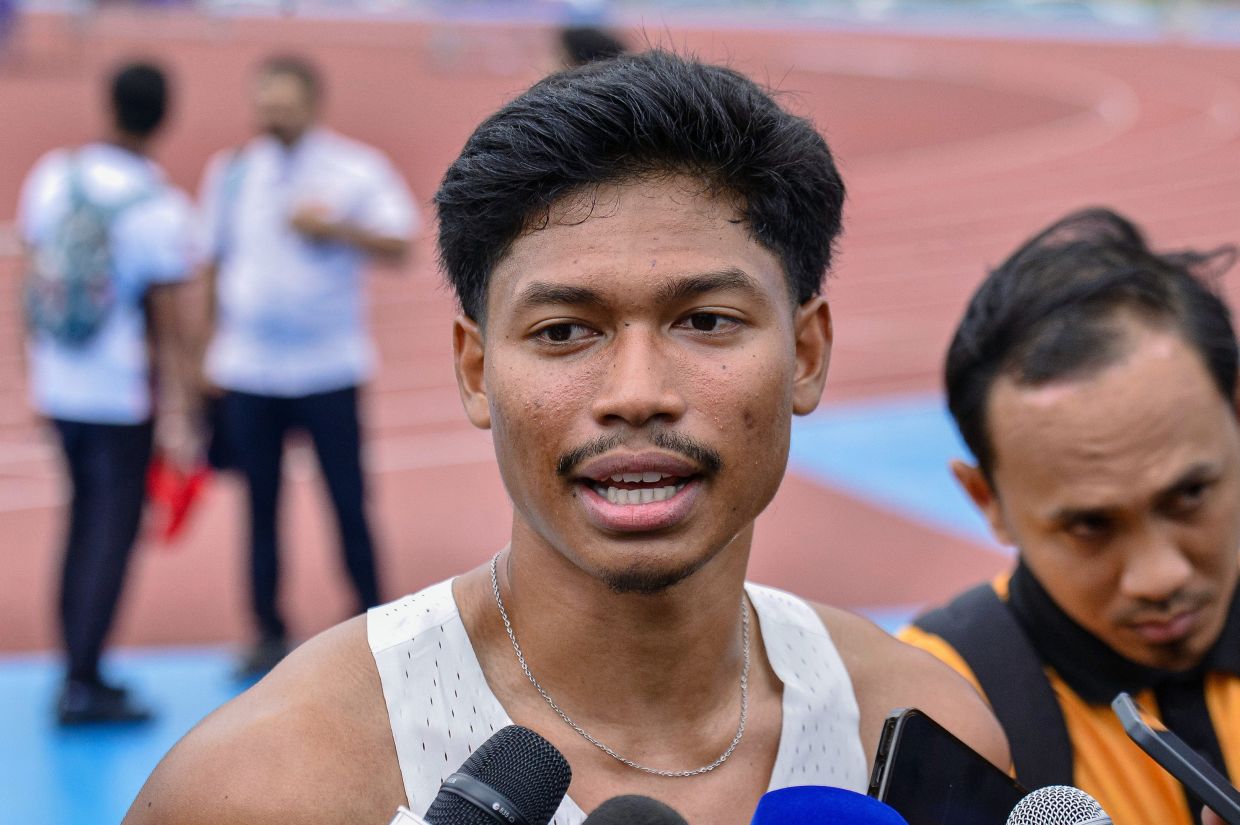
Malaysia's accomplished sprinter Mohd Azeem Fahmi has announced plans to undertake postgraduate studies at Universiti Malaya, marking a significant shift in his career trajectory as he balances athletic pursuits with academic advancement. The 21-year-old recently concluded his undergraduate studies in the United States and has now returned to pursue a master's degree at the nation's flagship institution, signalling a commitment to developing his expertise alongside his track and field ambitions.
Fahmi's transition to postgraduate education at UM represents a deliberate choice to ground his future within Malaysia's academic ecosystem. During a formal courtesy visit to the university's leadership, he was received by vice-chancellor Prof Datuk Seri Dr Noor Azuan Abu Osman, who expressed institutional commitment to facilitating a productive academic pathway for the young athlete. The engagement demonstrated UM's strategic interest in retaining homegrown talent and integrating elite performers into its scholarly community.
The meeting underscored institutional backing for Fahmi's ambitions, with faculty leadership actively involved in welcoming the sprinter. Associate Prof Dr Zulkarnain Jaafar, dean of the Faculty of Sports and Exercise Sciences, and Afizal Abu Othman, director of the Sports Centre, were present at the discussion, reflecting UM's comprehensive approach to supporting student-athletes who seek to develop both athletically and intellectually. This multi-departmental engagement suggests the university has structured mechanisms to accommodate the unique demands placed upon elite competitors pursuing formal qualifications.
UM's track record of nurturing world-class athletes lends credibility to Fahmi's choice. The institution boasts an impressive roster of accomplished graduates in sports disciplines, including Olympic diving medallists Datuk Pandelela Rinong and Ooi Tze Liang, alongside Bryan Nickson Lomas, all of whom developed their careers whilst maintaining academic rigour. Vivian Hoo, a former national women's doubles shuttler, similarly graduated from UM with a Bachelor of Sports Science degree in 2019, establishing a contemporary precedent for athletes integrating elite-level competition with university education.
Fahmi's recent performances validate his standing within Malaysian athletics. At the Malaysian Open held at Universiti Putra Malaysia Serdang, he delivered commanding displays across sprint disciplines, capturing the gold medal in the men's 100 metres and anchoring the victorious 4x100 metres relay team. His relay contribution placed him alongside Danish Iftikhar Mohd Roslee, Pengiran Aidil Auf Hajam, and Mohd Armin Zahryl, demonstrating his consistency and reliability within the national sprint programme.
Fahmi's developmental journey reflects contemporary patterns among Malaysian athletes pursuing international preparation. In January 2023, he relocated to Auburn University in Alabama to undertake formal study in exercise physiology and kinesiology, disciplines directly aligned with athletic performance optimisation. During his tenure, he trained under Ken Harnden, an accomplished coaching figure, exposing himself to advanced training methodologies and sports science infrastructure available in the American collegiate system.
The decision to return to Malaysia whilst continuing postgraduate education speaks to evolving priorities within Malaysian athletics. Rather than indefinitely extending overseas, Fahmi appears to be synthesising his international experience with domestic opportunities, a pattern increasingly common amongst emerging Southeast Asian athletes who recognise the value of maintaining national connections whilst acquiring advanced qualifications. This approach preserves his availability for national team commitments whilst facilitating deeper engagement with cutting-edge sports science knowledge.
Fahmi's pursuit of advanced study in fields directly connected to athletic performance enhancement positions him advantageously for longer-term career trajectories. Understanding the physiological and biomechanical foundations of human movement enables athletes to make informed decisions about training methodologies, injury prevention, and performance optimisation throughout their careers. For a sprinter in his prime, such knowledge acquisition represents substantial career insurance against the inevitable physical demands of elite-level competition.
UM's receptiveness to integrating elite athletes into its postgraduate landscape reflects institutional recognition of sport's centrality to national identity and development. By facilitating pathways for accomplished performers to simultaneously pursue advanced degrees, the university reinforces the principle that athletic excellence and scholarly achievement need not remain mutually exclusive. This positioning also strengthens the institution's profile within international sporting circles and enhances its reputation for holistic athlete development.
Fahmi's transition arrives at a pivotal moment in Malaysian athletics, where pipeline development and international competitiveness remain focal concerns. Young athletes who successfully blend overseas training exposure with domestic academic grounding potentially emerge as mentors for subsequent cohorts, disseminating international best practices whilst remaining embedded within local coaching networks. His commitment to UM suggests willingness to contribute to this institutional development whilst consolidating his own competitive trajectory during what remain potentially formative years of his sprinting career.

