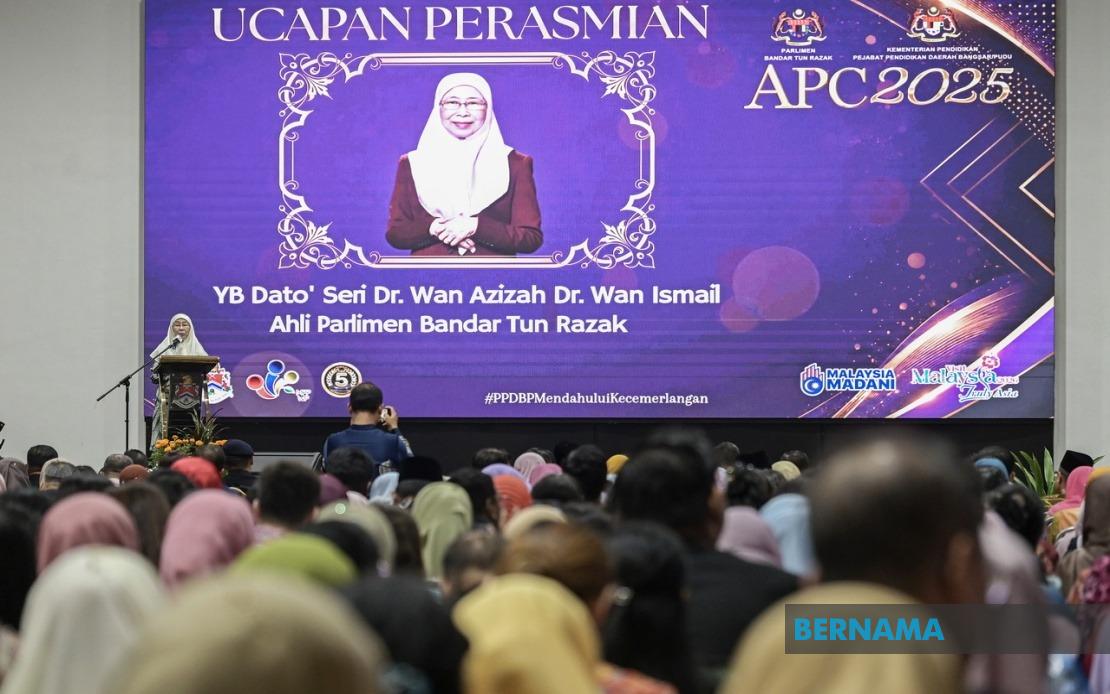
Datuk Seri Dr Wan Azizah Wan Ismail, wife of the Prime Minister and Member of Parliament for Bandar Tun Razak, has underscored a fundamental truth often overshadowed in policy discussions: that genuine national progress cannot be measured by gross domestic product figures or infrastructure projects alone. Speaking at the 2025 Excellent Service Award ceremony in Kuala Lumpur, she articulated a vision of national development rooted in the cultivation of citizens who possess not merely academic competence but also moral grounding and compassion—qualities that form the bedrock of a resilient society.
The recognition programme, organised by the Bangsar/Pudu District Education Office at the Kuala Lumpur City Hall Training Institute, brought together approximately 1,000 participants to honour 746 educators and school administrators drawn from 143 institutions across the district. The scale of the gathering reflected the significance accorded to the teaching profession and the systematic effort to acknowledge excellence within Malaysia's education sector. By convening such events, the government signals its commitment to valuing educators whose daily work shapes future generations, a message that carries particular weight in a country navigating rapid social and technological transformation.
Dr Wan Azizah's remarks centred on the outsized influence wielded by teachers in the formative years of childhood development. She noted that in contemporary Malaysian society, particularly within urban contexts, students spend substantial portions of their waking hours within school environments—a reality born of the dual-income household model that characterises many middle-class families. This structural reality means that educators assume responsibilities extending well beyond subject matter instruction, effectively becoming secondary custodians of character formation during critical developmental windows. The implication is stark: schools have become de facto moral institutions, whether or not this role is explicitly acknowledged in curriculum frameworks.
Central to her argument was the distinction between education narrowly construed as knowledge transmission and education more broadly understood as holistic human development. She stressed that the contemporary education system must transcend the mechanical transfer of information to encompass the intentional cultivation of noble character, courteous conduct, and genuine compassion for others. This framing challenges prevailing utilitarian approaches to education policy that prioritise measurable outcomes in standardised testing or workforce readiness metrics, suggesting instead that schools should be evaluated partly on their success in developing conscientious citizens capable of ethical reasoning and empathetic engagement with their communities.
The temporal context of Dr Wan Azizah's address—delivered against the backdrop of accelerating artificial intelligence deployment and the exponential proliferation of information sources—lends particular urgency to her advocacy for values-centred pedagogical approaches. She identified a critical pedagogical challenge facing contemporary educators: equipping students with the intellectual tools necessary to navigate an information ecosystem increasingly characterised by misinformation, deepfakes, and algorithmic distortion. In such an environment, traditional knowledge transmission becomes insufficient; students require cultivated capacities for critical analysis, source evaluation, and discernment between credible and spurious claims.
This emphasis on critical thinking within a values-based framework addresses a genuine anxiety animating education policy discussions across Southeast Asia. As digital technologies proliferate and information flows accelerate, policymakers worry about youth susceptibility to manipulation, conspiracy narratives, and ideological extremism. Dr Wan Azizah's formulation suggests that robust character education—instruction in ethical reasoning, intellectual humility, and principled scepticism—provides a more durable defence against information-age threats than technical fact-checking alone. Students anchored in clear ethical frameworks and trained in rigorous thinking prove more resistant to manipulation than those possessing only surface-level factual knowledge.
The Prime Minister's Political Secretary, Datuk Azman Abidin, and Kuala Lumpur Federal Territory Education Department director Megat Affandi Ismail attended the ceremony, signalling institutional endorsement of the recognition initiative from multiple governmental levels. This presence underscores official commitment to strengthening education sector morale during periods when teachers frequently report declining social status and remuneration concerns relative to other professions requiring comparable qualifications. Recognition ceremonies of this scale serve both symbolic and practical functions—they publicly affirm societal appreciation for teaching while creating opportunities for peer recognition and professional networking among educators.
The breadth of the awards—honouring more than 700 individuals across numerous schools—reflects systemic rather than exceptional commitment to educational excellence. Rather than concentrating recognition on a handful of outstanding performers, the awards programme distributes appreciation across multiple practitioners and support staff, reinforcing the principle that educational progress depends upon collective effort rather than individual heroics. This inclusive approach to recognition potentially cultivates organisational cultures within schools emphasising collaborative improvement over competitive distinction.
For Malaysian policymakers and educational administrators, Dr Wan Azizah's intervention in the public discourse surrounding education serves several functions. It recentres character formation and ethical development within national education priorities at a moment when policy attention often gravitates toward STEM subjects, digital skills, and workforce alignment. It validates the instincts of educators who view their work as encompassing moral guidance alongside academic instruction. Simultaneously, it frames the teaching profession as central to national interests, positioning investment in teacher development and welfare as strategically consequential rather than merely compassionate.
The emphasis on teachers as architects of national character reflects longstanding Malaysian political rhetoric emphasising the interconnection between education quality and national security, social cohesion, and economic competitiveness. By framing teachers as stewards of the nation's greatest resource—its human capital in cultural and ethical dimensions—the remarks elevate teaching from a technical profession to a calling bearing direct implications for national destiny. This rhetorical elevation potentially justifies prioritising education spending, though actualising such commitments requires sustained budgetary allocation and policy consistency beyond ceremonial acknowledgment.
Looking forward, the sustainability of values-based education initiatives depends partly on teacher preparation and ongoing professional development. Educators must themselves possess well-developed ethical frameworks, pedagogical sophistication in character education, and supportive working conditions enabling them to pursue formative rather than merely instructional goals. The gap between aspirational policy rhetoric and classroom reality often widens when institutional support proves inadequate. Successful implementation requires not only ceremonial recognition but also curricular guidance, teacher training investments, and structural conditions within schools permitting educators to prioritise character formation alongside academic achievement metrics.
For regional observers and neighbouring Southeast Asian governments similarly navigating education modernisation amid technological disruption, Dr Wan Azizah's address articulates an alternative paradigm to purely technocratic education reform. Rather than positioning education principally as workforce development or economic competitiveness strategy, this framing emphasises civic and moral dimensions of schooling—dimensions carrying particular salience in diverse societies managing identity formation and social cohesion challenges. The recognition programme itself exemplifies how governments can operationalise commitment to holistic education through institutional mechanisms acknowledging and celebrating educators advancing such broader objectives beyond standardised test score improvements.

