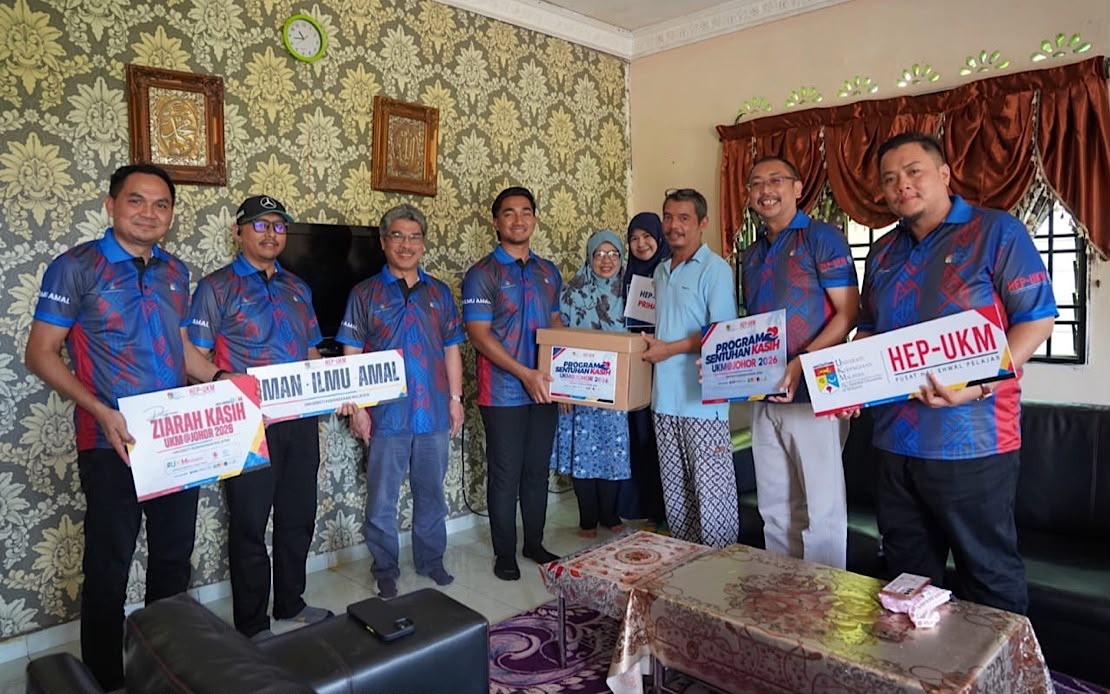
Universiti Kebangsaan Malaysia's latest community engagement drive has drawn nearly 1,000 residents from across Johor, marking a significant expansion of the university's outreach footprint in the southern state. The Sentuhan Kasih UKM@Johor programme, coordinated through the institution's Student Affairs Centre, unfolded over two days in late June across four distinct localities: Kota Masai and Pasir Gudang in the industrial corridor, alongside Kampung Baru Sri Aman and Taman Jaringan in Skudai. Operating under the banner "Dari Kampus ke Komuniti, Menyebar Kasih dan Bakti" (From Campus to Community, Spreading Love and Service), the initiative deployed 78 UKM personnel including students, faculty and administrative staff to bridge institutional and grassroots engagement.
The programme's scope extended well beyond symbolic gestures, encompassing practical community service projects, mental health awareness screenings, recreational sports activities and what organisers termed "ziarah kasih" visits to selected households. This multifaceted approach reflects a deliberate strategy to address diverse community needs while simultaneously exposing university participants to real-world social challenges. The inclusion of mental health screening carries particular significance in Malaysia's current landscape, where psychological wellbeing increasingly competes with physical health as a public concern, yet remains under-resourced in many suburban and semi-industrial communities. Higher Education Minister Datuk Seri Dr Zambry Abd Kadir's attendance underscored governmental recognition of the initiative's broader policy alignment with national community development objectives.
Associate Professor Dr Darfizzi Derawi, who directs the Student Affairs Centre and chairs the Sentuhan Kasih steering committee, articulated a philosophical position that challenges the traditional insularity of Malaysian universities. His observation that institutions should not remain "confined within campus walls" speaks to evolving expectations about higher education's role in society. The argument that practical community interaction cultivates soft skills—adaptability, communication effectiveness, and interpersonal dexterity—that classroom instruction cannot replicate reflects international pedagogical trends emphasising experiential learning. For Malaysian students preparing to enter a competitive regional job market, such exposure to diverse socioeconomic contexts and communication styles offers tangible professional preparation beyond formal curricula.
The geographical selection of engagement sites reveals strategic thinking about community reach. Johor's industrial zones around Pasir Gudang and Kota Masai house substantial working-class populations whose weekend availability remains constrained by employment demands. Herman Ismadi Ismail, identified as a community leader in the Kota Delima zone, acknowledged this scheduling tension while noting that approximately 80 per cent of local residents work in manufacturing and related sectors. Despite these structural obstacles, community participation remained robust, suggesting genuine appetite for institutional engagement among residents who might otherwise experience universities as distant, inaccessible entities. This receptiveness creates opportunities for UKM to establish sustained relationships rather than conducting one-off charitable exercises.
UKM's vice-chancellor Prof Datuk Dr Sufian Jusoh positioned the initiative within a broader institutional commitment to student welfare that transcends financial support mechanisms. His framing emphasises holistic human development encompassing "compassion, togetherness and social responsibility." This rhetorical positioning carries significance in Malaysian higher education discourse, where universities increasingly market themselves as developers of "human capital" aligned with national aspirations. The specific mention that UKM's support represents "a long-term investment" for student focus and competitiveness reframes welfare not as charity but as institutional investment in graduate outcomes. For current UKM students, such articulated commitment may provide tangible reassurance, particularly for cohorts managing financial constraints or personal difficulties that could otherwise derail academic progress.
The programme's inclusion of outreach visits to seven student families in the Tiram and Puteri Wangsa areas demonstrates attention to individual welfare dimensions often overlooked in large-scale programmes. These household visits—potentially addressing family circumstances ranging from economic hardship to health crises—exemplify the "ziarah kasih" concept and acknowledge that student welfare extends inevitably to family contexts. For institutions serving Malaysia's socioeconomically diverse student population, such targeted support addresses real vulnerabilities that affect academic persistence and performance. The geographically dispersed nature of these family visits across Johor's suburban landscape also signals UKM's willingness to commit resources to individual cases rather than relying exclusively on centralised counselling infrastructure.
Associate Professor Darfizzi's announcement that Sentuhan Kasih would expand progressively to other states positions this Johor initiative as a pilot model rather than isolated activity. Such expansion indicates confidence in the programme's viability and impact, while also reflecting UKM's ambition to strengthen community presence nationally. For Southeast Asia's broader higher education ecosystem, this commitment to state-level engagement offers a counterweight to the dominance of capital-centric institutional strategies. When Malaysia's premier public research university invests systematically in suburban and semi-industrial communities, it implicitly legitimises such engagement as institutional priority rather than peripheral corporate social responsibility.
The community leader Herman Ismadi's observation that the programme allowed residents to "get to know UKM better and gain exposure to the university's initiatives and opportunities" highlights asymmetries in information access that constrain university-community relationships. Many Malaysians, particularly in non-urban areas, possess limited practical knowledge of higher education pathways, scholarship availability, or programme offerings. Direct institutional engagement can partially remediate such information gaps while simultaneously humanising universities that students and families often experience through remote, formal channels. For younger residents observing university students engaged in community service, such visibility may influence future educational aspirations or career trajectory considerations.
The thematic framing "Dari Kampus ke Komuniti, Menyebar Kasih dan Bakti" (From Campus to Community, Spreading Love and Service) employs language that transcends purely instrumental or transactional registers. The invocation of "kasih" (love) and "bakti" (service/devotion) appeals to values rooted in Malay-Islamic ethical traditions while remaining accessible across Malaysia's multicultural landscape. This linguistic choice matters because it positions community engagement not as institutional obligation or public relations exercise but as moral imperative. For UKM students participating in such initiatives, this value-laden framing potentially reshapes their self-conception from primarily academic credentialing recipients toward agents of social contribution.
The industrial sector's dominance in the Johor communities engaged reflects Malaysia's ongoing economic transformation and regional development patterns. The concentration of manufacturing and related employment in Johor's zones means that community-university partnerships become increasingly important for workers whose educational backgrounds may not provide natural pathways to continuing learning or professional development. UKM's presence in these communities, particularly through initiatives emphasising mental health and recreational activities, addresses social infrastructure gaps that often accompany rapid industrialisation. For policymakers considering regional development strategies, such university engagement offers cost-effective complementary investment in community wellbeing without requiring substantial new government expenditure.
The timing and scale of this initiative—nearly 1,000 participants across multiple sites—distinguishes it from smaller-scale charitable activities that characterise many Malaysian university-community relationships. The deliberate deployment of substantial institutional resources suggests UKM views such engagement as strategic priority warranting significant investment of personnel and logistical capacity. This approach contrasts with universities that treat community service as optional enhancement to core academic mission. For Malaysian institutions evaluating their own community engagement strategies, UKM's commitment provides both model and implicit benchmark. The measurable participation figures and geographic specificity offer templates for assessment and accountability that many similar programmes lack.
Looking forward, the programme's planned expansion to other states positions UKM within Malaysia's evolving higher education landscape where community responsibility increasingly features in institutional brand positioning and government funding considerations. As Malaysia's universities compete for resources and reputational advantage within ASEAN and global higher education rankings, demonstrated community impact becomes measurable institutional asset. The Sentuhan Kasih model—combining student professional development, community benefit, and institutional capacity building—aligns with international best practices for community engagement while remaining contextually appropriate for Malaysian social and economic conditions. For communities throughout peninsular Malaysia, UKM's expansion of such initiatives offers tangible prospect of enhanced access to institutional resources and expertise previously concentrated in major urban centres.

