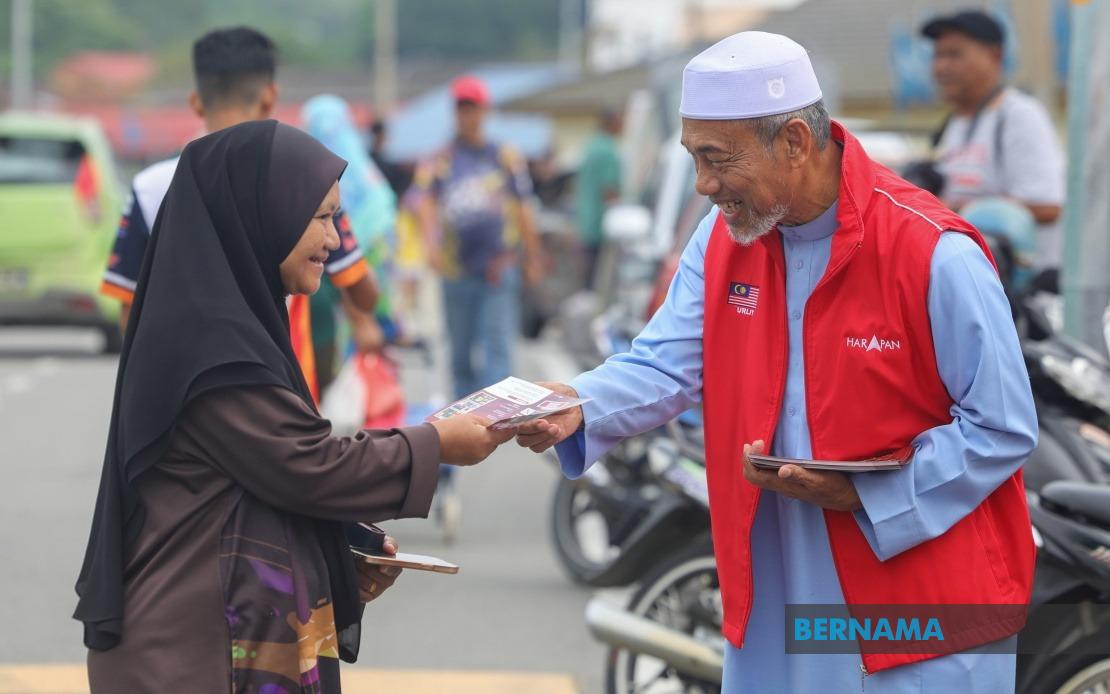
The race for the Negeri Sembilan State Legislative Assembly entered its critical second day on July 19, with candidates across the political spectrum shifting into high gear to capture voter attention before the August 1 polling day. With 12 days remaining in the official campaign window, leading contenders are deploying intensive ground strategies centred on direct engagement, attending dawn prayers, sharing meals with constituents, and conducting neighbourhood walkabouts designed to build personal connections ahead of the vote.
Menteri Besar Datuk Seri Aminuddin Harun, defending his Linggi state seat under the Pakatan Harapan banner, exemplifies the hands-on approach dominating this election cycle. On the second day alone, the PKR vice-president and Negeri Sembilan PH chairman performed Subuh prayers at Masjid Jamek Pasir Panjang before proceeding to breakfast engagements and market walkabouts across multiple residential areas including Pasir Panjang, Taman Setia, Taman Kekatong, and Rumah Rakyat Telok Pelandok. He also scheduled a dedicated session with members of the Indian community, reflecting the electoral importance of minority group outreach in mixed constituencies.
Aminuddin's campaign messaging emphasises direct accountability and developmental responsiveness. During his engagements, he framed the walkabouts as opportunities to listen to constituent concerns and aspirations, positioning himself as accessible and attentive to grassroots sentiment. His statements underscore a broader PH narrative of inclusive governance that extends benefits across community lines, a particularly significant pitch in Negeri Sembilan where demographic diversity shapes voting behaviour in several key marginal seats.
On the opposition's side, DAP secretary-general Anthony Loke, who holds the Chennah state seat, adopted comparable strategies, commencing his campaign day at the Seremban Central Market—a traditional venue for politician visibility—before evening engagement activities. Loke's prominence as a DAP national figure suggests the party's investment in retaining and consolidating its Negeri Sembilan presence, with the Chennah seat serving as a symbolic and strategic anchor for the party in the state.
Other PH candidates are similarly embracing rigorous schedules designed to maximise voter contact. Kamarul Ariffin Wafa, the PH contender for Seri Menanti, orchestrated eight separate programmes including market visits and community interactions, while Yaacob Mahmood, contesting Serting for PH, deliberately chose informal settings such as morning gatherings and business premises in Felda Raja Alias 3 and Bandar Seri Jempol. This emphasis on casual, unhurried interaction reflects a broader campaign philosophy that voter trust is built through repeated, authentic personal contact rather than formal rallies alone.
Barisan Nasional candidates are equally active, though their approach emphasises consolidation of existing support bases. Datuk Seri Mohamad Hasan, the incumbent Rantau assemblyman and BN deputy chairman widely known as "Tok Mat," stationed himself at the BN Polling District Centre in Taman Kelab Tuanku, Mambau, signalling focus on organisational infrastructure. Meanwhile, Negeri Sembilan UMNO Liaison Committee chairman Datuk Seri Jalaluddin Alias deployed a mixed strategy combining youth engagement through a sepak takraw tournament in Pertang with cultural outreach to the Orang Asli community in Kampung Utara Putra, demonstrating BN's effort to maintain its traditionally strong support among indigenous groups and younger voters.
The election itself is being held against the backdrop of significant political flux in Negeri Sembilan. The state legislative assembly was dissolved on June 5 following developments that prompted the dissolution. The Election Commission set August 1 as polling day and July 28 for early voting, accommodating 5,455 police personnel and military voters and their spouses who participate in the early voting process. This compressed but substantial campaign period forces candidates to maximise visibility within a defined window, explaining the prevalence of multiple daily engagements across competing political organisations.
The electoral stakes are correspondingly high, with approximately 889,490 registered voters eligible to participate. This figure breaks down into 867,151 ordinary voters, 16,884 military personnel and spouses, and 5,455 police personnel voting early. The overall voter turnout and demographic breakdown will significantly influence seat distribution, particularly in constituencies where demographic composition has shifted or where previous electoral margins were narrow. For Malaysian political observers and regional analysts tracking coalition dynamics in a crucial peninsula state, the Negeri Sembilan election serves as an important bellwether for popular sentiment regarding the PH-led government's performance and BN's capacity to recapture lost ground.
The intensive grassroots approach currently dominating the campaign reflects a lessons-learned approach from previous elections across Malaysia. Candidates have increasingly recognised that door-to-door engagement, market visibility, and community participation generate voter goodwill and collect real-time intelligence about local preoccupations—development gaps, livelihood concerns, and service delivery—that shape voting decisions. The prevalence of candidates scheduling up to nine activities daily demonstrates how contemporary Malaysian political strategy emphasises saturation engagement, attempting to ensure that at least some proportion of voters within each constituency experience direct contact with leading candidates.
For Negeri Sembilan specifically, the election carries particular significance given the state's geographic position, demographic diversity, and economic structure. The state encompasses Kuala Lumpur's southern periphery, making it sensitive to federal policy impacts, while also maintaining distinct rural and agricultural constituencies with indigenous populations. Electoral outcomes here will influence both the coalition composition at state level and perceptions regarding momentum heading into future federal electoral contests. The current campaign intensity thus reflects recognition among political operators that Negeri Sembilan represents genuinely competitive terrain where marginal voter persuasion could determine final seat allocations and governmental formation.
As the campaign proceeds through its remaining eleven days, candidates across both major coalitions will maintain comparable activity levels, with market appearances, constituency forums, and community gatherings forming the backbone of direct engagement strategies. The August 1 election will ultimately determine whether PH's state-level governance record and developmental claims resonate sufficiently with voters, or whether BN's traditional organisational strength and messaging around stability and experience produces a reversal of recent electoral trends in the state.

