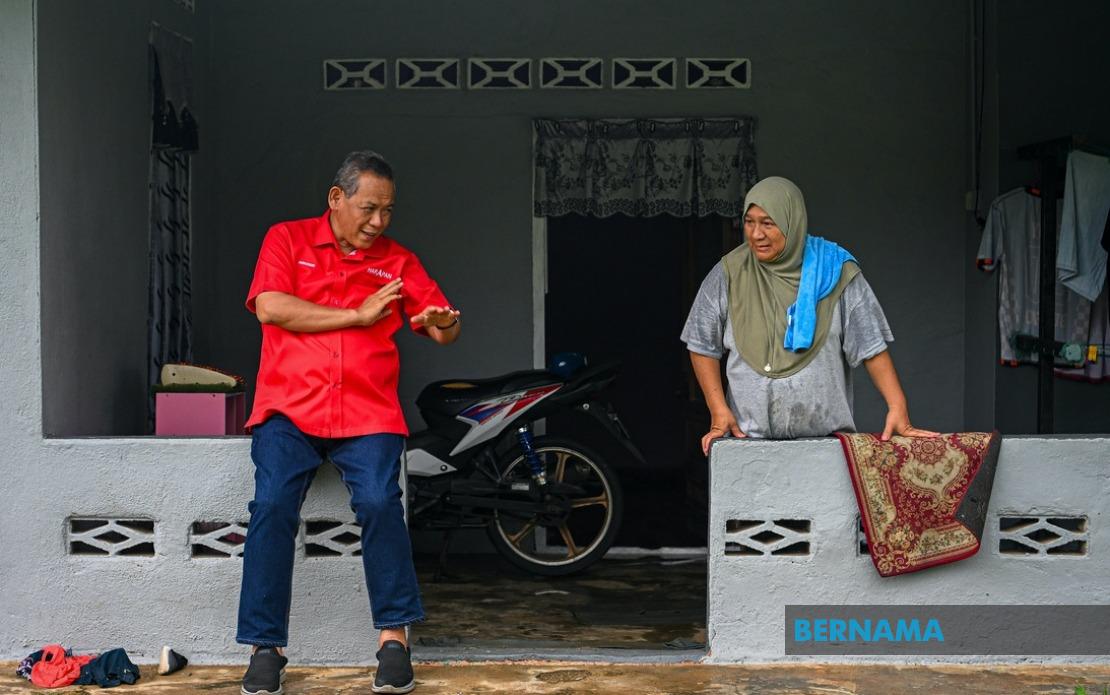
Pakatan Harapan is gambling on the administrative credentials of Menteri Besar Datuk Seri Aminuddin Harun as its central strategic plank in the forthcoming Negeri Sembilan state election. The coalition has positioned itself as the custodian of transparent governance, hoping that voters will reward it with another mandate based on an unblemished record of service over nearly two consecutive terms. This emphasis on accountability and integrity represents a calculated pivot away from national political turbulence, anchoring the campaign firmly in state-level performance and local delivery.
The coalition's election director and Selangor Menteri Besar Datuk Seri Amirudin Shari conveyed confidence stemming from preliminary campaign feedback. During the initial three days of grassroots outreach, PH workers reported receptiveness among ordinary Negeri Sembilan residents, suggesting that the messaging around clean leadership had found purchase beyond party rallies and formal events. Amirudin, who also holds the portfolio of Gombak Member of Parliament, acknowledged that enthusiasm for the coalition extended beyond headline-grabbing gatherings into the quieter spaces where electoral decisions genuinely take shape.
Central to this narrative is Aminuddin's personal standing as both Menteri Besar and Port Dickson MP. According to Amirudin, voters have articulated no substantive grievances with the incumbent administration, and notably, no major corruption scandal or governance failure has tainted Pakatan Harapan's tenure in the state. This absence of headline-grabbing controversy becomes a critical asset in a landscape where rival coalitions frequently invoke governance lapses to undermine opponents. The PKR vice-president stressed that this clean slate was not incidental but foundational to the coalition's appeal.
The campaign also draws organisational strength from what PH describes as a well-developed grassroots machinery. Rather than relying entirely on top-tier personalities or manufactured enthusiasm at mass rallies, the coalition has built its Negeri Sembilan strategy around persistent, ground-level engagement. This approach reflects lessons learnt from recent electoral contests, where traditional campaigning methods alone proved insufficient against better-organised rival machinery. The coalition appears confident that sustained local-level mobilisation will translate grassroots sentiment into electoral outcomes.
Prime Minister and PH chairman Datuk Seri Anwar Ibrahim's role as a campaign asset cannot be underestimated. Amirudin cited the precedent of the Johor state election, where Anwar's involvement bolstered candidate performance and voter confidence in the coalition. The PM's leadership and the economic progress achieved under his administration are expected to radiate legitimacy downward to state-level candidates, creating what PH hopes will be a consolidating effect. This vertical integration of national momentum into state campaigns reflects a sophisticated understanding of how voter perceptions cascade through electoral hierarchies.
The coalition is preparing to unveil its state election manifesto, which will blend continuation of existing initiatives with fresh policy proposals. This dual approach seeks to satisfy voters who appreciate continuity with those demanding innovation and accelerated development. For Negeri Sembilan, the manifesto is intended to address priorities around economic growth, people-oriented programmes, and social welfare, thereby constructing a comprehensive platform that acknowledges both achievements and aspirations.
Contextually, the 2023 state election delivered a fragmented legislature that neither produced decisive dominance nor stability. Pakatan Harapan secured 17 seats, Barisan Nasional captured 14, and Perikatan Nasional won five, a distribution that necessitated coalition-building to form government. The upcoming contest will determine whether PH can strengthen its position or whether opposition forces can narrow the gap. In Malaysia's current electoral environment, where state governments increasingly function as laboratories for governance models and policy experimentation, the Negeri Sembilan outcome carries implications beyond the state itself.
The electoral logistics are substantial. Some 889,490 registered voters are eligible to participate, a figure encompassing 867,151 ordinary voters alongside 16,884 military personnel and their dependents, plus 5,455 police personnel designated as early voters. Early voting is scheduled for July 28, with general polling set for August 1. The Negeri Sembilan State Legislative Assembly was dissolved on June 5, setting in motion the formal countdown to what could reshape the state's political complexion for the next five years.
For Malaysian observers, the Negeri Sembilan election functions as a significant mid-term test of Pakatan Harapan's governance model and electoral durability. Unlike federal elections, which involve competing national narratives and diverse coalitional mathematics, state contests invite voters to pass direct judgment on administrative performance, service delivery, and local leadership quality. A strong PH performance would validate the coalition's strategy of emphasising good governance and administrative stability as differentiating factors. Conversely, any loss of ground would prompt soul-searching about whether clean governance alone suffices in a competitive political marketplace where rival coalitions deploy alternative appeals around development promises, patronage networks, and identity politics. The campaign's final weeks will reveal whether Negeri Sembilan voters prioritise the governance credentials that Pakatan Harapan is emphasising or whether other factors prove decisive.

