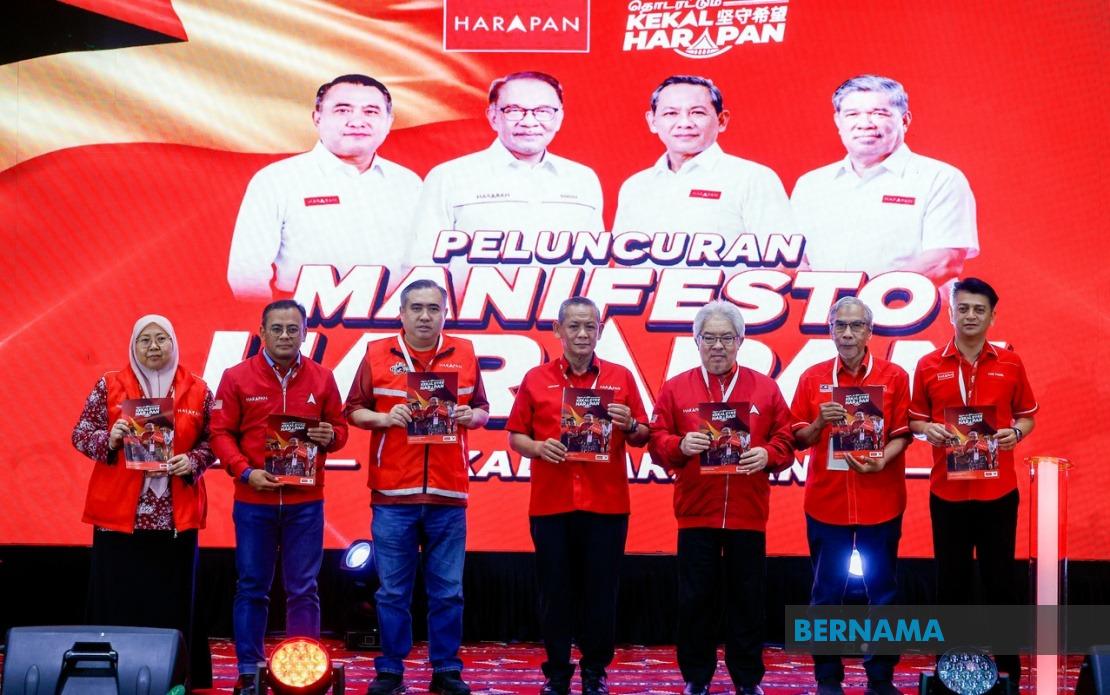
Pakatan Harapan is repositioning its Negeri Sembilan state election campaign around proven delivery rather than untested pledges, with coalition leadership arguing that voters deserve tangible results grounded in track record rather than aspirational rhetoric. The approach marks a deliberate tactical shift as the ruling coalition seeks to consolidate support in the state, where PH has governed for eight consecutive years and now faces the challenge of maintaining momentum while defending its incumbent status.
Menteri Besar Datuk Seri Aminuddin Harun, who chairs the PH coalition in Negeri Sembilan and is defending his Linggi state seat, articulated this philosophy at the launch of the manifesto themed "Negeri Sembilan Kekal Harapan" (Negeri Sembilan Stays With Harapan). Rather than presenting an entirely new agenda, the coalition's ten key commitments centre on consolidating and strengthening programmes already underway during its two previous terms in office. This reflects a maturing political approach where incumbent administrations increasingly must justify their continued stewardship by demonstrating progressive enhancement of existing services rather than simply launching fresh initiatives.
The distinction between implementation and rhetoric carries particular weight in Malaysian electoral politics, where voters have become increasingly sceptical of campaign promises that fail to materialise once parties assume power. PH's emphasis on delivering improvements to programmes already in motion suggests the coalition recognises this voter sentiment and aims to position itself as a pragmatic administrator focused on tangible outcomes. For Negeri Sembilan residents, this messaging implies that the next five years will prioritise deepening the impact of current development trajectories rather than pursuing disruptive policy reversals.
Aminuddin's framing also addresses an implicit challenge facing any long-serving government: distinguishing between genuine progress and stagnation disguised as continuity. By explicitly stating that the manifesto reflects an intention to "improve and strengthen" existing initiatives rather than maintain the status quo, PH leadership attempts to deflect potential criticism that eight years in office should naturally yield more ambitious transformations. The approach requires the coalition to demonstrate measurable enhancements to public services, infrastructure projects, and social programmes that residents can observe and experience.
The manifesto's foundation in eight years of governance experience provides PH with concrete data about what programmes function effectively and which require recalibration. This evidence-based approach contrasts with opposition parties that may lack equivalent administrative experience at the state level and must therefore rely more heavily on theoretical policy platforms. For voters evaluating competing visions, PH's grounding in practical governance experience offers both an advantage in demonstrating feasibility and a vulnerability if constituents perceive that the coalition has exhausted its capacity for innovation.
Negeri Sembilan's political context within the broader Malaysian landscape adds another dimension to PH's campaign positioning. As a state where the coalition has maintained stable control while facing competition from Barisan Nasional and other opposition groups, retaining voter confidence becomes paramount. The manifesto's emphasis on building "a strong foundation for Negeri Sembilan that can benefit future generations" suggests PH aims to position itself as steward of long-term state development rather than a transactional political force focused solely on the next electoral cycle.
The ten key commitments outlined in the manifesto, though not detailed in the initial announcement, presumably address areas where PH believes its track record merits continued support: potentially encompassing economic development, education, healthcare, infrastructure, and social welfare. The specific content of these commitments will likely receive detailed exposition during the campaign period, with PH attempting to correlate each pledge with demonstrable achievements from its previous tenure.
For Southeast Asian observers, PH's approach reflects broader regional trends where established ruling parties must increasingly compete by proving competence rather than simply mobilising partisan loyalty. In Thailand, Indonesia, and the Philippines, incumbent governments have faced electoral challenges from voters demanding visible progress on development metrics and service delivery standards. Negeri Sembilan's election campaign thus participates in a wider pattern of democratic competition becoming more performance-driven and less reliant on party machinery or personality cults.
The coalition's decision to foreground delivery and implementation also implicitly acknowledges internal political pressures within PH itself. Managing coalition dynamics between multiple parties and factions requires demonstrating that government power translates into tangible benefits for voters, thereby justifying continued participation in the federal administration for constituent parties. Aminuddin's message that the next five years are "about ensuring these plans become a reality" serves simultaneously as a promise to voters and a reassurance to internal coalition partners that the alliance retains purpose and capacity.
Opposition parties will likely counter by arguing that eight years represents sufficient time for more revolutionary change, or by highlighting specific policy areas where they contend PH's implementation has fallen short. The election campaign will therefore pivot significantly on voters' assessment of whether incremental improvement of existing programmes constitutes an adequate vision, or whether more ambitious policy transformation is necessary to address emerging challenges in a rapidly evolving economic and social environment.

