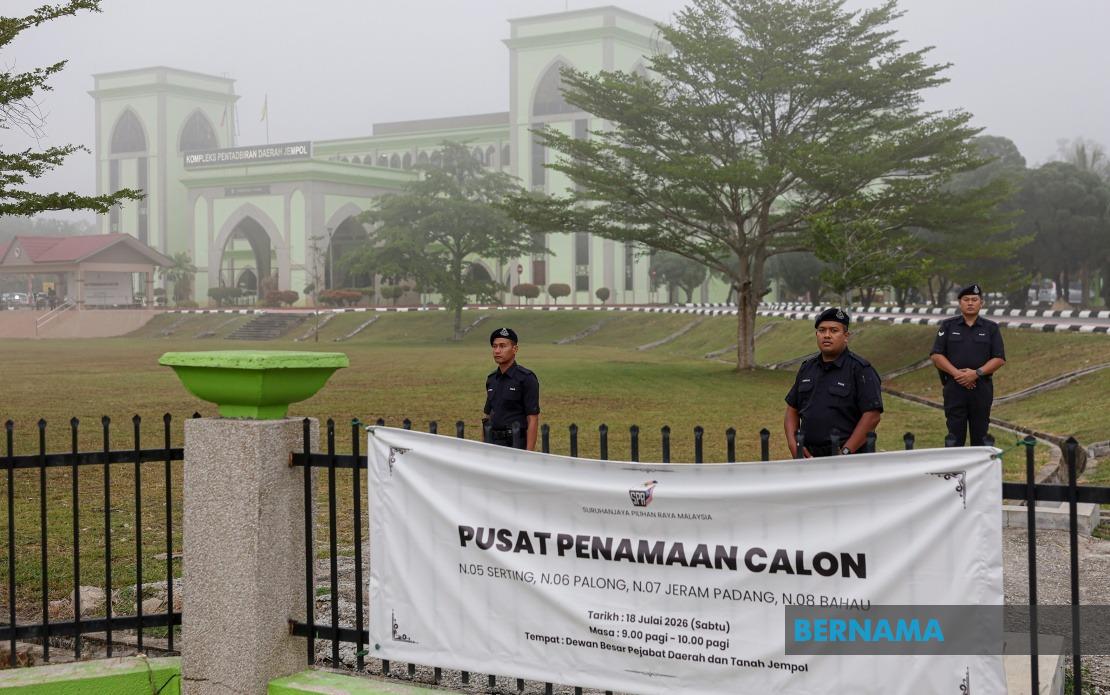
The candidate nomination process for the 16th Negeri Sembilan state election proceeded without incident on July 18, as all eight polling centres across the state's districts welcomed prospective candidates from 9 am. The one-hour registration window, which closed at 10 am, represented the formal gateway for individuals seeking to contest seats in the 36-seat state assembly. Election officials subsequently announced the validated candidate list following the completion of nominations, triggering the commencement of the official campaign phase.
Authorities had implemented comprehensive security arrangements to ensure the smooth operation of the nomination day proceedings. Datuk Alzafny Ahmad, the state police chief, confirmed that 2,393 police personnel had been strategically positioned across the nomination centres to monitor activities and maintain public order. The substantial deployment reflected the importance placed on safeguarding the electoral process during this critical preliminary phase, a concern that remains pertinent across Malaysian electoral contests where maintaining confidence in institutional integrity proves essential.
The electoral campaign will span exactly 14 days from the announcement of nominated candidates through July 31, allowing parties and independent contenders a defined period to present their platforms to voters. This structured timeline, established by electoral authorities, creates a compressed but intensive period for campaigning across all seven districts of Negeri Sembilan. The relatively short campaign window presents particular challenges for candidates competing outside the established party machinery, potentially disadvantaging grassroots movements and independent contenders who may lack institutional resources and established communication networks.
Weather conditions favoured the conduct of nomination day activities, with observers noting stable atmospheric circumstances throughout Negeri Sembilan's seven districts. Clement weather patterns minimized logistical complications for voters and officials alike, eliminating weather-related disruptions that could have complicated the registration process. Such operational smoothness stands in contrast to some previous Malaysian electoral events, where monsoon conditions or unexpected climate events have occasionally necessitated procedural adjustments or date modifications.
The 16th election itself follows the constitutionally mandated dissolution of the state assembly on June 5, which occurred subsequent to formal authorization from Tuanku Muhriz Tuanku Munawir, the Yang Dipertuan Besar of Negeri Sembilan. This procedural requirement underscores the constitutional role of the hereditary ruler in state-level governance frameworks, distinguishing Malaysia's electoral architecture from purely parliamentary systems. The timing of dissolution aligned with the culmination of the previous assembly's natural tenure, avoiding any perception of early termination or political maneuvering.
The election timetable indicates that early voting will occur on July 28, permitting military personnel, their spouses, and police officers to cast ballots ahead of the general polling date. This accommodation recognizes the operational demands placed on security personnel who may be engaged in electoral security duties on the primary voting day. The comprehensive electoral roll, updated as of June 4, 2026, identifies 889,490 registered voters across Negeri Sembilan, comprising 867,151 ordinary civilians alongside 16,884 military-affiliated voters and 5,455 police personnel eligible for early voting.
Negeri Sembilan's electoral landscape reflects the broader competitive dynamics that have reshaped Malaysian politics over recent election cycles. The previous 2023 state election produced a coalition outcome, with Pakatan Harapan securing 17 of 36 seats and thus governing control, Barisan Nasional maintaining 14 seats as the principal opposition force, and Perikatan Nasional capturing five seats. This fragmented outcome differs markedly from earlier eras when Barisan Nasional dominated state legislatures comprehensively, reflecting the electorate's increasing willingness to distribute support across multiple political vehicles and coalitions.
For Malaysian observers and regional analysts tracking democratic processes in Southeast Asia, Negeri Sembilan's election mechanisms demonstrate the institutional maturity and procedural consistency characterizing Malaysian electoral administration at state level. The Election Commission's orchestration of concurrent nomination processes across multiple centres, coupled with coordinated security deployments and transparent candidate verification procedures, reflects institutional capacity that sets Malaysia apart from several regional peers. However, the compressed campaign window and the structural advantages enjoyed by established parties continue to shape competitive dynamics in ways that merit ongoing scholarly and journalistic scrutiny.
The August 1 polling date marks the culmination of a process initiated on July 18, representing the electorate's opportunity to determine state leadership composition for the subsequent assembly term. Voters across Negeri Sembilan will navigate the ballot after a fortnight of campaign messaging, policy presentations, and political advocacy. The outcome will determine whether Pakatan Harapan consolidates its 2023 positioning, whether Barisan Nasional successfully recaptures assembly control, or whether the fragmented political environment produces another coalition-dependent administration. Ultimately, the 16th state election demonstrates Malaysia's commitment to regular democratic renewal while highlighting the increasingly competitive nature of Malaysian electoral politics.

