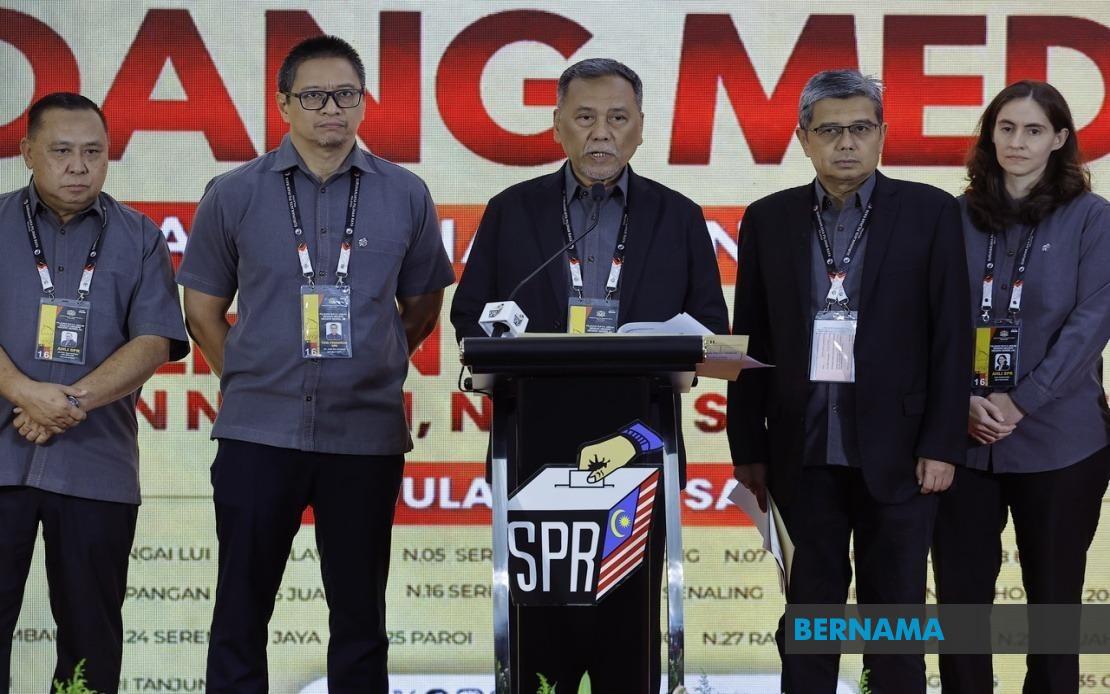
The 16th Negeri Sembilan state election will see a particularly fragmented political landscape, with the Election Commission confirming that 103 eligible candidates will contest across the state's 36 assembly seats. The proliferation of three-cornered battles—affecting nearly 60% of constituencies—signals intensifying competition beyond the traditional two-party system and reflects the evolving political dynamics in one of Malaysia's smaller states.
Election Commission chairman Datuk Seri Ramlan Harun announced the final candidate count on July 18 after the nomination verification process concluded at nomination centres statewide. The breakdown reveals Pakatan Harapan's commanding position in this contest, with the coalition fielding the largest contingent at 36 candidates. Barisan Nasional follows with 25 candidates, while Bersatu brings 24 contenders to the race. Perikatan Nasional, despite its national profile, has a more limited presence here with just 11 candidates. This distribution underscores how Pakatan Harapan continues to consolidate its appeal in this central peninsular state, though fragmentation in the broader opposition camp through Bersatu's separate candidacies could potentially reshape seat outcomes.
Beyond the major coalitions and parties, smaller political entities are also making their presence felt. Berjasa, the Malaysian Orang Asli Party (ASLI), and the Socialist Party of Malaysia (PSM) each put forward a single candidate, reflecting either their targeted approach or limited organisational capacity in the state. Additionally, four independent candidates are running, a phenomenon that has become increasingly common in Malaysian state elections as voters occasionally champion localised, non-partisan figures. Together, these fringe candidates add unpredictability to specific contests, particularly where margins are expected to be narrow.
The electoral terrain is notably uneven across constituencies. While 21 seats will feature three-cornered contests—the dominant configuration—11 seats will see straightforward two-candidate races that typically favour incumbents with strong ground machinery. Two constituencies, Nilai and Sri Tanjung, will witness five-cornered battles, creating scenarios where vote-splitting becomes acute and second-place finishes cannot be automatically discounted. Jeram Padang and Rahang each present four-candidate fields, further complicating vote arithmetic. These fragmented contests may ultimately decide whether Pakatan Harapan can convert its numerical candidate advantage into seat gains or whether Barisan Nasional's organisational experience in fewer seats yields better returns.
Demographic details of the candidate pool reveal a pronounced gender imbalance common across Malaysian elections. Of the 103 candidates, 94 are male and only nine are female, a ratio that reflects persistent underrepresentation of women in electoral politics despite increasing advocacy for parity. Age diversity spans from a 23-year-old Bersatu representative contesting in Sri Tanjung to a 70-year-old Pakatan Harapan aspirant in Gemencheh, indicating that political recruitment in Negeri Sembilan draws from across generational lines. However, the dominance of middle-aged candidates remains characteristic of Malaysian politics generally.
The electoral machinery is now fully mobilised for a condensed campaign period. The Election Commission has designated July 28 for early voting, accommodating military personnel, their spouses, and police officers among the approximately 889,490 registered voters in the state. Polling day itself falls on August 1, giving candidates and parties roughly two weeks from nomination closure to campaign intensively. This timeline, while standard for Malaysian state elections, concentrates messaging and voter outreach into a relatively brief window, favouring well-resourced organisations with existing voter databases and media access.
The eligible voter roll reflects Negeri Sembilan's composition and security apparatus footprint. Of the total 889,490 voters, 867,151 are ordinary civilian electors, while 16,884 military personnel and their spouses are enrolled, and 5,455 police officers constitute the security sector component. This distribution—where defence and law enforcement personnel represent roughly 2.5% of the electorate—is substantial enough to influence outcomes in tight contests, particularly where military or police communities dominate specific constituencies. Both coalitions typically invest effort in appealing to these communities, given their organisational coherence and higher-than-average turnout propensities.
Negeri Sembilan's assembly was dissolved on June 5, setting this election's timeline in motion. The state has proven politically dynamic in recent electoral cycles, with shifting allegiances between Pakatan Harapan and Barisan Nasional reflecting both national political currents and local grievances around development, administrative efficiency, and representation. The fragmentation evident in this candidate distribution suggests voters may be increasingly willing to consider alternatives beyond traditional coalitions, though whether this translates into actual seat changes remains to be seen on August 1.
For Malaysian political observers and the broader Southeast Asian context, Negeri Sembilan's election offers an important barometer of coalition stability and voter sentiment outside major urban centres. As a mid-sized state with neither the profile of Selangor and Penang nor the marginalised position of smaller jurisdictions, electoral outcomes here often signal broader regional trends that subsequently influence national calculations among party leadership. The prevalence of three-cornered contests and the active candidacies of smaller parties suggest the Malaysian political landscape continues fragmenting, even as major coalitions attempt consolidation.

