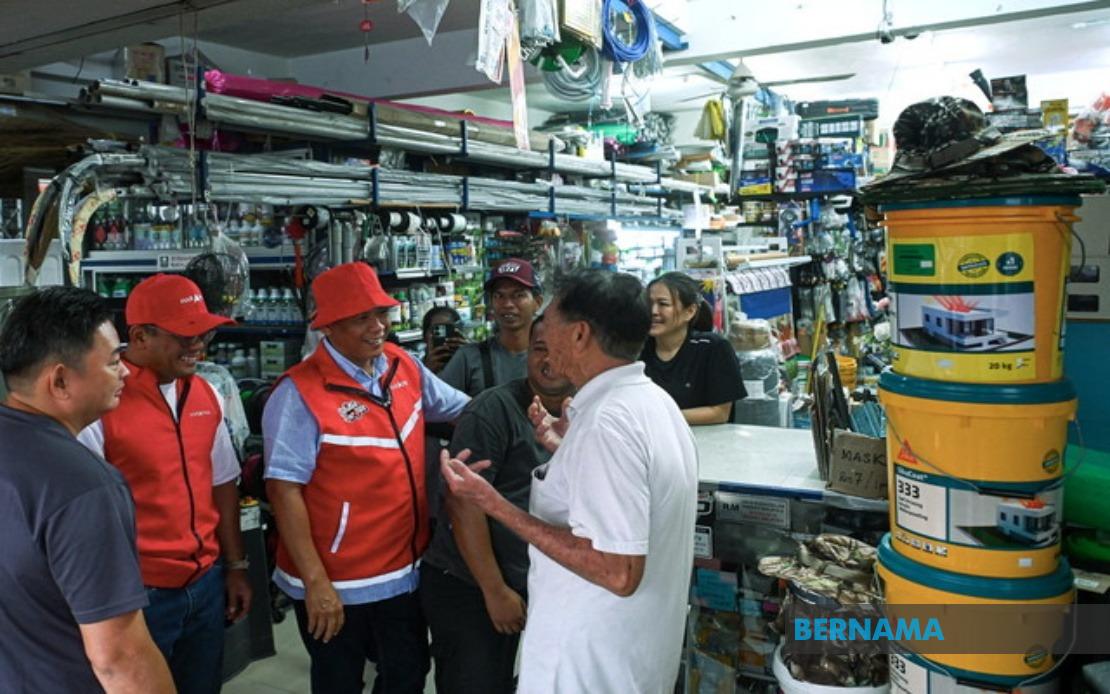
Negeri Sembilan's investment performance under the Pakatan Harapan administration has substantially outpaced the targets pledged by Barisan Nasional in its manifesto for the upcoming 16th state election, according to Menteri Besar Datuk Seri Aminuddin Harun. Speaking during a campaign walkabout in Pekan Linggi on July 25, the PH state chairman drew a stark contrast between the incumbent government's economic delivery and the opposition coalition's campaign promises, highlighting what he characterised as a significant gap between BN's ambitions and PH's tangible results.
The comparison centres on a crucial economic metric: foreign and domestic investment flows. Barisan Nasional's election manifesto, unveiled just a day before Aminuddin's remarks, commits the coalition to attracting RM30 billion in fresh investments over a five-year governing term if voters grant them the mandate. This target, while substantial, now appears modest when measured against the pace of capital inflows under the current administration. The Menteri Besar emphasised that Negeri Sembilan achieved RM19 billion in recorded investments during 2023 alone, followed by nearly RM13 billion captured in the first half of 2024, cumulatively exceeding the RM30 billion threshold in approximately 18 months of governance.
This acceleration speaks to a broader state development strategy that positions Negeri Sembilan as an increasingly attractive destination for manufacturing and commercial enterprises. Rather than resting on these achievements, the PH state government has deliberately set an even more ambitious annual investment target of RM10 billion going forward. According to Aminuddin, this higher benchmark reflects the administration's assessment of Negeri Sembilan's genuine economic potential and capacity for sustained growth, essentially signalling confidence that the state can maintain or exceed current momentum.
The investment conversation carries particular significance for Negeri Sembilan's development trajectory and employment landscape. Historically, the state has struggled with outmigration as younger citizens and professionals sought better career opportunities in Kuala Lumpur, Selangor, and other more industrialised regions. Investment growth directly translates into job creation, wage growth, and the prospect of retaining talent within the state borders. By expanding the investor base and industrial capacity, the PH administration aims to create conditions where residents can build sustainable careers without abandoning their home state.
Aminuddin's remarks also touched on divergent development philosophies regarding Malaysia Vision Valley, a strategically important economic zone within Negeri Sembilan. The BN manifesto proposes restructuring development approaches for this corridor, presumably to balance industrial expansion with residential projects. The Menteri Besar countered that the PH state government has already shifted priorities toward industrial-led development, deliberately deprioritising housing projects in favour of manufacturing and commercial facilities. This sequencing reflects a conviction that job creation must precede residential expansion, ensuring that new housing development is driven by genuine economic demand rather than speculation.
These development strategy differences underscore broader competing visions for Negeri Sembilan's future. The Pakatan Harapan approach emphasises establishing the state as a self-contained economic hub capable of generating quality employment and sustaining middle-class lifestyles, reducing dependence on neighbouring states. The implicit critique of BN's approach is that residential-first development risks recreating patterns of dormitory towns that feed workers into Selangor and Kuala Lumpur rather than creating genuinely integrated economic communities.
Social assistance policies also featured in Aminuddin's electoral pitch, with the Menteri Besar claiming that while both coalitions offer similar incentive schemes, the PH administration has adopted a more expansive targeting mechanism. Specifically, Pakatan Harapan extends economic benefits to the M40 income group—the middle 40 percent of earners—while maintaining support for the B40 population, effectively broadening the welfare net compared to traditional BN approaches that typically prioritised lower-income brackets. This positioning attempts to capture middle-class voters who may feel excluded from narrowly targeted poverty-reduction schemes.
The timing of these claims matters considerably. With early voting scheduled for July 28 and election day set for August 1, the Negeri Sembilan campaign has entered its decisive phase. Aminuddin's walkabout in Pekan Linggi, where he himself contests the Linggi seat, reflects the ground-level intensity of PH's push to retain state government control. The involvement of Datuk Seri Amirudin Shari, the national PH election director, signals that the party hierarchy views Negeri Sembilan as a significant electoral battleground despite the state's relatively modest population compared to Selangor or Pahang.
For Malaysian observers watching regional political trends, the Negeri Sembilan contest offers insights into how incumbent administrations leverage economic performance narratives in defending electoral ground. The stark differential Aminuddin presented—achieving a five-year target in 18 months—serves as a powerful rhetorical tool, though voters will ultimately weigh such claims against their lived experiences of employment, cost of living, and infrastructure development.
The election's outcome will partly reflect whether Negeri Sembilan residents perceive the Pakatan Harapan government's investment-focused development model as delivering tangible benefits to their communities. Opposition parties may counter that headline investment figures mask concerns about job quality, wage levels, or whether foreign direct investment flows to capital-intensive industries that employ relatively few workers. Such nuanced economic debates typically carry less electoral weight than broader sentiments about governance competence and future prospects.
Negeri Sembilan's August 1 election occurs amid broader Malaysian political realignment, with both PH and BN competing intensely for state-level control. The state government's investment performance claims represent the administration's central defence against electoral challenge—essentially arguing that economic progress justifies continuity. Whether voters respond positively to this pro-growth narrative, or whether they demand additional focus on cost-of-living pressures and social services, will determine whether Pakatan Harapan retains control of this strategically located state in Malaysia's central region.

