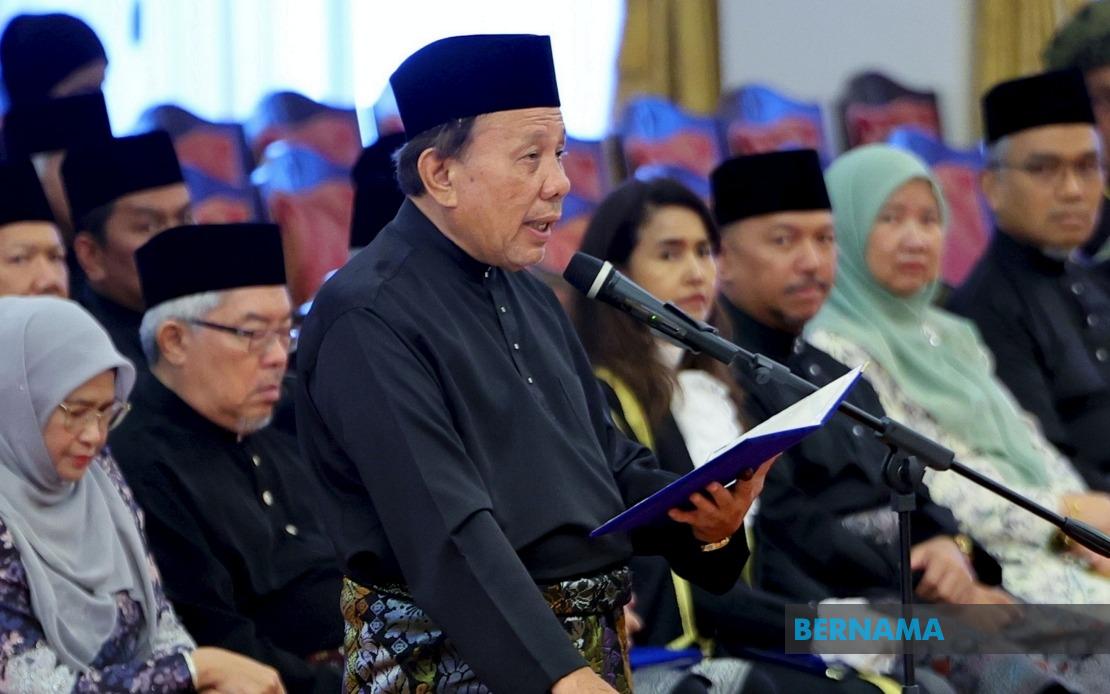
Datuk Ismail Lasim officially assumed office as Negeri Sembilan's Menteri Besar during a swearing-in ceremony held at Istana Besar Seri Menanti before Yang Dipertuan Besar Tuanku Muhriz Tuanku Munawir, marking a significant transition in the state's political leadership following the 16th State Election. The Kuala Pilah-based ceremony represented not merely a procedural milestone in the state's administrative calendar, but a symbolic moment reflecting the democratic mandate recently conferred upon the new administration through the electoral process.
In his oath of allegiance address, Ismail framed the electorate's decision as carrying profound implications extending beyond political victory. He characterised the public mandate as a demonstration of trust that demands nothing less than diligent governance, genuine responsiveness to constituent needs, and unwavering commitment to equitable administration. This framing positioned the incoming administration within a broader social contract paradigm, where electoral support imposes reciprocal obligations upon those entrusted with state power rather than merely conferring unchecked executive authority.
The new Menteri Besar explicitly committed to safeguarding institutional integrity by upholding the sovereignty and constitutional prerogatives of the Yang Dipertuan Besar, acknowledging the paramount importance of Malaysia's constitutional monarchy framework. Ismail's emphasis on adhering to royal guidance and the principles of Constitutional Monarchy alongside Parliamentary Democracy underscores the delicate institutional balance that characterises Malaysian governance, particularly relevant in Negeri Sembilan where the Ruler exercises distinctive constitutional powers within the Federation's federalist architecture.
Ismail articulated a vision for state development that transcends conventional metrics of progress, deliberately rejecting narrow quantitative assessments based solely on infrastructure proliferation or gross economic expansion. Instead, he advocated for a holistic development paradigm encompassing social wellbeing, institutional resilience, community cohesion, and sustained public confidence in governmental systems. This philosophical positioning suggests awareness of mounting public expectations across Malaysia for governance that addresses qualitative dimensions of life—social harmony, institutional accountability, and equitable wealth distribution—beyond traditional development indicators.
Central to Ismail's governance framework is the preservation and contemporary application of Adat Perpatih, Negeri Sembilan's distinctive customary legal system founded upon principles of consensus, equity, collective welfare, and prudent decision-making. By pledging to embed these traditional values within modern state policymaking, the new administration acknowledges the cultural specificity of Negeri Sembilan's constitutional arrangement and seeks legitimacy through cultural continuity rather than purely technocratic governance models. This approach holds implications for how the state navigates contemporary policy challenges while maintaining institutional coherence with its historical traditions.
The incoming administration outlined economic and social priorities encompassing private sector engagement, employment generation, educational advancement, healthcare expansion, agricultural development, and housing provision. These conventional policy objectives reflect standard concerns facing Malaysian states, yet their articulation within a framework emphasising people-centric implementation distinguishes the stated approach. Ismail's commitment to ensuring rural and urban populations equitably benefit from development initiatives addresses persistent concerns regarding uneven regional growth patterns that have characterised Malaysian development for decades.
Ismail placed particular emphasis on establishing transparent administrative systems and institutional trust as foundational elements of effective governance. His references to integrity, efficiency, and professional civil service commitment suggest awareness that administrative legitimacy derives substantially from perception of institutional fairness and adherence to established procedural norms. For Malaysian readers accustomed to periodic governance controversies, such explicit pledges regarding transparency constitute implicit acknowledgment of public skepticism that must be systematically addressed through consistent administrative practice rather than rhetorical assertion.
The new Menteri Besar highlighted consensus-building and receptiveness to constructive criticism as governance principles, positioning these orientations as essential for long-term institutional sustainability. This emphasis on listening mechanisms and inclusive decision-making processes distinguishes his stated approach from more hierarchical or personalised governance models, suggesting commitment to deliberative processes that incorporate diverse stakeholder perspectives. For Negeri Sembilan specifically, such commitments carry particular weight given the state's tradition of consultative governance rooted in Adat Perpatih principles.
Ismail's recognition of his predecessor Datuk Seri Aminuddin Harun's contributions and developmental achievements demonstrates institutional continuity and gracious political succession, elements often absent from more acrimonious transitions. By positioning current development foundations as platforms for future advancement rather than declaring programmatic rupture, the incoming administration signals evolutionary rather than revolutionary governance approaches. This continuity orientation may prove strategically important for maintaining investor confidence and administrative momentum during the inevitable transition period.
The broader significance of Ismail's inaugural address extends beyond Negeri Sembilan's immediate political context to reflect evolving Malaysian expectations regarding state leadership. The emphasis on transparent, accountable, people-centred administration mirrors governance demands increasingly articulated across the Federation, suggesting that state administrations must demonstrate substantive commitment to institutional integrity and equitable policymaking. For other Malaysian states monitoring Negeri Sembilan's governance trajectory, the new Menteri Besar's explicit commitments regarding transparency, civil service professionalism, and anti-corruption measures establish benchmarks against which his administration's subsequent performance will inevitably be evaluated.
Moving forward, the critical test for Ismail's administration will involve translating rhetorical commitments regarding transparency, fairness, and people-centric governance into tangible administrative reforms and perceptible improvements in public service delivery. The gap between inaugural pledges and implemented reality frequently determines public assessments of political leadership, particularly in an era of heightened institutional skepticism and sophisticated media scrutiny. Negeri Sembilan's citizens and broader Malaysian observers will be watching whether the new administration's actions substantively reflect the governance principles articulated during this swearing-in ceremony.

