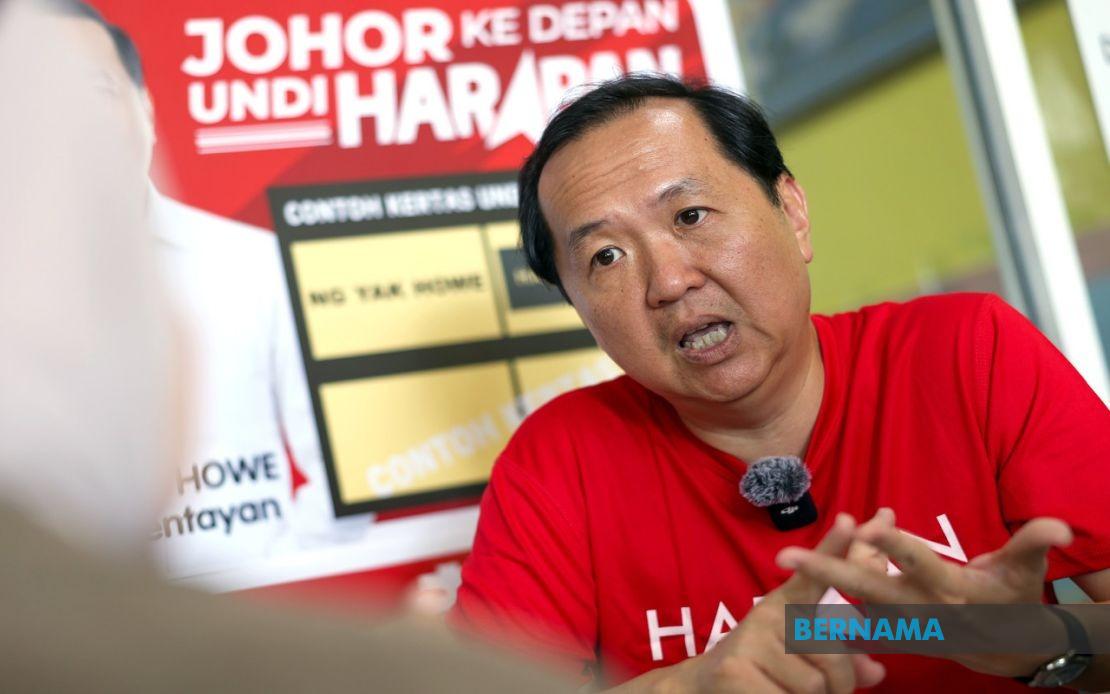
Pakatan Harapan's Ng Yak Howe, the incumbent assemblyman contesting the Bentayan state seat, has identified the rejuvenation of Muar town centre as his campaign's cornerstone issue ahead of Johor's state election on July 11. The challenge he seeks to address reflects a pattern increasingly visible across Malaysian towns: the gradual hollowing of urban cores as residents relocate to sprawling suburban developments, leaving commercial districts to languish during off-peak hours despite daytime vitality.
The Bentayan constituency encompasses more than half of Muar's town centre, positioning Ng's political fortunes closely to the area's economic health. His observations reveal a familiar urban malady—thriving business activity during working hours that evaporates into quiet streets once offices close and the working population disperses homeward. This pattern, replicated in towns nationwide, reflects deeper structural shifts in how Malaysians live and consume, from high-street shopping to suburban malls and residential enclaves. The vacancy rate itself, at 18 per cent of commercial premises, serves as a tangible measure of economic decline that troubles both business owners and local authorities.
Ng's approach to reversing this trend centres on attracting younger residents back to the town centre through a combination of commercial incentives and lifestyle programming. This reflects an emerging consensus among urban planners and politicians that demographic revitalisation requires more than property development—it demands deliberate cultivation of nightlife, entertainment, and community gathering spaces. His strategy acknowledges that economic activity alone cannot sustain urban vitality; the perception of a safe, vibrant, and culturally engaging environment remains equally critical to winning back residents who have become accustomed to suburban convenience.
Collaboration with the Bakri Member of Parliament, Tan Hong Pin, has already yielded tangible initiatives, including cash voucher schemes and lucky draw campaigns designed to redirect consumer spending toward the town centre. These stimulus measures, while temporary, serve a broader purpose: they generate momentum and media visibility that can help reverse the psychological perception of decline. Such coordinated efforts between state and federal representatives demonstrate the multi-level governance challenge posed by urban decay—a problem that transcends a single constituency's administrative boundaries and requires synchronized policy implementation.
Ng brings professional credentials to this platform. His background as a quality assurance engineer with more than a decade of industry experience suggests an emphasis on systematic problem-solving and measurable outcomes rather than rhetorical flourish. This technical orientation may resonate with business owners and traders seeking evidence-based approaches to their district's revival rather than simply promises of intervention. His quarter-century involvement in politics also positions him as someone with institutional memory of past cycles of prosperity and decline in Muar.
The political landscape in Bentayan will be contested directly between Ng and Barisan Nasional candidate Chua Lee Huat, a straight fight for a seat commanding 34,205 registered voters. In Johor's broader context, where the state has experienced significant political volatility in recent election cycles, such direct contests often amplify the importance of incumbent performance and local development delivery. Ng's bid for a third term effectively asks voters to validate his track record and vision against an alternative vision represented by his BN challenger.
The election itself, scheduled for July 11 with early voting on July 7, forms part of Johor's 16th state election, where 172 candidates overall compete across 16 state seats. This broader electoral context matters: Johor's political direction influences regional power dynamics within Malaysia, affecting not only state-level governance but also federal parliamentary representation and coalition positioning ahead of potential future national polls. A strong PH performance in urban-centred seats like Bentayan would signal voter appetite for opposition governance in strategic economic zones.
Muar town centre's fate carries implications beyond Johor's borders. Similar commercial districts across Malaysia face comparable pressures from suburbanisation, e-commerce expansion, and changing retail patterns. Success stories in revitalising such centres could provide replicable models for other towns confronting similar decline. Conversely, failure to arrest the slide might accelerate the transition toward dispersed economic activity patterns that characterise modern Southeast Asian urban development, fundamentally altering how towns function and serve their populations.
The emphasis on attracting younger demographics speaks to demographic realities facing many Malaysian towns. Without deliberate intervention to make urban centres appealing to younger cohorts, towns risk becoming residential repositories for older populations while economic dynamism concentrates elsewhere. Ng's strategy implicitly recognises this generational challenge, suggesting that urban revival requires not merely commercial restoration but the cultivation of environments where younger Malaysians choose to live, work, and spend leisure time.
For Malaysian readers observing local and state electoral contests, Ng's campaign illustrates how granular, constituency-level issues connect to broader urbanisation challenges. His prioritisation of town centre revival reflects growing political awareness that economic inequality and spatial disparities between thriving commercial hubs and declining traditional districts constitute legitimate electoral concerns worthy of policy attention and resource allocation.

