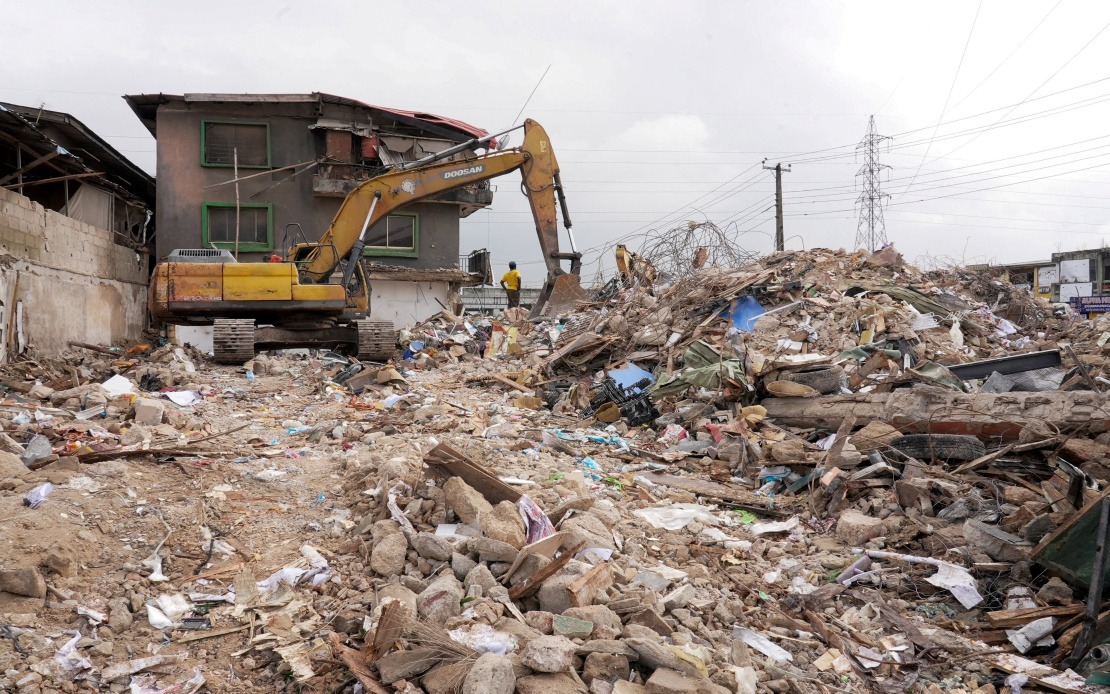
A three-storey shopping complex in the Alakija district of Lagos state, Nigeria, collapsed on Thursday morning, leaving nine people dead and prompting an intensive search-and-rescue operation that concluded Friday. Among the 27 individuals pulled from the wreckage were shop proprietors, customers conducting business, and nearby residents caught in the disaster. The incident unfolded along the Lagos-Badagry Expressway, a major commercial corridor in Nigeria's most populous state, disrupting economic activity in the growing satellite community.
Emergency response teams mobilized swiftly after the structural failure, with the Lagos State Emergency Management Agency coordinating a multi-agency effort that operated continuously through the night. Olufemi Oke-Osanyintolu, the permanent secretary of the state's emergency management office, confirmed that rescue personnel worked without pause to locate survivors trapped beneath concrete and debris. The rescued individuals sustained injuries ranging from minor to severe, necessitating immediate hospitalization and medical intervention at local health facilities.
The composition of those affected underscores the commercial vitality of the location. Most casualties were retail business operators and shoppers who had opened their establishments for the day's trading when the structure gave way. The timing of the collapse—during peak morning business hours—likely increased the death toll and injury count significantly. Local residents dwelling in adjacent structures also found themselves at risk, adding to the complexity of the rescue operation.
Acknowledging the scale of the emergency, the China Civil Engineering Construction Corporation, which operates a railway development project in the surrounding area, deployed resources and personnel to assist in extracting victims from the rubble. This partnership between state authorities and a major infrastructure firm demonstrated the interconnected nature of construction activity and emergency response capacity in urban Lagos. By early Friday, rescue coordinators announced that all individuals beneath the collapsed structure had been located and evacuated, bringing the intensive operation to a conclusion.
The fundamental cause of the collapse remains under investigation by relevant authorities, with preliminary inquiries just beginning. Nigerian structural engineers and building inspectors face the challenging task of determining whether the failure resulted from design flaws, construction defects, material degradation, or improper maintenance. The initial investigation phase will establish crucial details about building permits, compliance certifications, and the structural integrity assessment history of the complex.
For Malaysian observers and Southeast Asian stakeholders monitoring construction standards across the region, the Lagos incident reflects broader patterns of structural vulnerability affecting rapidly urbanizing African cities. Building failures in Nigeria have emerged as a recurring public health crisis, driven by multiple interconnected factors that extend beyond any single incident. Experts consistently identify aging infrastructure as a primary concern, particularly in cities where post-colonial construction often lacks adequate reinforcement and periodic structural auditing.
Violations of established building codes and regulations represent another critical vulnerability. In many Nigerian jurisdictions, enforcement mechanisms remain underfunded and inconsistently applied, enabling developers to circumvent safety requirements without meaningful consequences. Inspectors may lack proper training or resources, creating gaps between official standards and ground-level reality. Corrupt practices sometimes allow substandard construction to proceed, with inspectors and officials overlooking obvious violations in exchange for informal payments.
The use of inferior construction materials constitutes a third major contributor to structural failures. Cost-cutting measures by developers, combined with weak material certification systems, mean that concrete, steel reinforcement, and other critical components sometimes fail to meet specified engineering standards. Building sites may employ materials salvaged from demolished structures or sourced from suppliers unwilling to invest in quality control. These practices accumulate structural defects that remain hidden until catastrophic failure occurs.
The Alakija collapse adds to a troubling statistical record. Lagos and other Nigerian metropolitan areas experience multiple building disasters annually, a pattern that suggests systemic rather than anomalous problems. Each incident produces official pledges to strengthen enforcement, improve training, and enhance oversight. Yet implementation of these reforms proceeds slowly, constrained by budgetary limitations, competing priorities, and institutional capacity constraints affecting many African states.
For the broader West African region, including coastal nations like Ghana and Côte d'Ivoire experiencing similar rapid urbanization, the Lagos incident serves as a cautionary example of what occurs when construction regulation weakens. Malaysia's experience developing robust building codes and inspection regimes offers relevant lessons for policymakers seeking to prevent comparable disasters. The intersection of rapid urban growth, informal construction sectors, and formal regulatory frameworks creates unique challenges requiring sustained political commitment.
The immediate human tragedy extends beyond those directly affected. Survivors will require ongoing medical care and rehabilitation. Families grieving lost relatives face both emotional trauma and potential economic hardship if deceased breadwinners have not left adequate provisions. The surrounding commercial district experiences disruption as investigators secure the site and business confidence deteriorates. Broader public anxiety about building safety affects residential and commercial real estate markets throughout Lagos.
Regulatory authorities in Nigeria have initiated investigations that will eventually produce findings and potentially recommendations for procedural or legal reforms. International construction standards organizations and development partners may offer technical assistance to strengthen oversight mechanisms. However, translating findings into sustained institutional improvement requires consistent resource allocation and political will extending far beyond the immediate crisis response. The challenge facing Lagos and similar cities involves fundamentally addressing the underlying structural conditions that make building failures predictable and preventable failures remain inadequately addressed.

