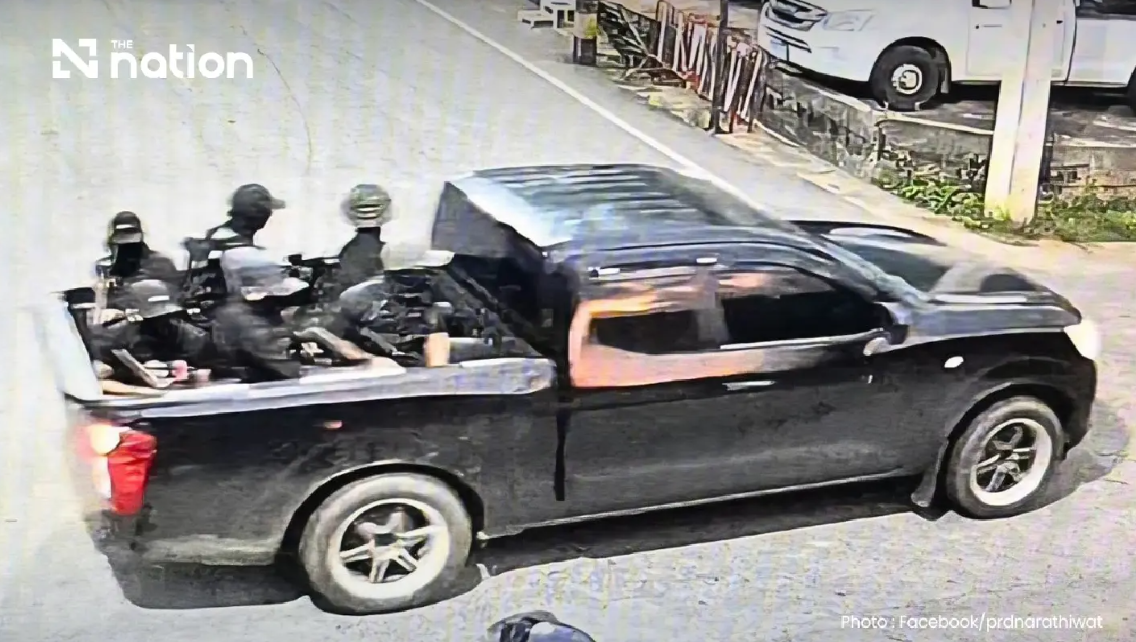
Security camera recordings have provided a detailed account of how nine armed assailants executed a lightning-fast attack on the Bukeh Sami checkpoint in Narathiwat's Ra-ngae district on Wednesday evening, resulting in the deaths of five paramilitary rangers and injuries to six civilians. The July 22 raid at approximately 6.45pm demonstrated operational coordination and tactical discipline, with the two-pronged assault lasting just 90 seconds before the attackers withdrew from the scene.
Initial assessments by investigators suggested a smaller force of six participants was responsible for the violence. However, detailed examination of surveillance recordings from multiple angles surrounding the checkpoint later revealed a nine-person unit divided into two distinct operational teams. The enlarged assessment prompted authorities to reassess their understanding of the group's capability and training level, signalling a more sophisticated attack than initially suspected.
The primary assault force comprised seven individuals transported in a black Nissan pickup truck bearing a Songkhla registration plate numbered ผน 6866. While one member operated the vehicle, the remaining six occupied the cargo bed, dressed in tactical black clothing and wide-brimmed hats that obscured their facial features to resemble paramilitary dress code. A secondary team arrived on a red-and-white Honda Wave motorcycle, with the operator wearing a white shirt and crash helmet. The motorcycle passenger adopted a deliberate disguise by wearing a black women's hijab and carried an AK-pattern rifle, with the motorcycle driver believed to be armed with an 11mm pistol. This rear security element maintained protective positioning as the main force approached the checkpoint from the direction of Tanyong Mat market.
Three ranger personnel stood guard at the roadside perimeter when the pickup decelerated upon reaching the checkpoint entrance. The armed occupants in the truck bed immediately discharged M16 and AK-type rifles at the three standing officers, quickly overwhelming their defensive capability. As the initial targets fell, the vehicle came to a halt and additional group members disembarked to engage the checkpoint structure and its protective bunker, where two additional rangers had taken position. The gunfire directed against the fortified bunker left visible impact marks across its surface, demonstrating the intensity and volume of the assault.
Following the suppression of armed resistance, the raiders conducted a rapid search through the checkpoint facility, systematically removing weapons and equipment as part of their apparent objective. A pipe bomb was hurled towards an elevated infrastructure element situated adjacent to a nearby bridge during the retreat phase. The tactical withdrawal saw both the pickup truck and supporting motorcycle depart towards Dusongyo subdistrict, with the entire operation consuming minimal time.
All five rangers assigned to the checkpoint perished in the assault at the location. The fallen personnel were identified as Sergeant Major First Class Theerayut Somakerd and ranger volunteers Sakiriya Jena, Wimon Dabthong, Nattasit Kaewsena and Salahudin Pi, all members of the 4509th Ranger Company under the 45th Ranger Regiment Task Force. Additionally, six civilians sustained injuries during the violence, including a 10-year-old child, with all wounded individuals evacuated to regional medical facilities for treatment. Initial casualty reporting fluctuated between two and five wounded civilians before stabilizing at the confirmed figure of six.
Narathiwat Governor Boonchuay Homyamyen coordinated with senior law enforcement and military commanders throughout an intensive overnight forensic investigation. Key personnel overseeing the examination included Provincial Police Region 9 commissioner Pol Lt Gen Piyawat Chalermsri, Narathiwat police chief Pol Maj Gen Prayong Khot Sakha and Col Witthaya Sariya, commanding the 45th Ranger Regiment Task Force. Explosive disposal specialists, tactical response units and forensic collection teams operated through the night to document evidence and reconstruct the sequence of events.
Ballistical analysis recovered more than 100 expended cartridge casings scattered across the access road and surrounding grounds, including spent rounds consistent with M16 rifles, AK-pattern weapons and the 11mm pistol. Additional ammunition discovered at the scene appeared to have been ejected during weapon clearing procedures, suggesting the assailants experienced mechanical difficulties with at least one firearm during the engagement. The bunker structure bore extensive evidence of concentrated gunfire, while materials related to the pipe bomb detonation were collected near the bridge-adjacent structure.
Inventory assessments revealed that the raiding party had absconded with four folding-stock AK-type rifles, one 11mm pistol, four ammunition magazines and four ballistic protective vests. Authorities acknowledged ongoing uncertainty regarding the complete inventory of missing items, as preliminary accounts from checkpoint personnel contained discrepancies about both the quantity and specific classifications of equipment that had been seized. This accounting challenge complicated efforts to fully understand the attackers' material goals and preparatory sophistication.
The black Nissan pickup utilized in the assault was subsequently discovered abandoned and extensively burned, indicating a deliberate effort to eliminate forensic evidence and vehicle identification traces. Security personnel implemented expanded checkpoint systems and vehicular control points across potential escape corridors immediately following the attack, initiating pursuit protocols to apprehend the fleeing assailants. The incident underscores persistent security vulnerabilities in Thailand's southern border region and raises questions about intelligence capabilities and checkpoint protection standards for paramilitary installations tasked with counterinsurgency operations in conflict-affected provinces.
The attack represents a significant escalation in both coordination and lethality within Thailand's ongoing southern insurgency dynamics. The nine-person composition, two-team tactical structure and apparent firearms expertise suggest organizational capacity beyond typical ad-hoc militant activities. For Malaysian observers and regional security analysts, the incident illustrates the transnational security implications of Thailand's protracted southern conflict, particularly regarding potential recruitment networks, weapons procurement channels and cross-border operational reach that could theoretically extend into neighbouring jurisdictions.

