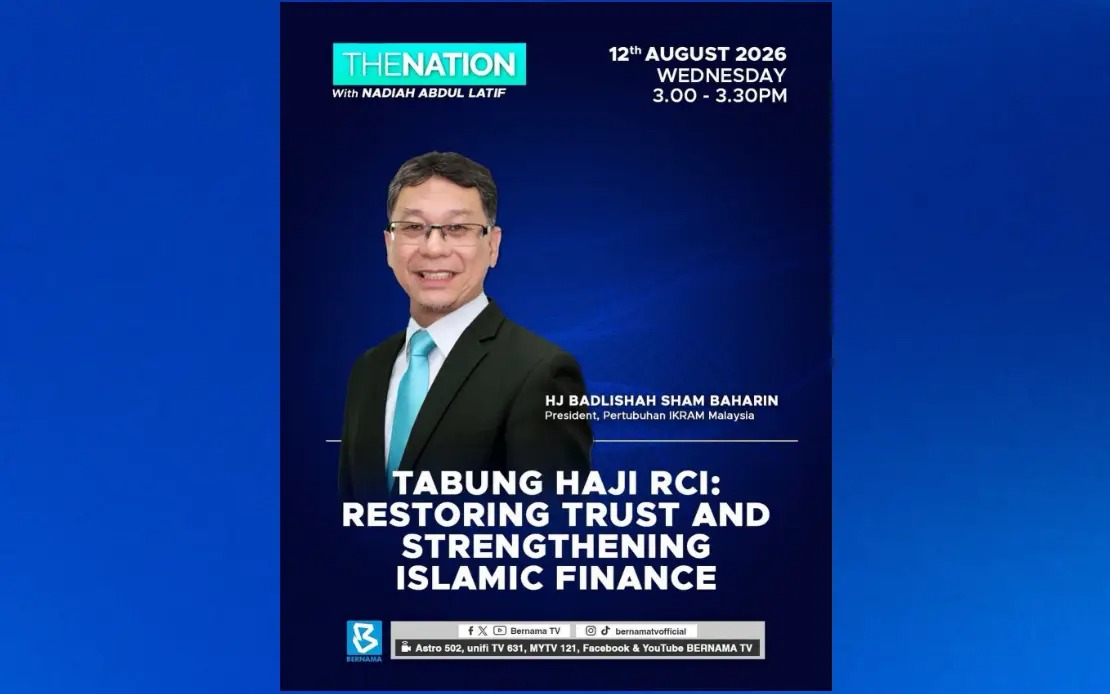
The Islamic finance advocacy group Pertubuhan IKRAM Malaysia has pushed back against growing calls from both government and opposition lawmakers for a fresh Royal Commission of Inquiry into Tabung Haji's operations, contending that existing investigative mechanisms already underway are sufficient to serve the interests of nearly 10 million depositors affected by the troubled pilgrimage fund.
IKRAM president Badlishah Sham Baharin articulated this position during an appearance on Bernama TV's "The Nation" programme, which examined faith-based financial governance. His remarks came as members of parliament from Barisan Nasional and Pakatan Harapan sought a new RCI to examine the 2021-2025 period, extending beyond the scope of an existing probe that covered only 2014 to 2020. The appetite for a second inquiry reflects mounting pressure from legislators concerned that gaps in the investigation may have allowed additional mismanagement to escape public scrutiny.
Badlishah Sham argued that establishing multiple RCIs for a single institution carries the danger of diminishing their institutional weight and authority. Royal Commissions, he suggested, function most effectively when reserved for exceptional circumstances and cases of grave national significance. Deploying them indiscriminately risks normalizing their use and eroding public confidence in their investigative integrity. Instead, Badlishah Sham advocated for reliance on existing law enforcement and oversight bodies such as the Malaysian Anti-Corruption Commission (MACC), which possess the statutory authority and investigative rigour to hold wrongdoers accountable and ensure legal consequences for any breaches uncovered.
Finance Minister II Datuk Seri Amir Hamzah Azizan provided a sobering financial assessment during recent parliamentary proceedings, revealing the staggering scale of Tabung Haji's investment losses. The fund incurred near-total losses across fourteen problematic investments, seven of which were entirely liquidated with zero recovery. The accumulated damage reached nearly RM13 billion, subdivided into RM10.2 billion absorbed by taxpayers through a 2018 government rescue via the vehicle Urusharta Jamaah Sdn Bhd (UJSB), alongside RM2.6 billion in write-downs recorded by Tabung Haji itself between 2018 and 2025 relating to investments still under management.
The Al-Rawda real estate venture emerged as the single largest hemorrhage within this portfolio. Between 2015 and 2017, Tabung Haji remitted approximately 1.4 billion Saudi riyals—equivalent to roughly RM1.5 billion—to intermediaries securing lease arrangements for four hotel properties in the holy cities of Makkah and Madinah designated to house Malaysian pilgrims. The structure unraveled catastrophically when Al-Rawda ceased rental remittances starting in the first quarter of 2019, ultimately compelling Tabung Haji to recognize a complete impairment loss of RM1 billion during 2024. This single investment exemplifies the governance failures that triggered the original RCI.
Despite his opposition to a new RCI, Badlishah Sham endorsed an alternative governance mechanism gaining traction among policy architects: a coordinated multi-agency task force designed to identify investments exhibiting early warning signals of distress and institute preventative measures against future replication of similar fiascos. Such an approach, he argued, places greater emphasis on anticipatory due diligence and procedural compliance conducted before capital deployment rather than post-facto investigations of damage already inflicted. Rigorous scrutiny at investment inception, scrutiny rooted in ethical Islamic finance principles and regulatory compliance protocols, must become the norm rather than exception.
The existing RCI, which examined Tabung Haji's operations spanning 2014 to 2020, released its findings in late July and contained twenty-five recommendations intended to fortify institutional safeguards and decision-making processes. By early August, Tabung Haji had already operationalized approximately seventy-five percent of these recommendations, suggesting some institutional momentum toward remediation, although critics question whether such reforms, implemented reactively and under political pressure, possess sufficient depth to prevent future misconduct.
Badlishah Sham's comments also extended to the conduct of certain opposition parliamentarians who walked out during the special Dewan Rakyat session devoted to debating the RCI report. He characterized this withdrawal as fundamentally irresponsible, highlighting that elected representatives bear a constitutional obligation to represent the interests of constituents and provide legislative scrutiny of executive action—responsibilities that persist regardless of partisan disagreement or dissatisfaction with governmental decisions. Walkouts, in his estimation, represent an abdication of this fiduciary duty to the 10 million Malaysians whose retirement security and pilgrimage savings rest within Tabung Haji's management.
Badlishah Sham further criticized what he characterized as performative opposition, wherein lawmakers conduct theatrical "debates" via social media platforms such as TikTok while absenting themselves from the legislative chamber where substantive parliamentary scrutiny must occur. The contrast between external posturing and internal disengagement, he suggested, betrays a fundamental misalignment between parliamentarians' public rhetoric and their actual legislative conduct. This disconnect undermines democratic accountability and deprives marginalized voices—those dependent on Tabung Haji for retirement provision—of robust parliamentary advocacy at the moment when such advocacy carries institutional consequence.
The Tabung Haji debacle intersects with broader concerns across Southeast Asia regarding governance deficiencies within faith-based financial institutions. While Malaysia's institutional frameworks eventually triggered investigation and remediation, the scale of losses and their concentration within a segment of the population dependent on pilgrimage savings raise troubling questions about regulatory oversight intensity and pre-investment due diligence standards applied to religiously-oriented financial vehicles. Malaysian policymakers, through bodies like MACC and the Securities Commission, possess the investigative and enforcement authority necessary to pursue accountability without requiring an additional RCI, provided existing mechanisms receive requisite political support and resource allocation.
Moving forward, the tension between establishing fresh inquiries versus strengthening existing investigation frameworks will likely persist as parliament and civil society weigh competing imperatives: the symbolic reassurance that public institutions take depositors' interests seriously, measured against the practical reality that mounting RCIs may create the appearance of accountability while dispersing responsibility across multiple bodies. IKRAM's position effectively advocates for concentrated, focused enforcement within established legal channels rather than diffused inquiries, provided those channels demonstrate genuine commitment to bringing perpetrators to justice and implementing structural reforms that prevent recurrence.

