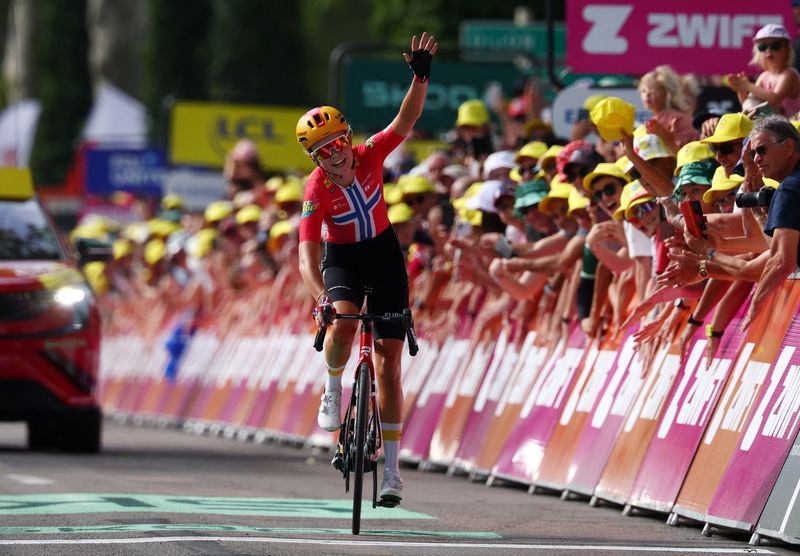
Sigrid Haugset has written herself into the history books of Norwegian cycling by delivering a dominant solo performance to clinch the opening stage of the Tour de France Femmes and seize the coveted yellow jersey that marks the overall race leader. The 27-year-old Uno-X Mobility rider's breakthrough came on Monday as she crossed the finish line in Poligny, becoming the first Norwegian ever to win a stage in this prestigious women's cycling competition.
Haugset's emotional triumph was rooted in her ability to maintain composure and mental fortitude during one of the race's most demanding moments. As Belgian rival Lotte Kopecky pressed hard to reel in the Norwegian in the final kilometres, Haugset dug deep into her reserves to push ahead decisively. Kopecky eventually finished 1 minute and 24 seconds adrift, with Dutch veteran Marianne Vos securing third place. The Norwegian's breakthrough moment resonated deeply with her, as she reflected on the magnitude of the achievement for her country's cycling tradition.
With this victory, Haugset now leads the overall general classification by a commanding margin of 2 minutes and 22 seconds over Kimberly Le Court of Mauritius. The achievement carries particular symbolic weight for Norwegian cycling, as Haugset has not only won a stage but also become the first rider from her nation to don the yellow jersey in the Tour de France Femmes since the race's inception. Her composed response in the post-race interview revealed both the shock and determination that carried her through the stage, as she acknowledged initially considering settling for second place before summoning the mental strength to push for victory, mindful of supporters back home.
The stage itself tested the field's resilience and technical abilities from its opening kilometres. As the peloton entered the mountainous terrain for the first time, a significant crash on the category one climb to Col de la Faucille caught several contenders off guard. Among those who went down were reigning world champion Magdeleine Vallieres and former Tour de France Femmes winner Demi Vollering, though fortunately both riders were able to remount immediately without suffering apparent injuries. The incident created a temporary scramble for position but did not spark the aggressive racing that often follows such disruptions, with the main bunch maintaining cohesion through the remainder of the 11.4-kilometre ascent.
Haugset's decisive move came during the subsequent climb to Col de la Savine, where she accelerated away from the broader peloton and established a breakaway. Her strategy appeared sound as Kopecky, sensing the threat to both stage victory and the overall classification, pursued within minutes. The race's 156.5-kilometre distance meant there remained considerable running still to play out, and Kopecky's pursuit intensified as the route crossed into France and descended toward the finish. The Belgian's experience and strength gradually narrowed the gap, and by the time the final 10 kilometres approached, Haugset's lead had evaporated to just 10 seconds.
The intensity of the closing kilometres tested Haugset's physical limits, with the Norwegian visibly struggling with fatigue as Kopecky bore down on her position. Yet the moment proved decisive in shaping her mental resilience. Rather than succumbing to exhaustion or tactical caution, Haugset summoned an unexpected reserve of energy and accelerated away from Kopecky once more. With just three kilometres remaining, she had re-established a near-minute advantage that Kopecky could not bridge. The Belgian's inability to match this surge reflected both Haugset's superior condition at this precise moment and the psychological impact of watching a seemingly secured victory slip away.
What made Haugset's performance particularly notable was her refusal to ease off as the finish line approached. Where many cyclists celebrate victoriously in the final metres, Haugset maintained maximum effort until crossing the line, a reflection of competitive intensity rather than a dramatic flourish. In the post-stage interview, she candidly explained this apparent lack of celebration by noting that exhaustion had left her physically unable to lift her arms from the handlebars, adding a humorous touch to the moment while underscoring the physical toll of her effort.
The context of her achievement deserves attention for Malaysian and Southeast Asian readers following international cycling. Haugset's victory demonstrates the expanding competitiveness of women's cycling globally and the depth of talent emerging from northern European nations. For regional cycling development, her success offers a template for emerging nations seeking to establish credibility in prestigious international competitions. The depth of the Tour de France Femmes field, featuring strong Dutch, Belgian, and other European competitors, alongside riders from regions like Mauritius, illustrates the sport's increasingly global character.
Haugset's yellow jersey comes with significant pressure to defend her position throughout the remaining stages. Her 2-minute-22-second advantage over Le Court provides some buffer, but mountain terrain ahead could present opportunities for challengers to apply pressure. The race dynamics suggest that while Haugset has demonstrated strength sufficient to win stages, sustaining the yellow jersey will demand consistent performances across varying terrain types. Her mental toughness displayed during the closing kilometres suggests she possesses the psychological foundation necessary for the challenge ahead.

